Litir ó Mheiriceá – ‘Operation Absolute Resolve’
At daybreak on January 3, 2026, in Caracas, Venezuela, the operation came to a rapid end. The helicopters lifted off. Nicolás Maduro was taken into custody in the United States (USA).
Various explanations emerged over the weekend.
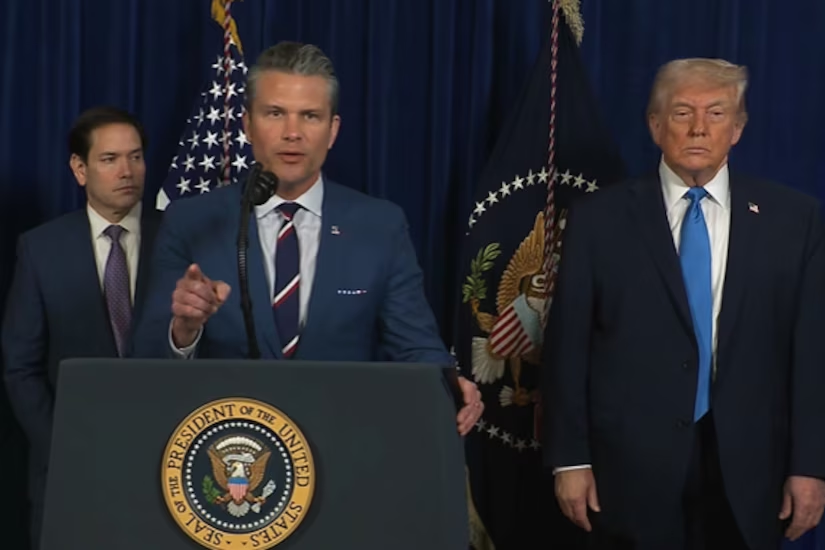
First, on television, Marco Rubio argued that the morning raid was not a war, but an operation specifically aimed at executing an arrest warrant. In this version of the story, the US army merely provided protection to Department of Justice officials as they went about their work.
A few hours later, aboard Air Force One, President Donald Trump gave another explanation. He said that the United States would be "running" Venezuela for a while. American oil companies would move in. The infrastructure would be repaired. Elections would come later.
Rubio’s story and Trump’s story were contradicting each other.
In Caracas, Maduro’s inner circle remained in place. The acting President of Venezuela, Delcy Rodríguez, asked the US to collaborate together.
In 2024, it was widely believed that opposition candidate Edmundo González won a contentious election against the incumbent, Maduro. An exit poll published by the American firm Edison Research showed González leading Maduro 65% to 31%. However, Maduro claimed victory, and González was forced to seek exile in Spain.
González stood in the 2024 election because the opposition leader, María Corina Machado, had been banned from being a candidate. Machado earned international acclaim last year when she was awarded the Nobel Peace Prize.
Shortly after the US operation on Saturday, Machado called on González to "immediately assume his constitutional mandate and be recognized as commander-in-chief." In a statement, Machado said her movement would "restore order, free political prisoners, build an exceptional country and bring our children back home."
Ina phreasagallamh féin, áfach, chaith Trump drochmheas ar mhaíomh fhreasúra Veiniséala chun na cumhachta. Nuair a ceistíodh é go díreach faoi Machado, dúirt Trump le tuairisceoirí: “Ceapaim go mbeadh sé an-deacair di a bheith ina ceannaire. Níl an tacaíocht aici, níl meas uirthi laistigh den tír.”
Police operation or armed robbery?
That raises a question: What plan did the Trump administration have in the first place? The same rotten regime is still in place, and Trump is against putting the winners of the 2024 presidential election in charge of the country, as he ought to do. Therefore, it is hard to see a coordinated US government strategy, which is a cause for concern for us all.
Rubio’s "police operation" tried to keep the raid within known legal boundaries. If it was law enforcement, there is no need to consult the US Congress. International law could be bypassed. The action would be unusual but constrained.
Trump’s explanation blew that approach apart. Running another country to reopen its oil wells is not law enforcement; it is occupation by another name, even if troops do not remain on the ground. In the US government, silence reigned, with Democrats who demanded Congressional oversight overruled by Republicans kowtowing to the Trump regime.
For many years, the post-war system relied on the US as an exemplar regarding compliance with international rules. When the United States used force before, it was in cooperation with its allies and yielding to international agreements.
Operation Absolute Resolve went against those long-established norms. In Venezuela, paralysis is the immediate result. A leader removed from office. A regime left behind. An opposition in exile. An occupying power that insists it is not occupying anything.
Cause for concern in other countries
In other countries, analysis followed quickly after the American operations. An attempt was made to explain this sudden change, not only in terms of the impact on themselves, but on the international order that is now clearly being violated by the US.
In Havana, Cuban state media reported that numerous Cuban security personnel were killed during the raid, confirming what Washington had long claimed: that Cuba was supporting the protection of the Maduro regime.
In Bogotá, Colombia, officials watched the increase in US warships and aircraft with worry. Trump has openly threatened Colombian President Gustavo Petro, accusing him of exporting cocaine to the United States.
In Copenhagen, Prime Minister Mette Frederiksen issued a statement urging the United States to "stop the threats" as Trump reiterated that he needs to acquire Greenland, for security reasons. Greenland, she said, was not for sale.
Trump had spoken about Greenland before. But after what he did in Venezuela, Denmark and Greenland realized that a serious threat was now involved. In Nuuk, the Prime Minister of Greenland wrote online that the rhetoric was "completely unacceptable." It was wrong, he wrote, to link Greenland with Venezuela.
In Brussels, European officials emphasized a distinction. Denmark was one of the founding members of NATO in 1949, along with 11 other countries, including the US. Venezuela is not part of that organization. Different rules apply to NATO, as it is an alliance. There would be major problems if the US took possession of a NATO member state, and there is a high chance NATO would not survive such a serious violation.
Canada was also keeping an eye on matters. Trump has already spoken carelessly about Canada as "the 51st state," a statement once accepted as an inconsequential dispute. After Caracas, however, the Canadian government must pay more serious attention to that threat.
Serious implications
This does not mean American troops will be on the ground in Greenland, Colombia, or Canada tomorrow. That is not how these changes work. But this saber-rattling is just the first step down that road. Therefore, weak countries under threat try to protect themselves by establishing new alliances with parties stronger than themselves. Allies re-examine their relationship with any country that violates international rules.
Competitors notice that they have a stronger argument for violating international rules too. With that new outlook, the invasion of Ukraine looks more acceptable. An invasion of Taiwan would be the same as an invasion of Venezuela. When international agreements regarding state sovereignty break down, everything is at risk. World affairs become much more uncertain and dangerous. The risks of war are raised in general, and that is not a good thing.
Big questions to answer
In Washington, there are big questions to answer. What is Operation Absolute Resolve? What are the milestones of the operation? Are other operations coming?
This confusion is part of the international environment. From Caracas to Havana, from Bogotá to Copenhagen, governments are getting used to not just American policy, but the inconsistency associated with multiple policies that are at odds with each other. That can only end badly. Sooner or later, the co-equal branch of the US government known as Congress must exercise its constitutional powers instead of sitting back and yielding all its power to the president and his friends.
The sooner the better.



 English
  Gaeilge