Comhaltas Barry Cogan

Comhaltas Barry Cogan

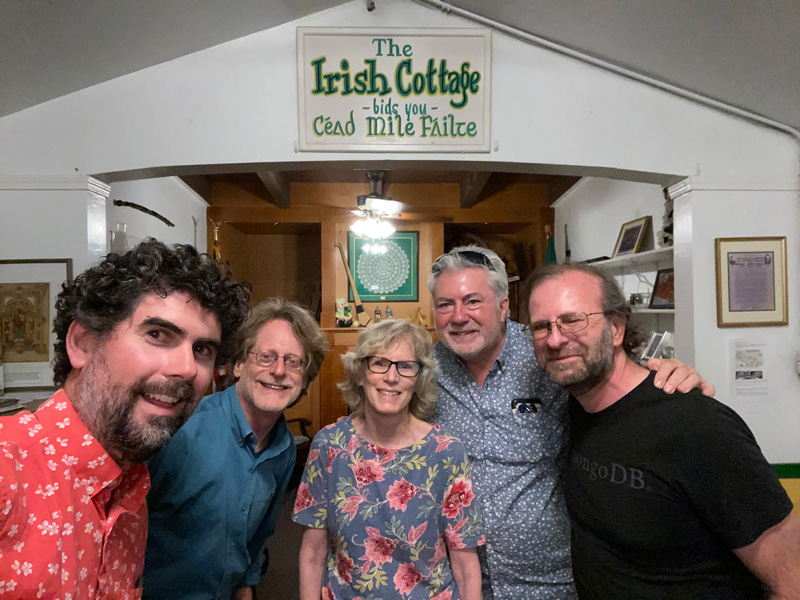
At one point in the evening, Sinéad and I looked around the room, then at each other, and realized that almost everyone else there had an instrument except us.

The host already had a mandolin in his hands. Someone else pulled a banjo from its case. Another person came in with uilleann pipes. After that came a flute, tin whistle, guitar, bodhrán, and more than one fiddle. The musicians sat down in a circle.

We had come to a house concert in La Jolla with no idea that a traditional music session would follow.

The evening began with a shared meal, though it was for the concert itself that we had come. The woman of the house gave us a warm welcome and offered us her own place on the couch, where we squeezed in close together. That was the kind of gathering it was: informal, generous, welcoming.

Brian Conway was the main musician that night. He was on the West Coast to promote a new album. Máirtín de Cógáin, a musician and storyteller from Carrigaline in County Cork, who has been living in the United States for the past twenty-three years, helped to organize the concert. He knows Brian and had played with him before. He invited us to attend the concert, and we gladly accepted.

Conway is no ordinary fiddler. He was born in the Bronx, and is widely regarded as one of the leading exponents of the Sligo style in America. He first learned from Martin Mulvihill and Martin Wynne, and Andy McGann also had a major influence on him. He spent his working life as a prosecutor. Now, in retirement, he devotes himself completely to the fiddle, as a teacher and musician.

In the first half of the concert, it was just Brian and his fiddle before us. He played in the Sligo style handed down from Michael Coleman. He drew beautiful tunes from the instrument, some lively and spirited, others quiet, almost wistful. He moved between tunes from his teachers and pieces he had composed himself.

Between tunes, he spoke about his life, about the Irish-American tradition, and about the musicians who shaped him. It was clear how deeply he respected his teachers.

In the second half of the program, the New York fiddler Cate Sandstrom joined him. Their playing was so close that at times it felt as though a single instrument, stronger and sweeter than any one instrument, was playing in the room.

After their music, as we were getting ready to head home, we heard talk of a session that was about to begin.

Anyone who wanted to play was welcome. We thought a few musicians might stay. Instead, the room changed before our eyes. People went out and came back with their instruments. Máirtín sat down and began to sing.

The music gathered around him naturally. After that he took up the bodhrán and played it softly, keeping the rhythm steady without overpowering the other instruments. These were not casual musicians. They had the tunes at their fingertips. This was Comhaltas Barry Cogan, the San Diego branch of Comhaltas Ceoltóirí Éireann, named in honor of Barry Cogan, a prominent figure in Comhaltas, who inspired the founding of the branch through his son, Máirtín. They meet every week for classes and sessions. It was a performance that was tight, confident, and alive. Even the host himself was a strong mandolin player.

A thought struck me. There before us, thousands of miles from home, Irish culture was in full flow. It was there not as a relic, but as something vividly alive.

We came to hear a concert and got far more than that. It was a real pleasure to listen to the session, but better still to take part in it. I will have to attend one of the Comhaltas weekly sessions. Perhaps I will bring a tin whistle or a guitar with me next time.


Sáinnithe i lár Cogaidh – Tuairisc mo neachta ó Dubai!

Trapped in the Middle of a War – My Niece’s Report from Dubai!


The war involving the United States, Israel, and Iran has taken a significant turn for the worse over the past week. Following Israeli strikes on major Iranian oil and gas facilities at South Pars and Asaluyeh on March 18, Tehran sharply escalated its threats, warning that Gulf energy infrastructure in Saudi Arabia, the UAE, and Qatar could be targeted. This sparked widespread anxiety across the region, as it signaled that the war could spread further, devastating the economies and lives of people already living under its shadow.

Iran also demonstrated its long-range capabilities by firing two ballistic missiles toward the joint U.S.-U.K. base at Diego Garcia in the Indian Ocean. Although reports indicate the missiles did not hit the base, the incident reinforced the sense that the conflict is widening, becoming increasingly unpredictable and difficult to contain.

President Trump then raised the stakes once again. He warned that unless Iran fully reopened the Strait of Hormuz within 48 hours, the United States would strike Iranian power plants. Iran countered with its own threat, stating that if its power infrastructure were attacked, it would retaliate against Israeli power plants and other regional power facilities linked to U.S. bases.

Then, almost as suddenly, Trump appeared to pull back. On March 23, he claimed that “very good and productive” talks were underway between the U.S. and Iran, with major points of agreement reached, and he postponed the threatened strikes for five days. However, Iran publicly denied that any such talks were taking place. Thus, the region remains in a state of profound uncertainty: one day brings threats of escalation, the next talk of diplomacy, followed almost immediately by denials and renewed doubt.

For those living in the UAE, it is a constant, agonizing journey. Every new threat spikes the tension. Every rumour of talks or a pause brings a small measure of relief, but that relief fades quickly, as no one knows what comes next.

My niece shared her thoughts with me before some of the most recent developments. If anything, the tension is even sharper now than when she wrote them:

“For me, the main feeling lately has been a kind of constant mental exhaustion. You’re always slightly on alert, waiting for the next notification on your phone and wondering if it will be followed by a bang, and if so, how far away it will be.”

In the UAE, a phone message is no longer just a message. Silence is no longer just silence. Every pause is heavy with the understanding that something else could be about to happen.

This pressure doesn't stay with just one person. It seeps into homes, onto the roads, into workplaces, and into family life. The city might still look normal from the outside, but the atmosphere has changed completely.

As my niece put it:

“I think many of us have become a bit irritable and hypersensitive too, simply because our nerves are on edge. It changes the look of everyday life. I get nervous about simple things like driving somewhere. There’s always a question in the back of your mind about something falling from the sky, whether that’s missiles or debris.”

It is easy, from a distance, to view these events as a series of headlines. But for those living in the UAE, the war is felt differently. It is felt in the phone alert that tenses your shoulders, in the instinctive glance at the sky before getting into the car, and in the effort to keep daily life moving while the wider region lurches from one threat to the next.

If the past week has shown anything, it is how suddenly this war can change direction. One day brings threats against power plants and Gulf infrastructure. The next brings talk of productive discussions. Then come denials and further uncertainty.

Undoubtedly, things are much worse for the people of Iran, with a terrifying amount of bombs being dropped on them by the U.S. and Israel. But my family is not in Iran, so I do not feel that direct impact in the same way. There is no such thing as a good war, and I hope this conflict ends soon. Even then, it will be difficult for life to return to how it was, and it is likely the people of the UAE will be keeping an eye on the sky long after the hostilities have ended.


Sáinnithe i lár Cogaidh – Tuairisc mo neachta ó Dubai!

Trapped in the Middle of a War – My Nephew’s Report from Dubai

Trapped in the Middle of a War – My Nephew’s Report from Dubai

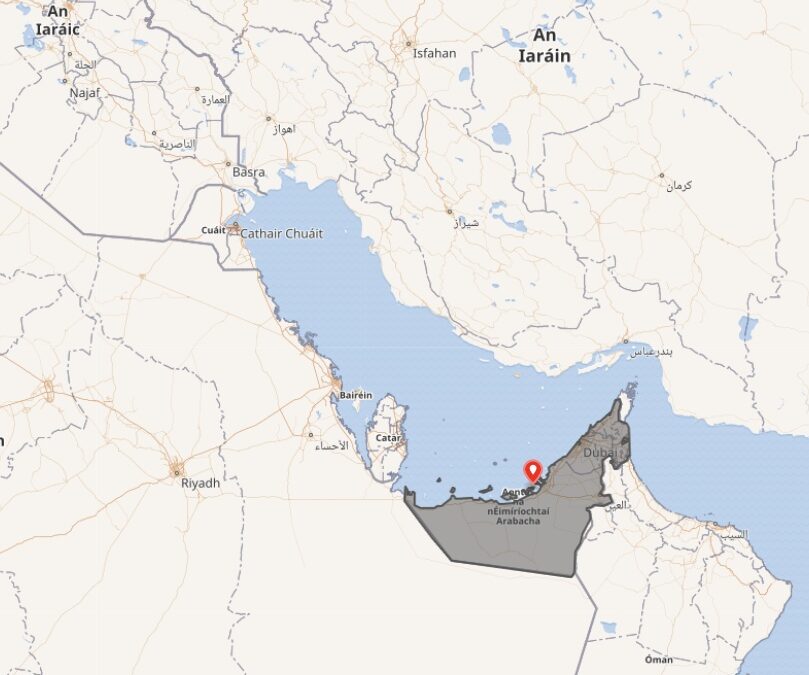
The situation for Irish citizens living and working in the Middle East, particularly in the UAE, has become far more stressful since the United States and Israel began the war against Iran. Although Iran says it is targeting military bases in the Arab Gulf states, it has been reported that hotels and other civilian sites in the UAE have also been hit. As a result, life has changed dramatically in Dubai, where my nephew and niece have lived with their families for years.

Before the war began, Dubai was widely regarded as one of the safest and most prosperous cities in the world. Now, Iran is launching missiles and drones toward the UAE almost daily. The UAE’s air defenses intercept most of them, but they do not manage to stop them all. This offers only a small amount of comfort to families living there, especially those with young children.

I asked my nephew and niece to describe daily life in Dubai at the moment. I am publishing my nephew’s report today, as it illustrates clearly what life is like there right now:

“Life in Dubai has changed dramatically over the past two weeks. There is a sense of uncertainty and unpredictability, and at times it feels dangerous. There has been a clear shift in day-to-day life.

Sometimes when you are outdoors, you hear missiles overhead or see them crossing the sky, with some being intercepted right in front of you. The sound of those explosions is unlike anything I have ever heard before. The shockwave travels through your entire body, and it is impossible to ignore.

We receive official government alert messages almost every day, instructing us to take shelter when waves of missiles are coming our way. Recently, other messages also arrive an hour or two later confirming that the situation is under control again. At night especially, people are much more alert, checking their phones, watching for alerts, and listening for unusual sounds. This creates a tension that is now part of everyday life. I’ve noticed one thing: every time I go out, I look up at the sky just to be sure. That has become an instinctive habit now—something that would have been quite strange a short time ago.

For families, especially those with young children, this is one of the most difficult aspects. We have two small children, and the sound of those explosions is very frightening for them. They are certainly afraid and don't understand what is happening, so we try to downplay the situation and reassure them, telling them it is a normal occurrence—like police cars or ambulances passing by.

Travel has also been heavily affected. Due to the closure of airspace, flights were not operating for certain periods. On some days, the airspace was reopened for a few hours to allow people who were on holiday here to return home to places like Ireland and England, but many flights were still cancelled. Once, when flights resumed for a short while, civilian aircraft appeared to be flying side-by-side with military jets. I had never seen anything like it before, and it was a surreal experience.

In everyday life, there is much less traffic on the roads, though most people are still trying to carry on with their routines and daily duties. It must be said that the response systems are working very effectively. Despite this, there are still cases where drones or debris have caused damage to buildings.

Overall, people are getting used to the situation as best they can, but the atmosphere is very different now. There is an understanding that things could change suddenly. Daily life continues, but everyone is more alert and more cautious than usual.”

Next week, I will continue this series with a report from my niece in Dubai.


Sáinnithe i lár Cogaidh – Tuairisc mo neachta ó Dubai!

Caught in the middle of a War!

Saturday, February 28, I felt the Iranian war for the first time in a text message from my sister.

“There are explosions in Dubai,” she wrote. “C. is terrified,” she added, referring to her daughter.

Another message arrived shortly after. “A missile hit The Palm Hotel and Resort in Dubai. It went up in flames.”

Then she sent me a screenshot of an alert her son and daughter had received on their phones: “Due to the current situation and the threat of missiles, take shelter immediately in the nearest secure building, and stay away from windows, doors, and open areas. Await further instructions.”

I called my sister immediately. She was anxious about her son, her daughter, and her three grandchildren in Dubai. I tried to reassure her. We agreed that the threat was "low."

But “low threat” changes its meaning when it concerns your own family. When danger involves strangers, it seems like a measured thing. When it involves the people you love, it no longer feels low. it is a threat, and it feels very close.

By Sunday, March 1, the reports out of Dubai were clearer. Reuters reported damage in Dubai, including at the international airport, Palm Jumeirah, and the Burj Al Arab, after the first wave of Iranian retaliation spread across the Gulf. That same day, another message came from my sister.

“They hit the airport and a missile was intercepted near where C. lives. C.’s nerves are shattered.”

Some of the first messages came in the chaos that accompanies a live attack. That is how it is in those moments. It is the "fog of war." Rumors, fear, and half-facts reach us in a single blur. But the overarching truth was clear enough. Iran was demonstrating that it could strike across the Gulf, terrorize the Arab Gulf states, and cause major disruption to life and the economy. It wasn't just a military message; it had a strong psychological element too. No one in the region was completely safe.

Since the war began on February 28, the United Arab Emirates has attempted to stay out of a wider regional conflict, even as they are forced to defend themselves against repeated attacks. That prudence is important, as it helps keep matters under control rather than expanding them across the region. Despite this, however, much of the danger is beyond their control. On March 9, the UAE envoy to the United Nations in Geneva called for de-escalation and a return to negotiations, while simultaneously stating that the UAE was ready to protect its critical infrastructure.

It is also clear that this war is far from over. Ali Khamenei was killed in a US-Israeli airstrike on Iran on February 28. On Sunday, March 8, Iranian state media reported that his son, Mojtaba Khamenei, had been chosen as the new Supreme Leader. Reuters reported that this appointment indicates continuity and confrontation rather than compromise.

No one can say for sure how this war will proceed, nor what it will mean for families in the UAE in the coming weeks. We hope, of course, that the attacks on the Gulf states will stop soon.

On Monday, March 9, the UAE stated that its air defense network has been under continuous attack since hostilities began on February 28. According to official figures, 253 ballistic missiles from Iran were detected. 233 of them were destroyed, 18 fell into the sea, and 2 landed on the ground. The UAE also said that 1,440 drones were detected, 1,359 of which were intercepted and 81 of which landed within the country. Eight cruise missiles were also detected and destroyed. Despite this, 4 people were killed and 117 others were slightly injured. Those killed were citizens of Pakistan, Nepal, and Bangladesh. Among the injured were residents from more than twenty countries. To our knowledge, no Irish people have been injured so far. The UAE Ministry of Defence said its forces were fully prepared to deal with any further threat.

The UAE's air defense relies heavily on American-made THAAD and Patriot systems, supported by other systems to deal with lower-flying missiles and drones. The UAE says they still have sufficient interceptors.

I recently received a detailed account from my nephew, who has lived in Dubai for several years, about life as it is now with the UAE under attack from Iran. It is clear from his words that ordinary life itself has changed. People are watching their phones, listening for alerts, and even looking up into the sky as a new habit. Due to space constraints, I cannot publish his full account here, but I will return to it in a separate article.

For people far away, war is often a headline, or a map, or a line of official numbers. But for families whose own people are under threat from missiles and drones, it is something else. It becomes personal. It becomes immediate. It becomes the thing you think about when the phone lights up in the middle of the night.


Cuairt Thráthúil ar San Miguel de Allende

A Timely Visit to San Miguel de Allende

Reaching San Miguel de Allende (SMA) in Mexico is no effortless journey. We recently flew from Tijuana, just across the border from San Diego, to León in the central highlands. The flight took about three hours. Then we headed out on the road for another two hours by charter bus until we reached SMA.

We stayed in a house that was like a small museum, located a ten-minute walk from the center of town at the top of a steep hill. Ceremonial masks stared down at us from the walls, and a matador’s suit stood in a glass case in the corner. Woven tapestries and paintings hung on the walls, and painted-back chairs stood against them. We sat at a large oak table beneath a beautiful bóveda brick ceiling (a vaulted brick ceiling)—a ceiling once said to be the largest of its kind in Mexico.

Every morning we woke up immersed in the country’s craftsmanship. It was a perfect base for the week. The town is preserved in Spanish colonial form. Narrow streets. Many of them one-way. Cobblestones everywhere. We were glad we didn’t have a rental car. Driving is best left to the care of the locals. Uber was easy and inexpensive, but we only used it a few times, as the town center was close to us.

The parish church, Parroquia de San Miguel Arcángel, is located in the center of town. The parish was founded in the 16th century, though the current structure was largely rebuilt in the 1690s. In the 1880s, Zeferino Gutiérrez reshaped the façade into the pink neo-Gothic structure that now defines the town’s skyline. It is the heart of the town.

Beside it stands the clock tower. Every fifteen minutes, the bells ring. In the Jardín, the central plaza, the sound spreads across the square. After a day or two, you stop noticing it; it simply becomes part of the rhythm of life. In the evenings, we sat on benches in the plaza. The light turned the stone to a golden color tinged with rose-pink. Mariachi bands gathered to play their tunes. Local families wandered or rested under the shade trees. Children chased each other across the square.

San Miguel was founded in 1542. It prospered in the 18th century as it sat on the "silver route." The revolutionary leader Ignacio Allende was born here in 1769, and after independence, his name was appended to the town in his honor. Today, foreigners make up about a quarter of SMA's population, many of them American or Canadian. That tradition began after World War II, when U.S. veterans arrived to study, funded under the “GI Bill.” The infrastructure still reflects that influence: good schools, modern hospitals, language institutes, and excellent restaurants.

We ate in restaurants every evening. The prices were reasonable. Most of the customers were American or Canadian. We met several women who return year after year to escape the cold at home. They spoke warmly about the weather, the food, and the culture in San Miguel de Allende. During the Super Bowl, our restaurant was packed with locals. They were there to see Bad Bunny perform at the halftime show. During the show, they were entirely focused on the screen. As soon as the music ended, they left.

One day, we hired a driver to visit another town called Guanajuato—by accident, really. We had intended to go to Cañada de la Virgen, an archaeological site about an hour away by car. When we arrived, however, it was closed. We found out later that soldiers had been put in charge of the site due to a dispute between federal authorities and a local landowner. It was our first hint that there was tension beneath the surface, despite the calm that was felt.

The driver suggested we visit Guanajuato instead, and we agreed. That town looked completely different compared to San Miguel. 19th-century architecture. Traffic flowing through underground tunnels. Colorful houses stacked steeply on the hills.

We visited the birthplace of the famous artist Diego Rivera. There were early works and photographs in the museum, as well as material relating to his wife, Frida Kahlo. It felt personal and intimate.

Back in San Miguel on the final day, we spent time at Fábrica La Aurora, formerly a textile factory that now houses studios and galleries. The artists worked behind open doors. The creative energy of the town was palpable.

About a week after we returned home, a major story broke. Nemesio Rubén Oseguera Cervantes, known as “El Mencho,” leader of the Jalisco New Generation Cartel, had been killed in a military operation. Retaliation followed in several cities. Armed men on motorbikes. Vehicles burned on highways. Supermarkets set on fire. Reports of violence in Puerto Vallarta, Guadalajara, Tijuana, León, and elsewhere.

We had flown through Tijuana. We had landed in León. As far as we know, there was no direct impact on SMA, but the peace was more fragile than we thought. We would like to return to that beautiful town again, but we will wait a while longer until things settle down again.

Ag seasamh ar mo dhá chos féin arís

Back on my own two feet again

Almost four months ago, I fell while hiking. I fractured my right ankle and leg and damaged the surrounding ligaments. I went home in a large boot to keep the leg immobilised, and onto crutches to keep weight off it. I can finally walk again. Recovery is near complete.

I learned a lot more than I ever expected about what it means to live with a disability.

Steps everywhere

Our house is built on a slope. There are steps outside and more inside. Once indoors, shallow steps separate rooms on the ground floor. The main bedroom is upstairs.

The doctor provided a mobility scooter, but it wasn’t of much use. It couldn’t manage steps, inside or out. It was only of use in the kitchen. I ended up using the crutches all the time.

I could manage the shallow steps between downstairs rooms, but the stairs to the first floor were too dangerous. Because of that, I moved into the guest bedroom downstairs. It was one of many compromises I had to make.

Not allowed to drive

I wasn’t allowed to drive for the first three months. I depended entirely on my wife to get out of the house. I didn’t understand until then how key a car is nowadays.

Even with someone else at the wheel, new problems appeared. Parking was the biggest. I couldn’t go far on crutches, so it was necessary to park close to the door. We applied for and received a temporary disabled parking pass.

Disabled spaces are wider, and there’s a reason for that. You have to open the door fully, swing both legs out, steady yourself, and get the crutches positioned before you stand. Standard spaces don’t allow for that. They don’t have enough space.

What we also learned was how few disabled spaces there are. They were often all taken. When that happened, my wife would drop me at the entrance and go to park. When leaving, she would fetch the car and bring it back to me again.

Doors and ramps

Automatic doors were a blessing. Manual doors were a problem, especially heavy ones that seemed determined to close on you. It was almost impossible to open them while keeping your balance on the crutches, then then keeping them open enough to get through. Often, strangers would come to my assistance.

Steps without ramps were another challenge. I could manage the steps when necessary, but I was not comfortable using them.

People make the difference

One time, we attended a music event in the district. Staff allowed me to enter early. Accessible seating and a table were ready for me, with a clear view of the band. It was handled quietly and well, without any fuss.

Before that concert, there was a queue outside. A man at the front told my wife that I’d be fine waiting like everyone else. She checked with staff. We were allowed in. The man wasn’t pleased. He had no understanding how uncomfortable it was to stand on one foot with crutches for any length of time. And he didn’t ask either.

Begrudgers are part of the landscape. You learn to live with them.

Seeing the world differently

What surprised me most was how quickly your perspective shifts. You start to notice kerbs, steps and doors. You notice which places are easy to enter, and which are not.

You begin to see the world as something designed for a particular body, moving at a particular pace. And you realise that body isn’t always yours.

When we are not disabled, we expect easy access everywhere. When we don’t have it, we are unhappy. When other people don’t have it, we rarely notice.

My injury fell into just one category: mobility disability. In the United States, fourteen broad categories of disability are recognised, ranging from sensory or cognitive disability to neurological and mental health conditions. It was enough for me to experience just one, even temporarily, in order to understand how layered and complex the issue is.

In Ireland, the legal framework around disability is extensive. It covers access to public buildings and services, education, employment, Irish Sign Language, and digital accessibility under EU law. It helps, though experience on the ground still definitely varies.

I didn’t travel by public transport or by air during those months, but I could easily imagine how important support is in those settings. How essential it is to be seen not as a problem to be managed, but as a person moving through the world in a different way and at a different pace.

Conclusion

I learned other things too. I learned how many people are quietly helpful. How often support comes without being asked. I learned to slow down. You can’t rush anywhere on crutches.

Around a quarter of the population lives with some form of disability. Many more of us will, temporarily or permanently, at some point in their lives.

We are lucky when we are able-bodied. But the measure of a society is how it treats all its members, including those who have different needs than ours.

The biggest lesson that stuck with me was this: It is worth our while making the effort to serve the needs of everyone, not just the needs of the able-bodied.


en_USEnglish