Daonáireamh 1926

1926 Census

When the 1926 Irish Census was put online recently, it opened up new possibilities for genealogical research.

My wife drew my attention to it after she saw the news. Since then, the two of us have spent many hours researching our family history.

For anyone with Irish roots, this is a treasure trove. The information is limited, but it is enough to give a glimpse of that time, and of the lives our ancestors lived.

The census was taken on April 18, 1926, under the administration of the Irish Free State. Unlike the 1901 and 1911 censuses, which covered all 32 counties, this one covered the 26 counties of the new State.

What makes it powerful is what you can do with it. The 1926 census acts as a bridge back to 1911. From there, you can go back to 1901, and then into Griffith’s Valuation—a mid-19th-century property tax record that serves as a vital substitute for missing census data from that era. After that, you can find further information in the birth, marriage, and death records available on IrishGenealogy.ie.

The Mayo Connection

In this article, I will focus on part of my own family line as an example of what can be done. There is much more still for me to explore.

I began with my father’s side. That was easier. My father was born in 1925, so there he was in the 1926 census, a nine-month-old baby. His older brothers and sisters were there too, along with my grandparents, all on a single handwritten page.

Seven of them were living in a two-room thatched cottage on 16 acres in Drumreagh, on the Mullet Peninsula in County Mayo. Later, when Sheila was born, there would be eight.

Using that information, I stepped back to 1911. There I found my great-grandfather, Michael Barrett, a widower, living in the same house with my grandfather and some of his adult siblings and a cousin. Going back again to 1901, he was there with his wife Julia and their nine children.

A Sad Story

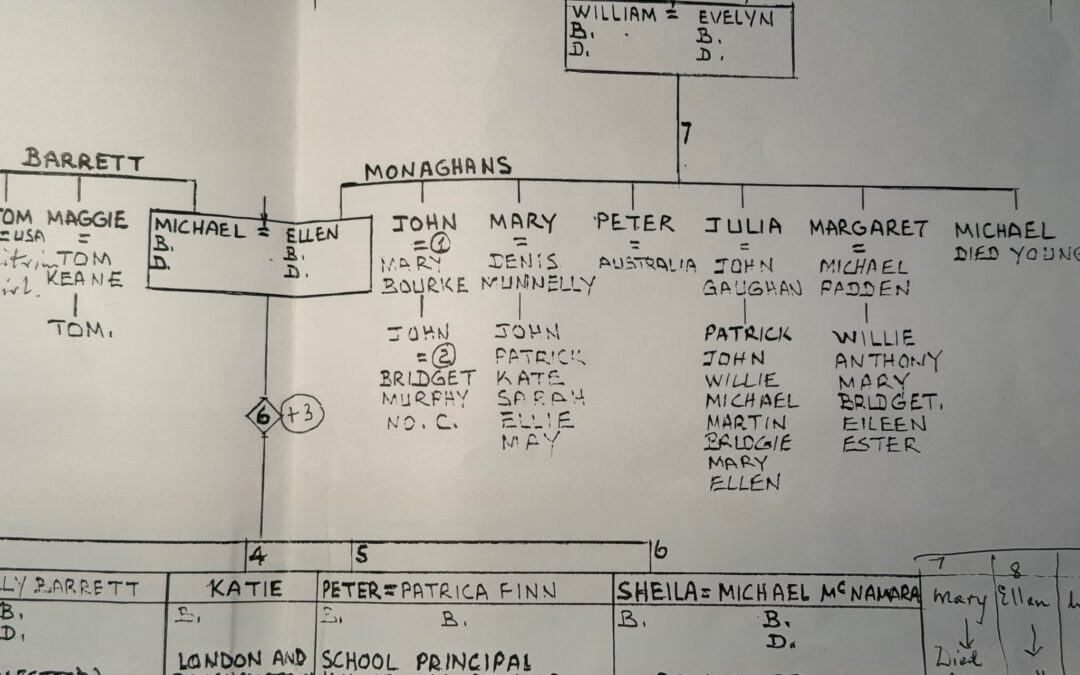
My father gave me a hand-drawn family tree some years ago, which he had put together with his brother John. Although not complete, it proved invaluable. It confirmed the research I was doing and gave me important clues for where to look next.

There was sadness in that family tree that was not immediately visible in the census records. My father’s records showed that three children in the previous generation—Ellen, Mary, and William—had died young. I found records online for two of them. Mary died at six days old. Ellen died at four months. I have not yet found William. It must have been devastating for the family to lose three out of nine children so young.

I searched the birth, marriage, and death records on IrishGenealogy.ie and was pleased to see that the civil records and census records matched. The civil records also provided new information. I discovered that my great-grandmother Ellen Monaghan’s father was named Richard Barrett. My father had written “Dick” in the relevant box on his family chart. Things were lining up again.

The Poet of Erris

My father told me that the connection back to the well-known Dick Barrett came through his mother’s side. Since my great-great-grandfather on my father’s mother’s side was named Richard Barrett, that strengthened the case.

Riocard (Dick) Bairéad was an Irish-language poet, satirist, and schoolteacher. He was involved with the United Irishmen and the 1798 Rebellion. He is best remembered as a poet. Among his works are “Eoghan Cóir” and “Preab san Ól.”

Another interesting name on my father’s chart was my great-great-grandfather, Éamon Barrett. I searched Griffith’s Valuation and found nothing under Éamon. Then I tried Edward Barrett.

There he was. On the same sixteen acres in Drumreagh. A tenant farmer. His landlord was Tobias Kirkwood. By 1901, it appears that Michael Barrett was no longer a tenant farmer but owned the land.

Heritage and Meaning

According to my father, Edward was the first Barrett to settle in Drumreagh as a tenant farmer. By 1901, eleven people were living in the same two-room thatched house. Seven in 1911. Seven again in 1926, including my father.

Life was hard in those days. In the mid-19th century, it must have been especially difficult for Edward Barrett and his family to survive. It is likely that he was farming that land during the time of the Great Famine. In June 1847, hundreds of starving people from Erris reached the workhouse in Ballina, only to be turned away because it was already full. People were living from hand to mouth, in conditions that are hard to imagine today.

I know from my father’s records that two of his uncles emigrated to Chicago in the 1910s. That is another line to follow later. There is a good chance I have relatives here in the United States.

When I look at all those names on the census pages, it strikes me that each one was a person, with a life and a story. Now, only the name remains on paper. Everything else is lost in the mist of time.

It is a sobering thought to see my uncle, my grandfather, and my great-grandfather there in the records, all sharing the same name as me—Michael Barrett. They give me context. They give me meaning.

I am sure many who read this are carrying out their own research using the 1926 census, tracing their families, and learning more about where they came from and how they lived.

I have only followed one line so far. There are many more to explore, and it will take time.

If you have not had the chance yet, I hope my story encourages you to explore your own family roots in the 1926 census.

 

Ar Sciatháin Túis Nua

The Wings of a New Beginning

“Send these, the homeless, tempest-tossed to me,

I lift my lamp beside the golden door!"

  • Inscription on the Statue of Liberty, New York.

We should all, especially the President and government of the United States of America (USA), always keep those important words in mind. Currently, however, the government is ignoring them. For example, ICE (immigration law enforcement agency) and the National Guard (military force) are mistreating many people in the country, including citizens. We all saw the recordings: masked men jump out of a van and grab people from the street, and some of them are never seen again because they are placed in a detention centre somewhere. We must tackle such behaviour and restore our core principles.

The following true and historical story demonstrates the values of the USA as they were and as they should be again.

Thanks to Nancy Kramer (an American living in Julian, San Diego, in the United States) for sharing her own story with us. She is an inspiration and a role model for us, as we too can be true to our word. Here is the question for us who live in democratic countries: What can I do today to improve our country and ensure fair play for everyone currently here, regardless of the colour of their skin or their religion.

The Wings of a New Beginning by Nancy Kramer

As a Pan Am flight attendant, I've seen all kinds of passengers—many memorable Hollywood stars, popular bands, government officials—and I've even helped with onboard marriage proposals. However, my favorite flights were those on which we boarded groups of refugees in Manila and Bangkok.

In our crew briefing, we were informed that the back part of our airplane would be filled with refugees, organized by the U.S. government and resettlement agencies like the IRC. We were advised to expect passengers with limited English who might need help with basics like seat belts and lavatories.

As the bus doors opened at the foot of our 747, families stepped out, blinking into the sun, mothers gripping small hands. Most had never set foot on an airplane before. I watched a little girl frozen at the bottom of the blue Pan Am stairs, terrified by the sound from the engines, clinging to her father's pants.

They arrived in small, quiet groups—Southeast Asian refugees, some with babies strapped to their backs in cloth carriers, others with hollow eyes that spoke of horrors we couldn't imagine, shepherded by young volunteers wearing International Rescue Committee badges. Each family clutched identical canvas tote bags—stark white with bold blue letters: IRC. Those little bags held their only belongings.

Departing families were issued travel-appropriate Western attire to help them look "presentable" upon arrival in Western countries, as agencies knew first impressions could affect how refugees were treated in their new communities. They wore mostly outdated Western-style clothing donated by IRC and faith-based charities: button-up shirts and slacks for men, modest dresses or blouses and skirts for women, along with light jackets or sweaters for the cooler U.S. weather—and secondhand shoes or sandals with socks.

Once on board, we helped them settle into the back rows of seats. The cabin smelled faintly of unfamiliar spices and wood smoke, as if the journey from the camps in Thailand had come with them. I heard many utter a quiet "Cảm ơn" or "thank you" when I showed them how to fasten their seat belts.

During takeoff, many passengers gasped or cried softly as we left the ground. The children’s eyes were wide, torn between wonder and fear. For the adults, the roar of takeoff symbolized both hope and heartbreaking finality. Would they ever see their war-torn homeland again?

After leveling off, we prepared to serve them special rice dishes, which they were more familiar with than our Western foods. We poured them cups of tea, in which some put their wrapped pat of butter. I had read that the Nepalese drank yak butter tea, so I wasn’t sure if that was intentional or if they just didn’t know what butter was.

A young mother with an infant gestured for help in warming a bottle. I carried it to the galley, and when I returned, she bowed her head, tears streaming down her cheeks. They were all so shy, timid, extremely polite, and very grateful. I gave the children plastic Pan Am wing pins, providing a fleeting moment of joy on their frightening and emotional journey.

Some passengers dozed fitfully, jolting awake with every bump of turbulence, while others sat stiff and silent for hours, clutching the IRC bags in their laps like life preservers. These bags were distributed in the refugee camps as part of their travel preparation. The bags contained essential documents like I-94 forms, medical records, sponsorship papers, and a few personal items, such as photos, traditional clothing, or a family keepsake.

As we approached Los Angeles, the dawn light broke over the Pacific, flooding the cabin in gold. For the first time, I saw faint smiles and heard whispers of excitement. The volunteers moved through the aisles, explaining what would happen at the airport: there would be men and women waiting to welcome them, take them to homes, and help them start over.

When we landed at LAX, the plane erupted in applause—a soft, scattered clapping of relief and disbelief. As we taxied to the gate, I looked out at the tarmac, where a group of Americans waited with blankets, signs, and stuffed animals. I took a deep breath, trying to hold back my tears.

I had always loved flying because it connected people and places. But on those flights, I understood that an airplane could carry not just passengers but entire futures.


Aistear Neamhghnách Mac an tSiúinéara!

The Extraordinary Journey of the Carpenter's Son!

John Ireland, Kilkenny Hero on the Minnesota Prairie

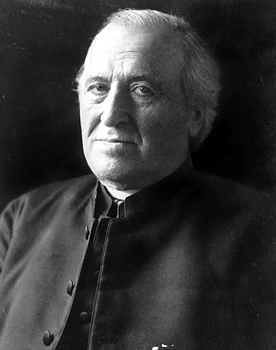
Would you believe that a man from Burnchurch in County Kilkenny achieved fame and renown as far from home as the United States in the 19th century? It happened. It's no surprise for someone who held a tremendous number of important positions during his life - as a brave soldier in the American Civil War, as a priest, as a bishop, as the first archbishop of Minnesota, and as creator of an Irish community numbering in the thousands.

The name of that famous man? His name was John Ireland, a native son of County Kilkenny.

A Boy in the County of the Cats

John Ireland was born on September 11, 1838 in Burnchurch. His father Richard was a carpenter who had six children. We don't have much information about Richard's wife and John's mother - Julia Ireland (née Naughton).

The Catholics of the country, the Ireland family included, were still under the control of the British Empire and had no economic stability. They had to pay punitive taxes for the benefit of the Church of Ireland. Strict land laws were also in force for tenant farmers. That's what led to the Battle of Carrickshock (1831), a nearby place, when tenants ambushed the police—a vivid illustration of the inhumane system that existed for the Catholic population.

Father Theobald Matthew, founder of the Catholic Total Abstinence Union, had a strong influence on young John who served him as an altar boy. His message about abstaining from alcohol as a way to improve workers' lives deeply affected the boy's character.

Emigration and a New Beginning

After the Great Famine, Richard Ireland went to America with a group of emigrants in 1849. His wife and children followed him later that year. They settled first in Vermont, and then in Chicago in 1851.

More exploration lay ahead of them. Richard met John Gorman, another man from Kilkenny. They pooled their resources and brought their families forward to Minnesota, reaching St. Paul in May 1852. By the following year, they had land and houses—a dream that would have been impossible for them in Ireland.

Meanwhile, Bishop Joseph Cretin had a major administrative problem in the large diocese of Minnesota. He recruited John Ireland and Thomas Gorman (John's son) for the priesthood. In 1853, the two young men went for eight years to Meximieux in France, to attend the petit séminaire, the same school that Cretin had attended earlier.

Priest, Soldier, and Entrepreneur

John returned to Minnesota in 1861 and was ordained in St. Paul. Shortly thereafter, he joined the Fifth Minnesota Volunteer Regiment as a chaplain during the Civil War. For two years, he cared for wounded soldiers and celebrated Mass while they were under attack.

By 1875, he was appointed coadjutor bishop of St. Paul. When he saw Irish immigrants packed into urban slums, he strongly believed that they needed farmland to achieve their independence and dignity. Therefore, he established the St. Paul Catholic Colonization Bureau in 1876.

It was a clever plan:

  • it provided affordable land to Irish families,
  • the railroads got new customers,
  • and the Catholic population in the diocese increased.

New towns were founded with Irish names—Clontarf, Avoca, Iona—in the heart of Minnesota.

The Archbishop and National Influence

In 1884, despite having no staff or major resources, John announced that he was going to establish a Catholic high school. St. Thomas Aquinas High School opened in September 1885. Universities and other schools soon followed, including the University of St. Thomas and institutions in Washington DC.

In 1888, the diocese of St. Paul received archdiocese status and John Ireland was appointed its first Archbishop. He promoted progressive views on the national stage—particularly regarding equality for African Americans and against discrimination based on race or religion.

He completed the construction of the great Cathedral of St. Paul on the highest point in the city—publicly announcing that the Catholic population of Minnesota could no longer be ignored.

The Archbishop died on September 25, 1918, with his old friend, Bishop Thomas Gorman, and his sister, Mother Seraphine, present.

A Legacy that would shape Generations

In the end, John Ireland closed the circle of his life. He remained faithful to the values he heard in Burnchurch—land ownership, temperance, and education. From the quiet fields of Kilkenny to the wide frontier of Minnesota, he spent his life fulfilling the promise of his youth, and leaving a rich legacy that would inspire Irish and American generations long after him.


Athbheochan na hÚcráinise!

Revival of the Ukrainian Language!


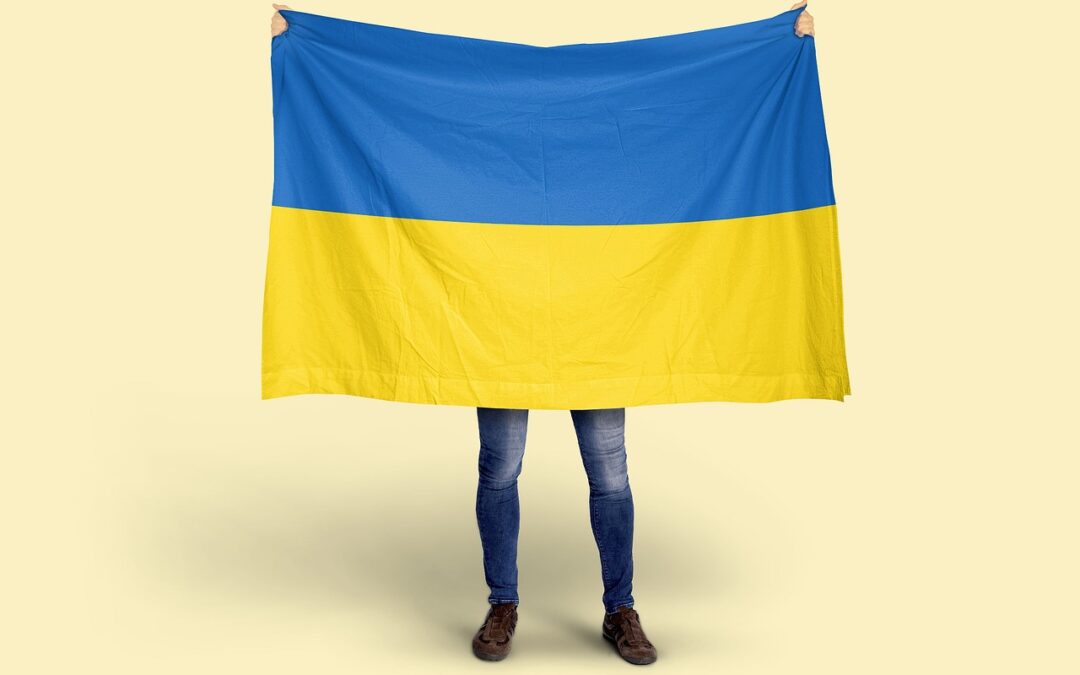
Ukraine gained its independence in 1991 after the collapse of the Soviet Union. At the time, the revival of Ukrainian, the country's native language, was promised. It is a miracle that it was still alive, as the Russian Empire and later the Soviet Union did so much damage to the Ukrainian people, culture and language over the centuries. Another miracle is underway in Ukraine right now, regarding the revival of Ukrainian. Before I reveal that miracle, it is worth writing a few words about how difficult it was for the Ukrainians to preserve their culture and language through the unique crises that happened to them over the years. With that knowledge, we will have a deeper understanding of the miracle itself.

Shortly after she came to power in 1762, the Russian Empress Catherine II banned the teaching of Ukrainian at the Kyiv-Mohyla Academy, the most important cultural center in Ukraine at the time. Later on, she gave orders to the churches to conduct church services only in Russian and to the schools to have Russian as a compulsory subject.

In the 19th century, the Russian Empire repeatedly persecuted the Ukrainian culture and especially the Ukrainian language, fearing that it would be a great threat to the unity of the Empire. In 1804 Ukrainian was banned as a subject and language of instruction in schools.

But even more severe measures followed in 1863 when the Imperial Minister of Home Affairs Pyotr Valuev issued a manifesto to end the publication of books in Ukrainian. According to the manifesto, "'Little Russian' (meaning Ukrainian) has never existed and will never exist."

In 1922, shortly after the Russian Revolution, Ukraine was absorbed into the Soviet Union, where new policies were implemented, known as 'Ukrainization'. It was a complete change and there was no longer any ban on the use of Ukrainian.

The 'Ukrainization' was short-lived, however, as the dictator Joseph Stalin canceled it in 1933. Worse than that, a good number of Ukrainian intellectuals, including famous writers and artists, were killed in the 'Great Purge' in 1937. After Stalin's death in 1953, a cultural revival flourished and in addition, a new generation of writers and artists emerged.

When Ukraine gained its independence in 1991, the government pledged to support culture and language. But the negative influence of Russia on the Ukrainian language was still visible in the new country and long after that, Ukrainian television, its newspapers, and even the names of its streets were still mostly in Russian. It wasn't time yet.

With the EuroMaidan Revolution in 2013-2014, a pro-Kremlin regime was ousted and replaced by a pro-Ukraine regime. Vladimir Putin did not accept that, and Russia annexed Crimea in 2014. Soon after, Russia invaded eastern Ukraine, seizing parts of the self-governing regions of Donetsk and Luhansk. Strict restrictions were placed on the use of Ukrainian in those occupied territories as part of the occupation.

Finally in 2019, the Language Act was passed in Ukraine, which established Ukrainian as the country's official language, forcing the media, the education system and public bodies to use the language publicly.

Then, in the year 2022, Putin's forces brutally attacked Ukraine, and although Putin thought he would win within a few days, the war is still ongoing two and a half years after the attacks. With Russian imperialism in full swing, the Ukrainian revival took off. The people of the country were single-mindedly committed to speaking their native language, regardless of their ability in the language. It was then that the miracle happened and the facts tell the story. Eight months after the attack, 71% of the country's population said they were speaking Ukrainian more, and 33% of Kyiv residents switched from Russian to Ukrainian as their spoken language.

From April 2023, anyone trying to become a citizen needs to pass Ukrainian exams (written exam and oral exam). "We are going through the rebirth of the language. We're just discovering what we've always had,” said Volodymyr Dibrova, a writer and translator who teaches Ukrainian at Harvard. Neither religion nor territory, but language, said Dibrova, is the factor that most significantly distinguishes them from their enemy. "It is as if the people of the country have woken up and are asking themselves: Who are we? What is our real history? What is our real language? If Ukrainian is our real language, why don't we speak it all the time? Why don't we speak Ukrainian as the language of our relationships and at all events - both formal and informal?" The answers were very clear to the people of the country, and they understood well that their language is a key part of their identity as a community and as a nation. That's why they started learning or re-learning it and speaking it as much as they could. They realized that their culture and especially their language was intertwined with their national identity. And they went into the breach and stood up for that same identity!

I highly recommend everything that the people of Ukraine are doing regarding their language, despite the fierce war that is going on. It also raises a few questions for us, regarding our culture and our language. Who are we? What is our real history? What is our real language? If Irish is our real language, why don't we speak it all the time? Why don't we speak Irish as the language of our relationships and at all events – both formal and informal? And finally the most important question for us to answer – what needs to happen to us so that we wake up from our stupor before it is too late and save our language – short of war?

Cothrom na Féinne sa Bhunreacht?

Fairness in the Constitution?


I was eating my lunch alone, upstairs in the furniture store 'Meubles' when I recognized my old friend Séimí in the buffet queue. I waved my hand at him to get his attention and he gave me a big smile before coming in my direction.

"Nice to meet you here, Michael!" said Séimí as he sat in front of me at the table. "I didn't know you liked the 'Meubles' restaurant, son!"

“I love the clam chowder here. But I was the one who was surprised, because I'm always here, and I've never seen you here before, Séimí!" I said.

"I'm late today, Michael, but I come here once or twice a week at noon and I'm gone within half an hour!"

"Call me from now on if you want my company, and I'll be happy to meet you at noon," I said matter-of-factly.

"Thank you, and if I'm not in a hurry I'll call you!" answered Séimí. "But what about the 'fairness' that was established in this country after the 'Easter Rising, 1916'? Do you have any opinion on it now, Michael?” As usual for my friend Séimí an Droichid, he tilted his head as he scrutinized me.

"Share your own views with me first, Séimí!" I said, "and then I will add them." I drank a cup of coffee, while I waited for what he would have to say.

“As you well know, I have a liberal attitude. Once, my views were not accepted and people labeled me a hippie. But now we have a liberal, progressive country, almost free from the yoke of the Church at last. When it was drawn up in 1934-1937, the constitution was strongly in line with the teachings of the Church, and particularly with the views of Father McQuaid (then president of Blackrock College, and later Archbishop and Primate of All Ireland) and the Jesuit Father Cahill. The three of them (deValera, McQuaid and Cathill) were conservative Catholics, who worked hand in hand to draft the constitution. It is not surprising then, that they intended to have a religious and conservative constitution. Unfortunately, it was also a discriminatory constitution because fairness was not given priority in the constitution. There have been 38 referendums on amendments to the constitution since 1937 and the constitution we have now is completely different and better than the first one. But we still have work to do!” Séimí finally stopped talking, and started eating his assorted salads.

"I agree with you, my friend," I said. "It is a great pity that deValera was not more objective about the constitution, but he was under pressure from all sides at the time. The Catholic Church was very powerful, as the majority of the population at the time were devout Catholics. Although there were not many Protestants in the south, there were many in the North, and deValera wanted to create a constitution that would be suitable for them as well. It was difficult for him to serve both sets of needs, however, and although he made peaceful gestures in the constitution for the Protestants, deValera was subject to the Catholic Church, and that is evident in the constitution he published in 1937."

"For the first time ever, we're not arguing with each other Michael!" said Séimí, laughing. “There are now major changes in the constitution regarding divorce, abortion and same-sex marriage that would have been unthinkable thirty years ago. But are we done yet?”

"Not really, as we said!" I said. "We have and will always have work to do. But although we still have a lot to do, the most important thing for us to do right now is to remove the reference to women being enslaved at home from the constitution. We will have a referendum on that later and I hope that amendment will be accepted!”

"Of course, Michael!" said Séimí. "Ireland is now a post-Catholic country, and it's time to put an end to the oppression and restrictions of the church."

“On that note, Séimí, let's end our sessions today! We don't always agree, but we agree on the most important things, in my opinion – things like equality in this great country.”

We walked out together, and I promised myself that I would be in touch with Séimí again before long.

.

.

Gael Linn!

Gael Linn!


I received my copy of the magazine 'Comhar' recently (May 2023), and I noticed that it was a special issue, commemorating the seventy years since Gael Linn was founded in May 1953. I didn't know about half the things that this significant organization has done so far for the Irish language, regarding both language and culture. When Fionbarra Ó Brolcháin was writing about the pioneering of three people who were very active in the organization - Dónall Ó Móráin, Riobard Mac Góráin and Séamus mac Crosáin, he referred to something said by the anthropologist Margaret Mead: ''Never doubt that a small group of thoughtful committed citizens, can change the world. Indeed, it is the only thing that ever has.” Isn't that statement inspiring and also true? Undoubtedly, it was true in the case of Gael Linn. In my opinion, that small team understood how important and central our language and culture are to us in this country, and that our national identity stems from that. That team realized that it would be better to attract people into Irish instead of trying to push them into it. The Gael Linn team achieved those goals. They made investments in the arts. They organized cultural events and Irish language learning schemes. In this way, they gave a new face, a contemporary face to the language and culture. They had a modern approach to teaching, a more comprehensive approach than ever before, in which they understood that you can learn Irish outdoors during entertaining events and enjoyable holidays. They were right and there was no lack of children applying for all kinds of courses organized by Gael Linn. When I saw that Gael Linn started a scholarship scheme in the 1950s, the memories came back strongly.

Gael Linn Scholarship Scheme

The Three Month Scholarship Scheme began in 1955 and the scheme continued until 1973. It used to be a period of three months rather than a month, as Máirtín Ó Cadhain believed that was the shortest period in which children would be able to acquire the language. A family used to be allowed to provide accommodation for (only) one child, so that the child would not have the opportunity to speak English in the house. The children attended a local school. It was a comprehensive experience - immersion in all aspects of our traditional culture - rural life, the spirit of the Gaeltacht, storytelling and music included. It was, without a doubt, a pioneering scheme. And I'm not just saying that, either!

My personal experience

I was only a ten-year-old child when I myself attended the Gael Linn course. I left home on my own for the first time and traveled to Galway by train, then on to Kilbrickan, Rosmuck, County Galway. Máire Bean Uí Ghriallais gave me a warm welcome, and my Gaeltacht adventure began immediately. Mrs. Grealish first gave me a bowl of soup but unfortunately it was so hot that I burned the roof of my mouth badly with it. It was very painful for a week or two! It was difficult to explain in Irish what happened to me!

After the long journey, I had to go to the toilet. Máire led me out of the house to the toilet, but it was pitch black outside. Consequently, I hit my knee against a wall and I was injured again! Although I had a bad start, things improved after that - and I didn't injure myself again either.

Although it was difficult at first to speak Irish, I was fluent before long. I had to speak Irish all the time - I didn't have another option because there wasn't much English to be heard in Rosmuc at that time. It was a natural process and I hardly noticed that my Irish was improving day by day. I was also learning other aspects of the culture. For example, I learned to play many songs on the tin whistle and box accordion. I was so happy in the Gaeltacht that I almost forgot my own family! My spell of time passed quickly, and it was difficult for me to return home. But I had no problem with Irish at school after that, and I had a lasting love for our language and our culture from then on, thanks to my father and Gael Linn. Gael Linn abú!

en_USEnglish