Athmhúintear an Ceacht…

The Lesson Repeats…

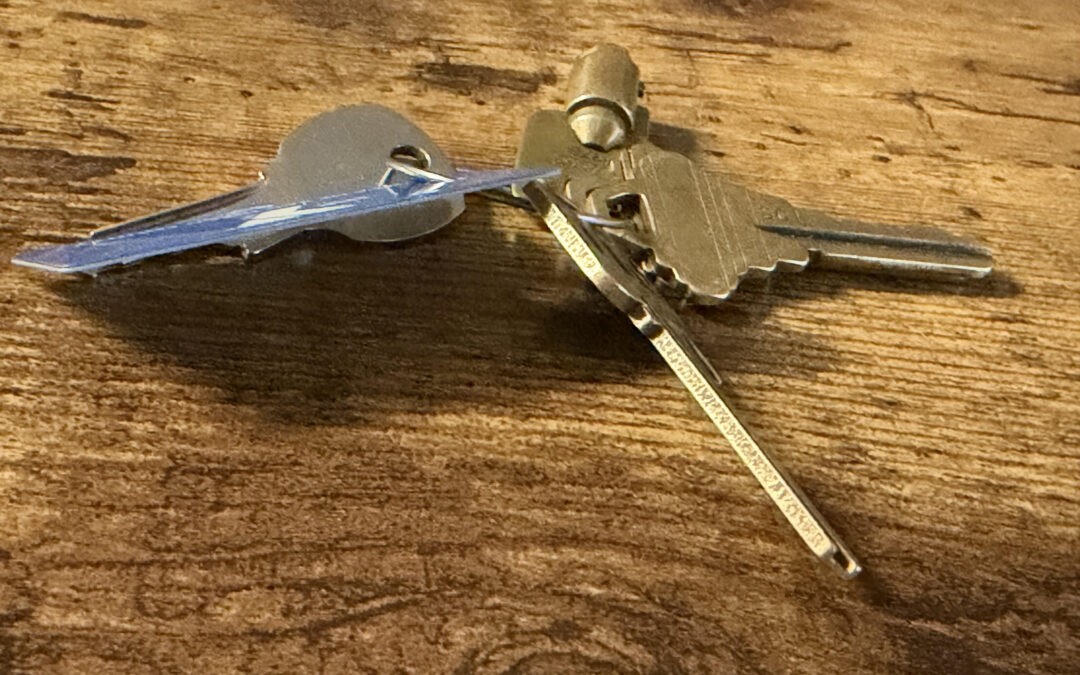
Our garage is also a small gym and a small office. You can enter it from the house through its own door. It has its own key, but I had never had any reason to lock it.

When a few families with young children came to visit recently, I locked the garage door for the first time, so that no child would go in there by accident.

During the visit, I had to go in and out of the garage a few times to get things that were there. After everyone had left, I tried to go back in to return a few things.

I could not find my keys.

There is a good chance I left the keys inside on my last trip into the garage and closed the door behind me. I could not find a spare key, though I had one. Then it occurred to me that the spare key was inside the garage, which was now locked.

Then I realized how important the garage was in my daily life. That is where I write. That is where I practise guitar. That is where I exercise. It is not elegant or impressive, but it had become a large part of my daily routine.

In the end, I called a locksmith. Fortunately, he was able to open the door without removing the lock and putting a new one in its place. And yes, my keys were sitting there on the desk.

Before he left, I asked him to make a couple of extra keys. I gave one to my wife straight away.

That reminded me of an accident that happened to me last year. For the first time ever, I was not wearing my hiking shoes walking up a mountain. I slipped and broke my ankle.

I realized then that these two incidents in my life were part of a wider pattern.

The real mistake was not that I forgot something. I had changed a routine I had, without putting a new safeguard in place.

A mistake of that kind can be small and annoying, as it was with the garage door. But it can also be much more serious.

Pilots know a lot about mistakes of this kind. In 1987, Northwest Airlines Flight 255 crashed shortly after takeoff in Detroit, in the United States. The National Transportation Safety Board, or NTSB, found that the aircraft took off without the wing flaps being properly set for takeoff. The problem? The crew had not completed the pre-takeoff checklist, and the warning system did not alert them that the plane was not properly configured. The crew failed to carry out an important task, and the warning system failed too.

The World Health Organization, or WHO, studied the use of a simple surgical safety checklist in hospitals in eight cities around the world. The number of major complications fell from 11 percent to 7 percent. The number of patients who died after major operations fell from 1.5 percent to 0.8 percent. It was not that surgeons did not know how to operate. But even skilled people can leave out basic steps when they are interrupted. In many cases, checklists can help avoid mistakes like this. Airlines and hospitals use checklists widely, not only for normal procedures, but also when unusual situations arise. The list itself is not enough, however. It has to be woven into the process. In high-risk situations, that may involve technology, warning systems, and another person confirming the important steps.

I now have my own checklists, for travel and walking, for example. It only takes a minute to go through my checklist, and it helps me avoid mistakes of that kind.

As for the garage door, the solution is now in place. Spare keys are no longer kept in the garage. My wife always has one. Our son too. I now make sure I have my keys any time I leave the car, the house, or the garage.

When I make mistakes like this, the most important thing is to put something in place so they are less likely to happen again.

It is said that the lesson repeats until the student has learned it. I hope I have learned the lesson well from these two recent incidents, and that I will be able to avoid mistakes of this kind from now on.


Daonáireamh 1926

1926 Census

When the 1926 Irish Census was put online recently, it opened up new possibilities for genealogical research.

My wife drew my attention to it after she saw the news. Since then, the two of us have spent many hours researching our family history.

For anyone with Irish roots, this is a treasure trove. The information is limited, but it is enough to give a glimpse of that time, and of the lives our ancestors lived.

The census was taken on April 18, 1926, under the administration of the Irish Free State. Unlike the 1901 and 1911 censuses, which covered all 32 counties, this one covered the 26 counties of the new State.

What makes it powerful is what you can do with it. The 1926 census acts as a bridge back to 1911. From there, you can go back to 1901, and then into Griffith’s Valuation—a mid-19th-century property tax record that serves as a vital substitute for missing census data from that era. After that, you can find further information in the birth, marriage, and death records available on IrishGenealogy.ie.

The Mayo Connection

In this article, I will focus on part of my own family line as an example of what can be done. There is much more still for me to explore.

I began with my father’s side. That was easier. My father was born in 1925, so there he was in the 1926 census, a nine-month-old baby. His older brothers and sisters were there too, along with my grandparents, all on a single handwritten page.

Seven of them were living in a two-room thatched cottage on 16 acres in Drumreagh, on the Mullet Peninsula in County Mayo. Later, when Sheila was born, there would be eight.

Using that information, I stepped back to 1911. There I found my great-grandfather, Michael Barrett, a widower, living in the same house with my grandfather and some of his adult siblings and a cousin. Going back again to 1901, he was there with his wife Julia and their nine children.

A Sad Story

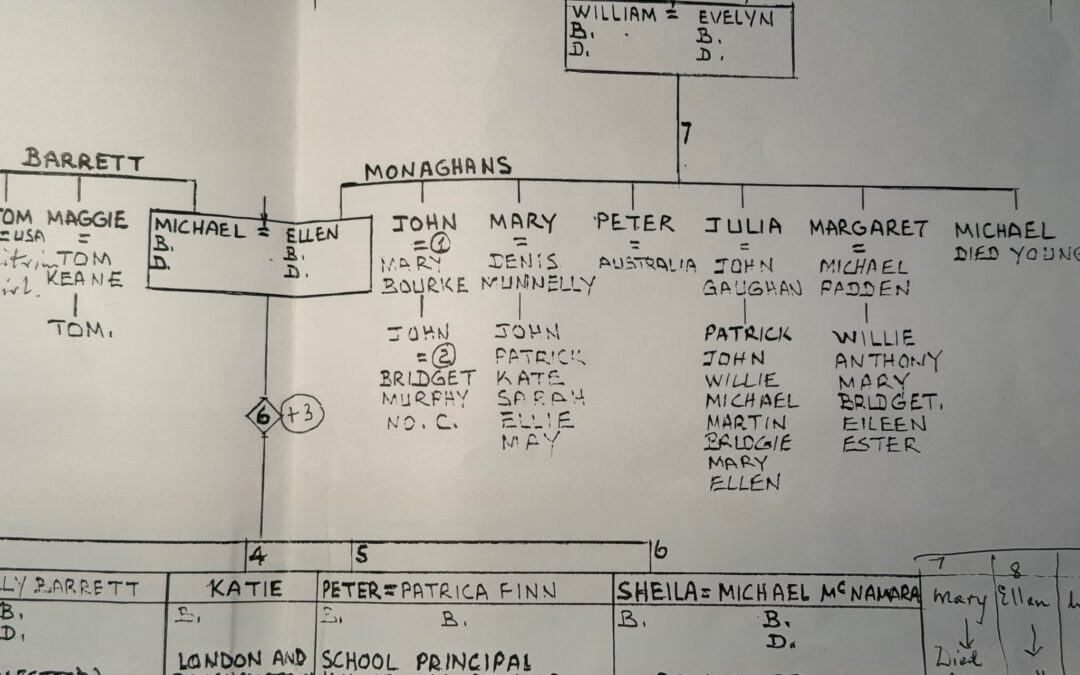
My father gave me a hand-drawn family tree some years ago, which he had put together with his brother John. Although not complete, it proved invaluable. It confirmed the research I was doing and gave me important clues for where to look next.

There was sadness in that family tree that was not immediately visible in the census records. My father’s records showed that three children in the previous generation—Ellen, Mary, and William—had died young. I found records online for two of them. Mary died at six days old. Ellen died at four months. I have not yet found William. It must have been devastating for the family to lose three out of nine children so young.

I searched the birth, marriage, and death records on IrishGenealogy.ie and was pleased to see that the civil records and census records matched. The civil records also provided new information. I discovered that my great-grandmother Ellen Monaghan’s father was named Richard Barrett. My father had written “Dick” in the relevant box on his family chart. Things were lining up again.

The Poet of Erris

My father told me that the connection back to the well-known Dick Barrett came through his mother’s side. Since my great-great-grandfather on my father’s mother’s side was named Richard Barrett, that strengthened the case.

Riocard (Dick) Bairéad was an Irish-language poet, satirist, and schoolteacher. He was involved with the United Irishmen and the 1798 Rebellion. He is best remembered as a poet. Among his works are “Eoghan Cóir” and “Preab san Ól.”

Another interesting name on my father’s chart was my great-great-grandfather, Éamon Barrett. I searched Griffith’s Valuation and found nothing under Éamon. Then I tried Edward Barrett.

There he was. On the same sixteen acres in Drumreagh. A tenant farmer. His landlord was Tobias Kirkwood. By 1901, it appears that Michael Barrett was no longer a tenant farmer but owned the land.

Heritage and Meaning

According to my father, Edward was the first Barrett to settle in Drumreagh as a tenant farmer. By 1901, eleven people were living in the same two-room thatched house. Seven in 1911. Seven again in 1926, including my father.

Life was hard in those days. In the mid-19th century, it must have been especially difficult for Edward Barrett and his family to survive. It is likely that he was farming that land during the time of the Great Famine. In June 1847, hundreds of starving people from Erris reached the workhouse in Ballina, only to be turned away because it was already full. People were living from hand to mouth, in conditions that are hard to imagine today.

I know from my father’s records that two of his uncles emigrated to Chicago in the 1910s. That is another line to follow later. There is a good chance I have relatives here in the United States.

When I look at all those names on the census pages, it strikes me that each one was a person, with a life and a story. Now, only the name remains on paper. Everything else is lost in the mist of time.

It is a sobering thought to see my uncle, my grandfather, and my great-grandfather there in the records, all sharing the same name as me—Michael Barrett. They give me context. They give me meaning.

I am sure many who read this are carrying out their own research using the 1926 census, tracing their families, and learning more about where they came from and how they lived.

I have only followed one line so far. There are many more to explore, and it will take time.

If you have not had the chance yet, I hope my story encourages you to explore your own family roots in the 1926 census.


Dearcadh Trump agus Leo ag teacht glan salach ar a chéile

Trump and Leo in Direct Conflict

As Pope Leo XIV flew to Algeria on April 13, he was asked about the latest attack Donald Trump had made on him. The Pope said he had no fear of Trump and would continue to speak out against the war.

On April 7, Leo said Trump’s threat against Iran was “completely unacceptable” - extraordinarily direct words for a pope to use when speaking about a sitting American president. He said threats against civilian populations raised serious moral and legal questions, and he urged people to pressure governments to move towards peace. A few days later, at a prayer vigil in St. Peter’s Basilica, he again spoke of the “delusion of omnipotence” that feeds war and warned against using God’s name to bless violence. It was clear who and what he was referring to.

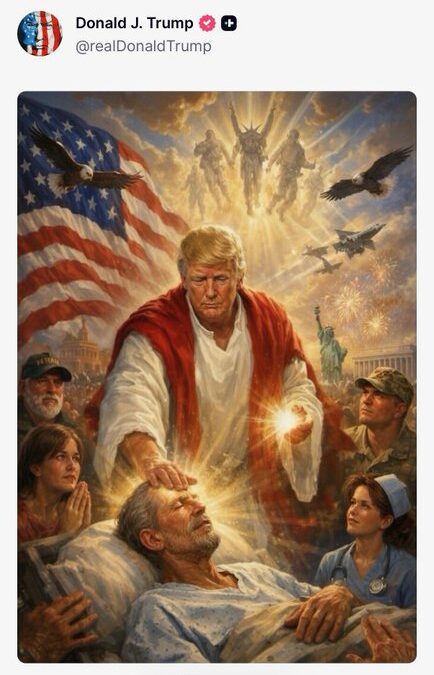
Trump’s reply came in his usual sharp, insulting style. He said Leo was “weak on crime” and “terrible on foreign policy”, and urged him to focus on being pope rather than acting like a politician. Then Trump crossed another line. He posted an AI-generated image of himself online in a pose that evoked Jesus, and later took it down after an angry public backlash. He said he had intended to portray himself as a doctor, not as Christ, but by then the damage had been done.

Leo did not raise the tension, though he responded wisely and firmly. He said his message was rooted in the Gospel, not in politics. He said the Church had a duty to speak for peace, dialogue and reconciliation. While in Algeria, he condemned “neocolonial” conflicts and violations of international law. The Pope made it clear that he had every right to speak on ethical and moral questions concerning war and peace.

This clash has been building for some time. Even before he was elected Pope, Robert Prevost criticised Trump’s politics, especially on the issue of immigration. In his first address as Pope to diplomats in May 2025, he said the dignity of immigrants had to be respected. In September 2025 he went even further, saying that someone who opposes abortion while accepting the “inhuman” treatment of immigrants cannot so easily claim to be “fully pro-life”.

The conflict between Trump and Leo has both political and spiritual significance. Trump succeeded in improving his standing among Catholic voters in the 2024 election. AP VoteCast found that 54% of Catholic voters voted for him, up from the near-even split in 2020. Trump attracts conservative Catholics because of the judges he appointed, his stance on abortion and his anti-liberal position. But Leo’s words on poverty, migration and peace compel every Catholic to look at their own political choices through the lens of their faith and the teachings of the Church.

There was also a strong backlash against Trump because of the fight he started with the Pope, both inside the Church and outside it. Archbishop Paul S. Coakley of Oklahoma City said the Pope was not in political competition with Trump, but was the Vicar of Christ speaking from the Gospel. AP reported that many Catholics in America were upset by the President’s attack on the first American Pope. In Italy, even Giorgia Meloni, who is usually careful in what she says about Trump, called his remarks “unacceptable”. That was significant because Meloni is one of the European leaders closest to Trump’s outlook. When even she feels compelled to draw a line, it suggests Trump misread both the office he was attacking and the watching audience around the world.

What makes this conflict so striking is that both men are speaking to Americans, but from very different ideas of strength. We know Trump’s version well: dominance, mockery, force and refusal to yield. Leo’s version is almost the opposite: restraint, moral clarity, care for the weak and suspicion of the powerful. While Trump sees a pope criticising him directly, Leo sees Trump going against the teachings of the Catholic Church.

Pope Leo is not easy for Americans to dismiss. He is American. He speaks in clear moral language. And his standing is exceptionally strong among American Catholics: a Pew Research Center survey published in September 2025 showed that 84% of them viewed him favourably. That does not mean every Catholic will now turn against Trump. But it does mean Trump chose to start a fight with a figure whose moral authority extends far beyond Rome.

There are other warning signs too for the Trump administration. Reuters reported that public confidence in the U.S. economy is at a very low level, driven in part by inflation and rising petrol prices linked to the war in Iran. In Hungary, Viktor Orbán also discovered that strong outside backing cannot simply be taken for granted. Trump endorsed him. JD Vance travelled to Budapest to show support. Reuters also reported that Russian sources, or sources linked to Russia, were boosting pro-Orbán messages before the vote. Even so, Orbán lost heavily to Péter Magyar.

That leaves a real choice before Americans at the ballot box, especially Republican Catholics. Will they heed the Pope’s clear condemnation of war, harsh immigration policies and moral indifference, or will they continue to support policies that conflict with the values they claim to hold? The answer should become clearer after the U.S. midterm elections in November, and it could set the stage for significant long-term change in American politics.


Ó Apollo go Artemis

From Apollo to Artemis

Dírbheathaisnéis 16- ag imeacht ón Tréad

On July 21, 1969, early in the morning, Dad and I sat watching Neil Armstrong step onto the moon. I do not remember if anyone else was with us. I was twelve years old and spellbound by the sight on television. It did not seem possible that such a thing could happen at all, yet there it was before us, taking place in our living room on the black-and-white television. When Neil Armstrong and then Buzz Aldrin walked on the moon, Michael Collins remained in orbit in the command module. All of them were white American men.

Now, many long years later, another American mission has carried astronauts back toward the moon. Artemis II has gone around the far side of the moon and is on its way home as I write this. As I watch this mission, I feel a little of the same wonder that Apollo awakened in me.

Apollo 11 belonged to the Cold War. At that time, the space race was bound up with national pride and rivalry between the great powers. Artemis II belongs to another age. This mission is an international collaboration. Diversity can be seen in the astronaut crew: a woman, Christina Koch, a man of color, Victor Glover, and a Canadian, Jeremy Hansen, along with the American Reid Wiseman.

What struck me most as I thought about these two missions was the length of time between them. In a way, much of my own life is measured between them. When Apollo 11 landed, I had not yet started secondary school. Now I am retired after a full working life as an engineer. By the time people return to the moon again under Artemis IV in 2028, nearly sixty years will have passed between those landings.

Back on Earth, some things have changed enormously. At the same time, much less has changed in other things. The digital world has changed beyond recognition. We have moved from a black-and-white television in one room of the house to a world of internet, mobile phones, instant video, livestreams, and now artificial intelligence, another development that would not have been easy to imagine in 1969. We saw Apollo 11 through television and radio. But Artemis II is always available to us on our phones and screens whenever we want to watch it.

Although digital technology has advanced at blazing speed, the same cannot be said of rocket propulsion. The SLS rocket used for Artemis II produces only 15 percent more thrust than Apollo 11’s Saturn V rocket. That is progress, certainly, but it is not a revolution. Artemis II is more modern, safer, and more sophisticated, but in physical terms it is still doing the same thing Apollo 11 did more than half a century ago.

We too have changed as a society, because the same bond no longer exists between us as we watch this astonishing achievement. We all watched Apollo 11 at the same time, and there was a feeling that the whole world was part of it. We felt closer to one another through that shared experience. Everything about Artemis II is available to us now, anywhere, anytime, on our mobile phones. But the shared public moment is much weaker now. Although we are more connected to information through technology, we are more separated from one another socially. We watch the mission in clips, often alone, and on our own schedules, because too many other things are drawing our attention away.

Although we have made enormous progress in technology since 1969, it cannot be said that we have moved forward in the same way in matters of peace for humanity. The wars in Afghanistan and Iraq came and went, carrying a terrible human cost. The war in Gaza has left dreadful destruction and loss of life. Ukraine remains under attack. At present, the conflict with Iran is under way, and fighting words have been heard from President Trump about destruction on a vast scale. A two-week ceasefire is now in place, but no one knows what will happen tomorrow.

Along with everything else, there is climate change, another threat growing before us. Those dangers were not so clear in 1969, but now everyone knows what is at stake, and weather conditions are worsening every year. Although Artemis II shines as a beacon of hope, grave dangers remain, including wars, authoritarian governments, and climate change.

Perhaps, however, that is precisely why this mission matters so much. It reminds us that people are still capable of realising dreams and doing good deeds. I think again of that boy sitting with his father in the middle of the night, staring at the black-and-white screen, spellbound. He could not have imagined the world that was to come. And perhaps we cannot fully imagine the world ahead of us either.

If there is anything to be learned from Artemis II, it is this: there is no strength without unity. And although we have failed again and again, we must still keep pushing forward toward a better world. We have no other choice.


Sáinnithe i lár Cogaidh – Tuairisc mo neachta ó Dubai!

Trapped in the Middle of a War – My Niece’s Report from Dubai!


The war involving the United States, Israel, and Iran has taken a significant turn for the worse over the past week. Following Israeli strikes on major Iranian oil and gas facilities at South Pars and Asaluyeh on March 18, Tehran sharply escalated its threats, warning that Gulf energy infrastructure in Saudi Arabia, the UAE, and Qatar could be targeted. This sparked widespread anxiety across the region, as it signaled that the war could spread further, devastating the economies and lives of people already living under its shadow.

Iran also demonstrated its long-range capabilities by firing two ballistic missiles toward the joint U.S.-U.K. base at Diego Garcia in the Indian Ocean. Although reports indicate the missiles did not hit the base, the incident reinforced the sense that the conflict is widening, becoming increasingly unpredictable and difficult to contain.

President Trump then raised the stakes once again. He warned that unless Iran fully reopened the Strait of Hormuz within 48 hours, the United States would strike Iranian power plants. Iran countered with its own threat, stating that if its power infrastructure were attacked, it would retaliate against Israeli power plants and other regional power facilities linked to U.S. bases.

Then, almost as suddenly, Trump appeared to pull back. On March 23, he claimed that “very good and productive” talks were underway between the U.S. and Iran, with major points of agreement reached, and he postponed the threatened strikes for five days. However, Iran publicly denied that any such talks were taking place. Thus, the region remains in a state of profound uncertainty: one day brings threats of escalation, the next talk of diplomacy, followed almost immediately by denials and renewed doubt.

For those living in the UAE, it is a constant, agonizing journey. Every new threat spikes the tension. Every rumour of talks or a pause brings a small measure of relief, but that relief fades quickly, as no one knows what comes next.

My niece shared her thoughts with me before some of the most recent developments. If anything, the tension is even sharper now than when she wrote them:

“For me, the main feeling lately has been a kind of constant mental exhaustion. You’re always slightly on alert, waiting for the next notification on your phone and wondering if it will be followed by a bang, and if so, how far away it will be.”

In the UAE, a phone message is no longer just a message. Silence is no longer just silence. Every pause is heavy with the understanding that something else could be about to happen.

This pressure doesn't stay with just one person. It seeps into homes, onto the roads, into workplaces, and into family life. The city might still look normal from the outside, but the atmosphere has changed completely.

As my niece put it:

“I think many of us have become a bit irritable and hypersensitive too, simply because our nerves are on edge. It changes the look of everyday life. I get nervous about simple things like driving somewhere. There’s always a question in the back of your mind about something falling from the sky, whether that’s missiles or debris.”

It is easy, from a distance, to view these events as a series of headlines. But for those living in the UAE, the war is felt differently. It is felt in the phone alert that tenses your shoulders, in the instinctive glance at the sky before getting into the car, and in the effort to keep daily life moving while the wider region lurches from one threat to the next.

If the past week has shown anything, it is how suddenly this war can change direction. One day brings threats against power plants and Gulf infrastructure. The next brings talk of productive discussions. Then come denials and further uncertainty.

Undoubtedly, things are much worse for the people of Iran, with a terrifying amount of bombs being dropped on them by the U.S. and Israel. But my family is not in Iran, so I do not feel that direct impact in the same way. There is no such thing as a good war, and I hope this conflict ends soon. Even then, it will be difficult for life to return to how it was, and it is likely the people of the UAE will be keeping an eye on the sky long after the hostilities have ended.


Sáinnithe i lár Cogaidh – Tuairisc mo neachta ó Dubai!

Trapped in the Middle of a War – My Nephew’s Report from Dubai

Trapped in the Middle of a War – My Nephew’s Report from Dubai

The situation for Irish citizens living and working in the Middle East, particularly in the UAE, has become far more stressful since the United States and Israel began the war against Iran. Although Iran says it is targeting military bases in the Arab Gulf states, it has been reported that hotels and other civilian sites in the UAE have also been hit. As a result, life has changed dramatically in Dubai, where my nephew and niece have lived with their families for years.

Before the war began, Dubai was widely regarded as one of the safest and most prosperous cities in the world. Now, Iran is launching missiles and drones toward the UAE almost daily. The UAE’s air defenses intercept most of them, but they do not manage to stop them all. This offers only a small amount of comfort to families living there, especially those with young children.

I asked my nephew and niece to describe daily life in Dubai at the moment. I am publishing my nephew’s report today, as it illustrates clearly what life is like there right now:

“Life in Dubai has changed dramatically over the past two weeks. There is a sense of uncertainty and unpredictability, and at times it feels dangerous. There has been a clear shift in day-to-day life.

Sometimes when you are outdoors, you hear missiles overhead or see them crossing the sky, with some being intercepted right in front of you. The sound of those explosions is unlike anything I have ever heard before. The shockwave travels through your entire body, and it is impossible to ignore.

We receive official government alert messages almost every day, instructing us to take shelter when waves of missiles are coming our way. Recently, other messages also arrive an hour or two later confirming that the situation is under control again. At night especially, people are much more alert, checking their phones, watching for alerts, and listening for unusual sounds. This creates a tension that is now part of everyday life. I’ve noticed one thing: every time I go out, I look up at the sky just to be sure. That has become an instinctive habit now—something that would have been quite strange a short time ago.

For families, especially those with young children, this is one of the most difficult aspects. We have two small children, and the sound of those explosions is very frightening for them. They are certainly afraid and don't understand what is happening, so we try to downplay the situation and reassure them, telling them it is a normal occurrence—like police cars or ambulances passing by.

Travel has also been heavily affected. Due to the closure of airspace, flights were not operating for certain periods. On some days, the airspace was reopened for a few hours to allow people who were on holiday here to return home to places like Ireland and England, but many flights were still cancelled. Once, when flights resumed for a short while, civilian aircraft appeared to be flying side-by-side with military jets. I had never seen anything like it before, and it was a surreal experience.

In everyday life, there is much less traffic on the roads, though most people are still trying to carry on with their routines and daily duties. It must be said that the response systems are working very effectively. Despite this, there are still cases where drones or debris have caused damage to buildings.

Overall, people are getting used to the situation as best they can, but the atmosphere is very different now. There is an understanding that things could change suddenly. Daily life continues, but everyone is more alert and more cautious than usual.”

Next week, I will continue this series with a report from my niece in Dubai.


en_USEnglish