Gníomhartha in ionad na Cainte – 2

Actions Instead of Words - 2


In the last article, we showed the gap between public demand for Irish-medium education and the State's response.

The Government needs a comprehensive revival plan, with clear targets that are measurable and time-bound, with proper funding, and with political consequences if those targets are not met. The current framework does not yet satisfy that test.

Legal Right to Irish-Medium Education

The State should have a legal duty to provide Irish-medium education where there is clear demand.

Currently, parents and local campaigners are forced to fight school by school, town by town, county by county. They must grapple with the Department of Education's arguments about population projections, funding constraints, and demographic formulas.

But it should be the State's responsibility in the first place, to provide the necessary resources to meet the demand for Irish-medium education across the country.

But it should be the State's responsibility in the first place, to provide the necessary resources to meet the demand for Irish-medium education across the country.

Targets

Under the National Plan for Irish Language Public Services, the State is working toward the target that 20 percent of new recruits in the public sector will be competent in Irish by December 31, 2030. The plan is designed to increase the number and quality of public services available through Irish.

As we stated in the last article, an educational target is needed as a foundation for that goal. Otherwise, where will the Irish-speaking civil servants come from?

The Government should set national targets for Irish-medium education at pre-schools, primary schools, secondary schools, and universities. Those targets should be measured, published, and submitted to the Oireachtas every year.

The Welsh Government's Cymraeg 2050 program includes targets for education through Welsh, including an interim milestone that 30 percent of children in Year 1 will be in Welsh-medium education by 2031. It also includes actions such as the Welsh Language and Education Bill, a 10-year plan to increase the number of teachers capable of teaching through Welsh, and supports for the use of Welsh between the school, the family, the community, and the workplace.

Cymraeg 2050 provides a practical template.

Priority for Teachers

No language revival succeeds without teachers being central to the process.

Ireland cannot expand Irish-medium education if schools cannot recruit qualified teachers with strong Irish. New Gaelcholáistí cannot be opened without Irish teachers. A proper system for the public service cannot be built if there are staff shortages in the education system itself.

Wales has a ten-year plan to develop enough teachers fluent in Welsh as part of Cymraeg 2050. Ireland needs a similar practical system.

That means scholarships for trainee Irish teachers. It means supporting Irish teachers to upskill. It means giving incentives to teachers in math, science, technology, and special education to teach through Irish. It means supporting teachers in Dublin and other expensive areas where housing issues make it much more difficult to recruit teachers.

The supply of teachers is the engine that will drive any language revival forward.

Continuity from Pre-school Onward

The Irish-medium process starts before primary school. It must continue through primary school, through secondary school, through third level, and into professional life.

That means more Naíonraí. More Gaelscoileanna. More Gaelcholáistí. More third-level courses through Irish. More supports for teachers, nurses, planners, Gardaí, civil servants, health workers, and social workers.

Canada's Action Plan 2023-2028 for Official Languages goes much further than education alone. It protects and promotes minority languages in the workplace and in the community, and supports the equality of the two official languages, French and English.

We should have a similarly comprehensive language plan, a plan that does not just relate to education, but that supports the use of Irish in the workplace, in public services, and in community life.

The Central Role of Local Authorities

Although the central government lays down national policies, it is at the local authority level that these policies succeed or fail.

County councils should have a duty to measure the demand for Irish-medium education in their areas. Every local authority should know where parents are seeking places for their children, where there are gaps in the education system, and where new workers will be needed to provide public services through Irish.

Responsibility in this area lies with the Department of Rural and Community Development and the Gaeltacht, supported by agencies such as Údarás na Gaeltachta and Foras na Gaeilge. But a stronger cross-Departmental mandate from the State is also required, along with a ring-fenced budget for the language revival, and the publication of an annual report on progress toward these targets.

A duty should also be placed on every public body to show how it will support education, recruitment, and services through Irish.

Political Pressure

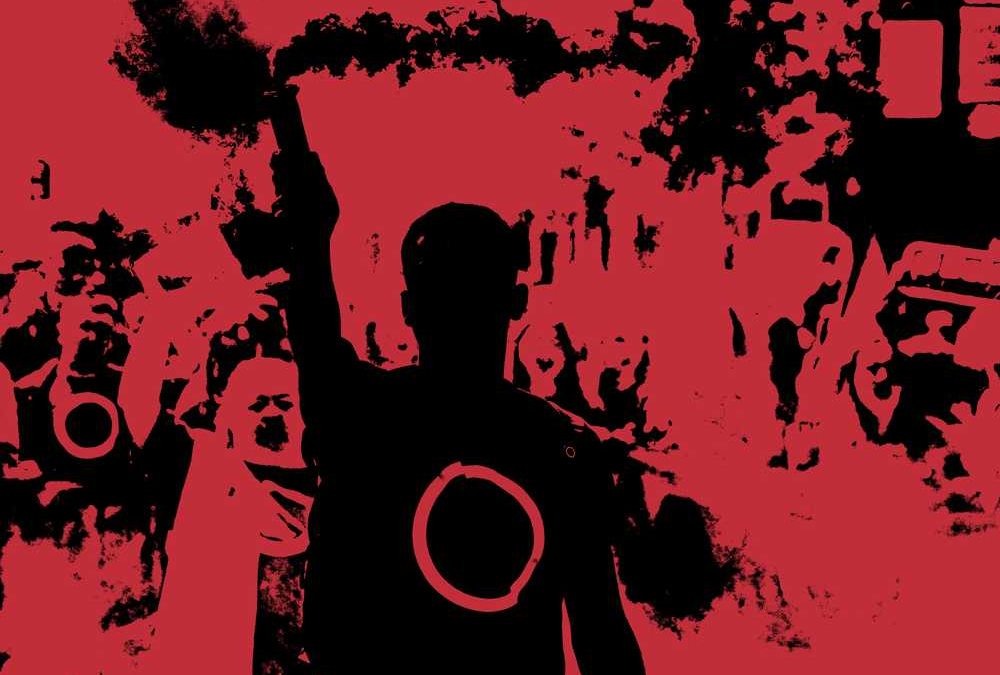
The Irish language movement already exists. Conradh na Gaeilge has more than 200 branches and describes itself as an all-island organization working on behalf of Irish speakers and Gaeltacht communities. An Dream Dearg has shown how a clear campaign based on language rights can bring the Irish language into the heart of the political debate.

In the North, An Dream Dearg helped turn language rights into a highly visible public campaign. It used clear demands, public mobilization, legal arguments, and political pressure. More than 12,000 people marched in Belfast in 2017 for an Irish Language Act. In 2022, more than 17,000 took part in An Lá Dearg after further delays in implementing Irish language legislation in the North.

The campaign did not get everything it was originally looking for, but it helped push real change forward. The Identity and Language (Northern Ireland) Act 2022 gave formal legal recognition to Irish in the North, created the role of the Irish Language Commissioner, and put important language protections into law. After many years of delay, the first Irish Language Commissioner was appointed in 2025.

Now, the same pressure is needed here regarding a complete revival plan for Irish: a legal right to Irish-medium education anywhere there is demand, strong national targets, proper funding for teacher training, more public services through Irish, supports in the workplace and the community, and the publication of an annual report.

Every candidate should be asked what their stance is regarding the Irish language. Every political party should be asked what its strategy is regarding the funding of the language. And every government should be judged by its actions, not by its speeches.

Ultimately, our votes should depend on those answers.

We know what needs to be done. Now it is time for us all to do it.
 

Gníomhartha in ionad na Cainte – 1

Actions Instead of Words - 1


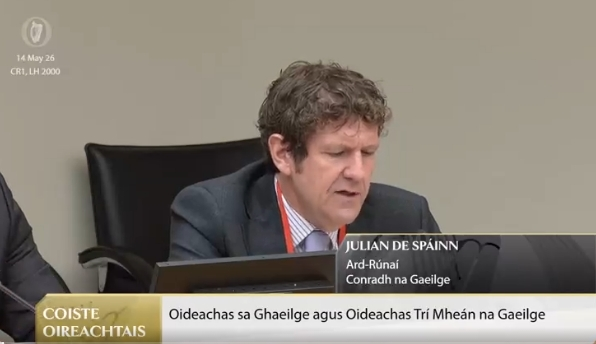
On May 14, 2026, the Oireachtas Education Committee heard two different versions of the state of Irish-medium education in Ireland.

Minister for Education Hildegarde Naughton cited over €500 million spent on building projects for Irish-medium schools since 2020. She reaffirmed the Government’s commitment to expanding opportunities for children to receive an education through Irish.

Then, representatives from Conradh na Gaeilge, Gaeloideachas, An Foras Pátrúnachta, and the lobby group Imeasc spoke.

They described a system struggling with a continuous lack of supply, political reluctance, and official complacency.

Julian de Spáinn - General Secretary of Conradh na Gaeilge, the national organization that promotes the Irish language - used words like “emergency,” “crisis,” “critical situation,” and “pretense” to describe the state of Irish in the education system. He said the Department or the Minister would never give such an honest description, even though the facts are clearly visible.

Lack of Schools

There are not enough Irish-medium schools in the country. It is a language crisis, because the government has never treated the problem as a matter of urgency.

This failure is even more obvious when compared to the Government's own commitments. The previous Programme for Government promised to attempt to double the number of young people in Irish-medium schools and to provide Gaelscoileanna and Gaelcholáistí anywhere there was significant demand. Conradh na Gaeilge told the committee that the number of students in Irish-medium schools outside the Gaeltacht fell from 48,518 in 2019/20 to 46,933 in 2023/24.

At primary level, the evidence has been visible for years. Gaelscoileanna are overcrowded in much of the country. Parents are on waiting lists because there are not enough places. According to Conradh na Gaeilge, only 6.7 percent of primary school pupils outside the Gaeltacht attend Irish-medium primary schools. At the second level, that figure is just 2.6 percent.

Conradh na Gaeilge cited independent surveys showing that 49 percent of people would choose an Irish-medium education if it were available in their own area. In another survey, 78 percent said every child should have the opportunity to get an Irish-medium education if that is their choice. Another 73 percent said every child who receives primary education through Irish should have the opportunity to continue it at the second level. But Irish-medium education is treated as a marginal sector, rather than being a core part of the country's educational infrastructure.

Unfortunately, the situation gets even worse at secondary school level.

Thousands of children finish their primary education through Irish with no Gaelcholáiste available to them. According to the figures put before the committee, around 3,000 students every year are effectively prevented from being able to continue their education through Irish due to a lack of appropriate supply at the second level. Thirteen counties are still without even one Irish-medium secondary school.

Lack of Planning

Despite this, the Department of Education has indicated that it has no plans to establish any new Irish-medium secondary school between 2026 and 2031 outside areas of demographic growth. This position contradicts the will of the public.

The broader system is failing too.

Conradh na Gaeilge told the committee that more than 60,000 secondary school students have exemptions from Irish. In 2025, 24 percent of Leaving Certificate students did not sit any Irish exam. That was the fourth consecutive year that more than one in five avoided Irish in the Leaving Cert. At Junior Cycle level, 20 percent of students did not take an Irish exam, even though almost everyone sat English, math, and history.

The contrast becomes even sharper when this situation is put in the context of the Official Languages (Amendment) Act 2021. Under that legislation, the State has a target that 20 percent of new public service recruits will be proficient in Irish by the year 2030. The legislation places stronger duties on the government regarding the provision of public services through Irish, especially in the Gaeltacht areas.

Teachers, nurses, Gardaí, and civil servants do not become fluent in Irish without a proper education system.

That process starts at the pre-school level. It continues through primary school and secondary school. It depends on opportunities at third level. A clear long-term plan is essential.

No such plan exists at present. Instead, many children have no access to Irish-medium education at all. And for many of those who do get that opportunity, it is lost halfway through their education.

At the third level, the same pattern continues. Important work is underway in institutions like University of Galway and Maynooth University, but education through Irish is still limited in a large number of professional disciplines.

On the one hand, the State has passed legislation to create civil servants with Irish. On the other hand, it has failed to provide the necessary educational supports to fulfill that duty.

Wales — a role model

Wales has a smaller population than Ireland, and furthermore, it is part of a (larger) state where English is dominant. But about a quarter of Welsh schools operate through Welsh, a much higher percentage than Irish-medium schools in Ireland.

More importantly still, the Welsh Government has adopted clear national targets linked to legislation, teacher recruitment, and long-term educational planning. Their goal is to increase education through Welsh from 23 percent to 40 percent by 2050. In 2022, the Welsh Government announced 23 new Welsh schools and an expansion of the language's use in 25 other schools as part of that approach.

Northern Ireland – Overcoming the Difficulties

Northern Ireland provides an even more striking comparison.

Irish-medium education operates there in a much more difficult political environment. There is still strong opposition from some unionist and loyalist politicians. The language is frequently dragged into broader culture wars.

Despite that, the number of students in Irish-medium education in Northern Ireland has been increasing steadily over the last twenty years. Even within a divided political system, legal duties have been placed on authorities to encourage and facilitate Irish-medium education.

If progress is possible there, despite those political difficulties, it is hard to accept our own government's excuses anymore.

For many years, governments have been quite happy to pay lip service to the plight of the language, without suiting their actions to their words.

Therefore, the citizens of the country must put real political pressure on the Government to implement the will of the public.

In the next article, we will examine the steps that are necessary now.


An Ghaeilge – 2025

An Ghaeilge – 2025

On a cold November morning at Dublin Castle, a line was quietly crossed. As Catherine Connolly delivered her inauguration speech, Irish carried the day.

For many years, Connolly has been a model in her consistent use of Irish in public life. As President, she made it clear that Irish will also be a central theme of her new role. From the first day onward, Irish will be the working language of the Office of the President. Her staff will operate through Irish.

That is an important decision. As head of state, she will have significant influence over the Official Languages (Amendment) Act 2021, particularly the provision that requires 20 per cent of new public service recruits to have Irish by 2030. With leadership from the top, pressure will be placed on the public service to follow her example.

But the ground had already been shifting.

Tob-Ghaeltachtaí

For at least the past decade, Irish has been gradually returning to everyday life. By 2025, that movement had reached a turning point.

An early signal came from the Pop-Up Gaeltachtaí. The first was founded in Dublin in 2017 and they spread quickly thereafter. By 2025, they had become a normal part of social life rather than a language experiment. They were simple and essential: places to speak Irish without classes or correction. Today, they are found across Ireland and overseas, including in the United States. Pop-Up Gaeltachtaí bridge the gap between having Irish and being able to use it.

Then came a sharper cultural turn.

Kneecap

Kneecap is a politically charged hip-hop/rap trio from Belfast that blends hardcore hip-hop with punk energy. They rap in both English and Irish, addressing working-class life, Irish identity, and political protest. Their sound includes elements of drill, house, and even folk, and their satirical lyrics are often controversial, paired with a raw attitude that attracts fans from the rock and punk worlds.

Their biographical film drew large audiences earlier this year. At concerts, teenagers in football jerseys and retro sportswear shout Irish-language lyrics with the same ease once reserved for English-language music.

This is no longer a marginal phenomenon. It is a movement that reached the mainstream in 2025, with support from the music industry and international media. For the first time, Irish is being seen as a central part of contemporary culture and a source of pride, especially among young people. There is no embarrassment in using the language, even if you only have a few words.

TikTok

Online, the shift is even clearer. On TikTok, Irish is spoken quickly and imperfectly, half-translated, mixed with dialects, nonsense, and memes. You don’t need perfect grammar. Taking part matters more.

“It’s no longer about being precise,” says Ciara, a nineteen-year-old student at UCD who runs a popular Irish-language account. “If you waited until you were happy with the standard of your Irish, you’d never speak. Now, you just start.”

Belfast

If there is one place that shows the scale of the change, it is Belfast. In October, Belfast City Council adopted a full Irish-language policy, backed by £1.9 million in funding. Bilingual signage. Services. Visibility. Ten years ago, such a move would have been unthinkable.

In 2025, however, the political and cultural context had shifted dramatically, with Irish now viewed as a public asset rather than a political flashpoint. The difference now is the presence of clear targets, resources, and public visibility. Irish has moved from promise to practice. This is a practical example of what can be achieved when policy and community align.

In the Gaeltacht Quarter, the impact was immediate. Irish on vehicles. On signs. On walls. A clear message being sent: the language belongs to us.

The change is also reaching higher education. From the 2026–27 academic year onwards, Queen's University Belfast will offer new degree programmes in Law and Broadcast Production through Irish. It is a clear statement of intent. Irish is a living language, not only in the South but in the North as well.

Looking ahead: 2026

The Action Plan for Irish in English-medium schools aims to tackle a familiar outcome: years of study with little confidence. Less emphasis on rote learning. More conversation. More use.

Abroad, demand continues to grow. Irish classes are filling quickly. In San Francisco, waiting lists already exist for courses beginning in early 2026.

There is still work to be done. Policy, funding, and infrastructure will determine how lasting this moment will be. But 2025 was a decisive year — not because of a new vision, but because of new usage. Irish has left the margins and returned to everyday life. That is what will drive the language forward in 2026.


Éamonn Mac Coistealbha – Gaeilgeoir go Smior!

Éamonn Mac Coistealbha – An Irish Speaker to the Marrow!

Éamonn Mac Coistealbha – An Irish Speaker to the Marrow!

Teacher, Mentor, Irish Speaker

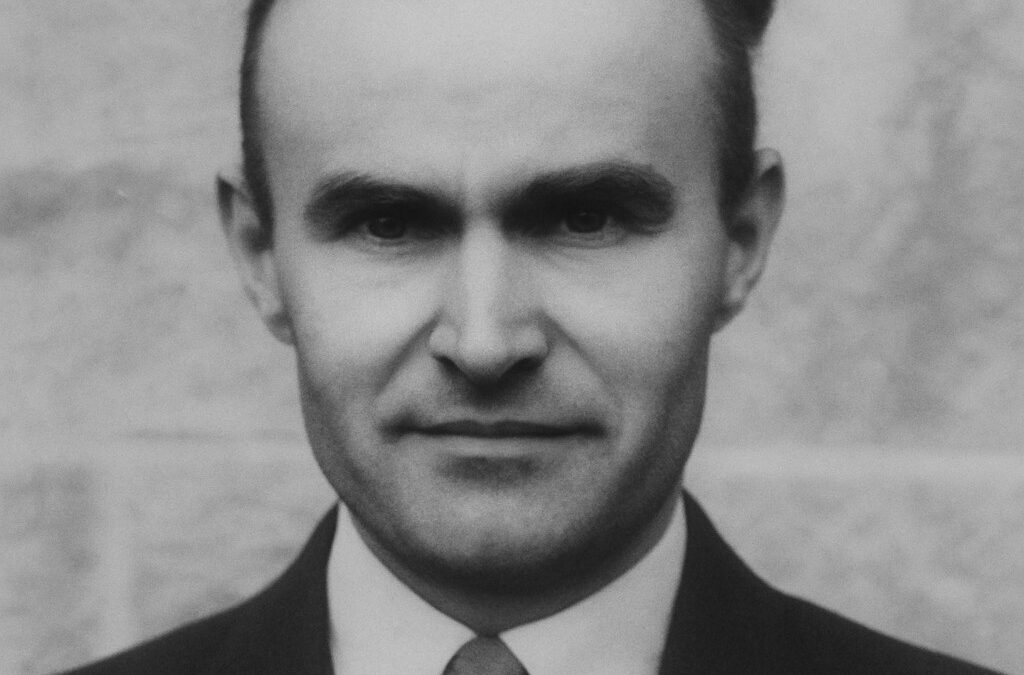
We had Éamonn Mac Coistealbha as our Irish teacher in second and third year at St Kieran's College, right up to the Junior Certificate. I was extremely fortunate, I must say, as I had excellent Irish teachers at the College. Éamonn was no exception. He was an Irish speaker to the marrow, who had not only a BA in Celtic Studies, but also an MA from Maynooth College. Éamonn attended St Kieran's College as a student, and returned as an Irish teacher in 1939. I think he was a mentor to most of the other Irish teachers in the school, including my father, who all had great respect for him.

A Strong Foundation in Irish

It's very important when you're learning any subject to have a good foundation. Without that, it's difficult to progress to learning more difficult things. I think that basic Irish is the most difficult subject to teach and to learn. Repetition and practice must be done again and again until you don't have to think about it. You're able to learn more interesting things after that – read wonderful books, have conversations on many topics, and so on.

Stone by Stone, Step by Step

Students who attended other schools said how difficult it was for them to learn Irish. But that wasn't the case for us at St Kieran's College at all. I didn't fully understand why at the time, but later I realised we had a high-calibre teacher. Éamonn was able to improve our knowledge, stone by stone, step by step, giving simple answers to our questions, and focusing on the important principles when we were ready. Éamonn was on the learning journey with us, working hand in hand (with us).

Éamonn was a patient, reasonable man, and a man who always listened to us. You have to take into account that Éamonn had a long curriculum to teach us for the Junior Certificate, and pressure on himself to finish it in time. There were teachers who taught their subjects at lightning speed. But perhaps they were the only ones who understood what they were teaching – we couldn't keep up with them in class at all.

Solid to the End

I don't remember when I first heard that Éamonn was very ill. But I remember that he would cough badly from time to time in class. Despite his poor health, Éamonn continued teaching right up to 1974, when he passed away.

Éamonn was a fine example to us. He never used the cane on us, never looked down on us, and always listened to us. He treated us well, and we had great respect for Éamonn because of that.

I will never forget Éamonn Mac Coistealbha. I use Irish in my own life every day, and I am grateful to that great man, Éamonn Mac Coistealbha, for what I learned from him all those long years ago.

Excerpt from his Obituary

There is no better way to conclude than with an excerpt from his obituary written by a fellow teacher at the school:

He was a man who devoted himself to his work always and never neglected any task he undertook. Teaching is often a thankless task, but that wasn't the case with Éamonn — his former students are forever grateful, understanding that they learned from him not only Irish but insight and wisdom about their own lives. He had a special interest in every aspect of College life — in every activity, in sports matters, in the boys' development overall. He was loyal to his people and to his parish, and was a committed member of the St Vincent de Paul Society in Kilkenny.

He was a truly generous, charitable person — a man from the country and of the country — who wanted nothing as respite from the cares of the world but a winter's day outdoors with his gun and his dog, or a golden August day by the western shore with his family. His death is a cruel blow to his wife and family, and a great loss to the College with the passing of this noble Christian. It is also a personal grief to those of us who worked many long years with him — we have lost a true friend. May God grant eternal rest to his soul and consolation to his wife and family.


Uachtarán na hÉireann Catherine Connolly  –	Teanga, Cultúr agus Cothromaíocht

President of Ireland Catherine Connolly - Language, Culture and Balance

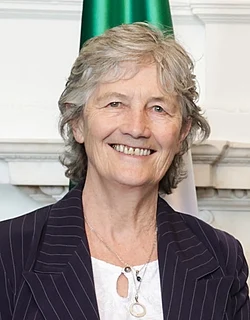
When Catherine Connolly was elected President of Ireland in October 2025, it was clear that a significant change was taking place in the political mood of the country, and that new values were being expressed through her victory. Connolly was the first woman ever to serve as Leas-Cheann Comhairle (Deputy Speaker) of the Dáil, and now she becomes the first independent President from Galway. She is a woman who places honesty and openness at the heart of her public life — especially regarding issues connected with the Irish language, Irish unity, the environment, neutrality, and social equality.

Biography and Roots

Catherine Connolly was born in Shantalla, Galway, where she was raised as one of fourteen children. She earned a Master’s degree in Clinical Psychology from the University of Leeds in 1981, before returning to the Claddagh in Galway, where she still lives with her husband Brian and their two adult sons. She later completed a Law degree at the University of Galway in 1989 and was called to the Bar in 1991. Her public life began in 1999 when she was elected to Galway City Council, and a few years later she became Mayor in 2004 — a period that deepened her awareness of Ireland’s cultural and linguistic identity. She was elected as an independent TD in 2016 and as Leas-Cheann Comhairle in 2020, confirming her as one of the most principled and fair-minded voices in Irish politics.

Return to the Irish Language

Connolly was not raised as a fluent Irish speaker. As she herself has said: “I only had the Irish I learned in school. I was embarrassed when I realised I couldn’t speak naturally with people in the Gaeltacht.” During her time as Mayor, after an event in Conamara where she found herself unable to say even a few words in Irish, she promised herself she would change that. She later completed a diploma course in Irish, and as she said afterwards: “I went back and learned it properly. And in the Dáil, from the very first day I was elected, I placed emphasis on Irish — as a living, vibrant language.” Gradually, Irish became a natural part of her daily life. She began using it in her speeches, interviews, and debates in the Dáil. She often reminds the public: “Irish is not a cultural ornament. It lies at the heart of who we are as a people.”

The Irish Language as a National Issue

Connolly’s election revealed how central the Irish language has become in political debate in Ireland today. Emer Higgins, a Fine Gael TD and Minister of State, said after the election that the government should “reflect on how central Irish was in the presidential race.” “I visited a school in Rathcoole,” Higgins said. “A pupil asked me, ‘Do you think Heather will lose because she doesn’t have Irish?’ Only one student in the class was fluent, yet every single one said it would matter to them if a presidential candidate spoke Irish.” For the first time in many years, Irish emerged as a major campaign theme across social media and news sites such as Tuairisc.ie and Extrag.ie. In an Irish Times poll, 3% of respondents said that “a person who speaks Irish” was the most important quality for a presidential candidate. While not a large number, it signaled a growing awareness of the language’s importance in political life. At the start of her campaign, Connolly herself stated: “It is essential that the President has Irish — not as a legal requirement, but as an expression of who we are as a nation.”

From Galway to Áras an Uachtaráin

Connolly’s roots run deep in Galway, a city where art, science, and community spirit meet. Before entering national politics, she worked as a barrister and city councillor and later as Mayor, known for her integrity and independence of mind. In the 2020 general election, she won a seat as an Independent TD for Galway West, and a few months later surprised many when she was elected Leas-Cheann Comhairle with 77 votes to the Government candidate’s 74. “I went for it,” she said, “because I couldn’t demand gender equality and then fail to act on it myself.”

Culture and Identity

For Connolly, language and culture are inseparable. As President, she is expected to emphasise the links between art, education, and language — “the three pillars of human society,” as she calls them. She believes Irish should not be left confined to classrooms or translation desks but returned to the heart of public life. “It is a living, central language. It is not a dead one,” she has said.

The Environment and Natural Balance

Connolly is also a passionate advocate for the environment. She believes it is not merely a technical matter but a moral one. “If we protect the land and the sea, we are protecting our heritage.”

Neutrality and Human Rights

Throughout her career, Connolly has consistently defended Ireland’s neutrality. “Neutrality is not the absence of action,” she said, “but an active commitment to peace.”

Reconciliation and Irish Unity

“We must create spaces where people can feel comfortable with their identity,” she says. “That is the beginning of reconciliation.”

Conclusion

It is a great honour to have Catherine Connolly as our President. She is an Irishwoman through and through, who will represent us with dignity on the national and international stage. At home, she will promote our language and culture. Abroad, she will stand against war, for human rights, and for our neutrality. In her own words: “Irish came back to me through patience, love, and daily use. Anyone can do the same.”

Saoire ar Árainn – Cuid 2!

Saoire ar Árainn – Cuid 2!

During our previous visits, I was determined to speak Irish to the locals. Although they spoke Irish, they only spoke English to me – in the shops, in the restaurants, in the pub. It really bothered me that I was treated that way. I couldn't understand why the locals wouldn't speak Irish to me. I was disappointed, as I thought Irish would be the normal language of the island.

I understand now. Árainn is crowded with visitors during the summer, boat after boat discharging crowds of passengers non-stop, from the beginning to the end of the season. Tourists come from all over the world, speaking many different languages. English is the main language of world commerce – on Árainn too. In addition, many people working in the services on the island do not speak a word of Irish. For these reasons, the islanders only speak English to visitors. When they talk to each other, they speak Irish. And if they know you well, they speak Irish to you without issue. I think they do not know that they have this habit, and that it is a practical thing that has happened over time, and is now part of their culture.

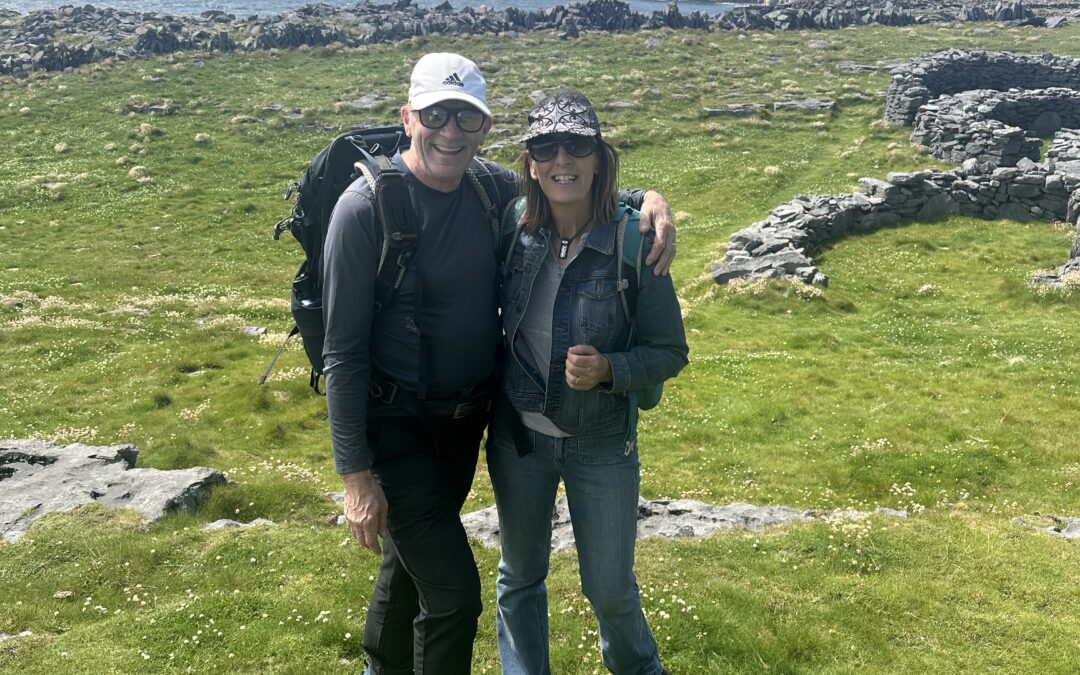
This trip, we had a great week on the island. We were busy the whole time - between walks, cycling, seeing the sights, and meeting people. Here is a little taste of the fun that we had.

Blowholes
We rented a couple of bikes. Cars are not usually allowed from the mainland. You see a lot of people on bikes on the island, especially when the weather is nice. The weather was not bad during our visit and we walked and cycled every day. Our first adventure was to visit blowholes. There are a few places on the island that have blowholes, and we went to the closest ones. These holes are formed by sea caves that have tunnels up to the surface, and when the sea is rough, they blow water up through the holes. We cycled to the beginning of a path next to the low road and walked down to the bottom of the beach. There was a sudden drop in the limestone at the edge of the shore, and a little further back, the holes were visible in the stone. Looking down into them, you could see the tidal water below them. Every time the waves came in, the water rose in the holes, and blew out through the holes and up into the air. There was a terrible noise to be heard – a crashing and throbbing that occurred between the limestone and the sea below. One can only imagine what it would be like in rough weather.

Dúchathair Fort

Another fine day, we cycled to the start of the path to Dún Dúchathair and walked the steep path up to the fort. Although this fort does not have a visitor centre, unlike Dún Aonghasa, it is just as impressive in some ways.

It is set high on the cliffs above the sea and has a beautiful expansive view along the coast. You can climb over the walls of the fort and enter the inner courtyard. The courtyard is surrounded by the fort on one side and by large cliffs on the other. Spend some time in Dún Dúchathair if you get the chance.

Aran Sheep: Aransheep.ie by Máirtín Ó Flaithearta

On the path to Dún Dúchathair, there is a sign outside a house: Aransheep.ie. We know the owner, Máirtín Ó Flaithearta and he made us very welcome. He showed us around his shop, which is also a museum, in reality. There was a lot to see and Máirtín had yarn from different breeds of sheep. There are Aran sweaters, blankets and caps on display, as well as a collection of different yarns. There are interesting maps and posters on the walls, showing all sorts of things about sheep, including the distribution of sheep in different parts of the world and different breeds of sheep. There is a big screen in the room and also plenty of chairs, for playing a video or giving a lecture. Máirtín is building another room, so that he has more space. We were there for over an hour, and we really enjoyed it. It is well worth a visit if you have the chance.

Midsummer's Eve

Midsummer's Eve is celebrated on July 23rd, a day when bonfires are lit on the island. It is a remnant of an ancient pagan festival, which used to be a midsummer celebration, associated with the fertility of the land and the worship of the sun. The fire is the heart of the celebration as it is a symbol of brightness. There were specific rituals associated with the celebration but I don't have the space here to discuss them.

Anyway, we visited Seán who had a bonfire lit, which he does year after year. People were coming and going all the time, and it was a great social event. There was a nice smell of peat from the fire, and the weather was reasonably good. Seán offered us drinks and snacks, and we had a nice chat.

There were more cars than usual driving around the High Road. As it turned out, the famous actor Patrick Duffy, the star of the TV series Dallas, was on the island, and according to the rumor he was in Bunghabhla. We didn’t stand idly by either. Curiosity got the better of us, and Seán drove us around the island looking at all the other fires. Quite by accident, we drove through Bunghabhla, but there was no sign or report of the star. But of course, it was a great evening, celebrating ancient traditions with the islanders, and searching for Patrick Duffy!

Conclusion

That’s just a small taste of what we did during our visit to the island. While the island itself is excellent in terms of natural beauty and archaeology, the people of the island are the heart of the place. If you get the chance, visit Árainn – you won’t regret it.


en_USEnglish