
Artificial Intelligence (AI) - We Have Only One Chance
Intleacht Shaorga (IS) – Níl againn ach Seans Amháin
AI is with us now.
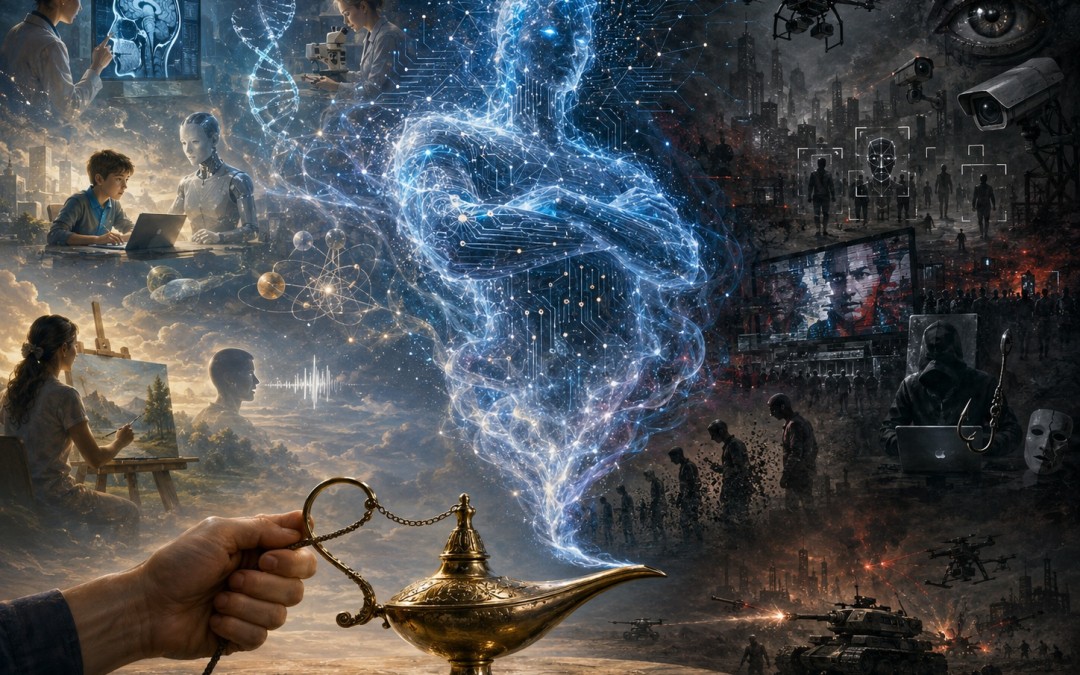
It is in hospitals, classrooms, banks, newsrooms, phones, cars, courts, weapons systems and children’s homework. It writes code, reads medical images, drafts letters, translates languages, creates images, summarizes reports and answers questions with expert confidence. AI is like the genie of the lamp: we give it a command and it does it.
AI can help detect diseases earlier, design new drugs and provide personal tutoring. It can help artists and writers, although it can also harm them.
There is a major problem, however. AI is being introduced into every part of society before we fully understand the dangers associated with it.
Geoffrey Hinton
Geoffrey Hinton is well worth listening to on this subject. He helped create AI. His pioneering work on neural networks and deep learning was an important step in the development of modern AI. He shared the Turing Award in 2018 and won the Nobel Prize in Physics in 2024.
For many years, Hinton worked on an idea that many people in computing had set aside. In the earlier forms of AI, people wrote code for the computer. Hinton believed there was a better way: to let the computer learn from examples and adjust its own behavior.
In the 1980s, artificial neural networks were not popular. They needed too much data and computing power. Despite that, Hinton continued the work on models such as the Boltzmann machine and helped develop the backpropagation algorithm, which allows neural networks to improve by correcting their own mistakes.
Finally, in 2012, the decisive turn came. AlexNet won the ImageNet challenge, a competition in which computers have to recognize images. AlexNet software, designed by Hinton’s students Alex Krizhevsky and Ilya Sutskever, was far ahead. It had an error rate of 15.3 percent, compared with 26.2 percent for the next competitor. That was the beginning of the deep learning revolution.
Hinton spent his life working on this kind of AI because he believed in it. It took a long time to develop, but he proved he was right. When he was 65, he took a job leading a Google AI research team in Toronto. When he left Google ten years later, having accomplished a great deal himself and with his team in the field of AI, he changed his mission.
“My life’s calling now,” he said, “is to warn people about the dangers of AI.” In his Nobel Prize banquet speech, Hinton said that AI could increase productivity in almost every industry. But he attached a condition to that: the benefits must be shared fairly in society. If that does not happen, AI can concentrate wealth in the hands of a few people, destroy jobs, spread propaganda and weaken democracy.
There are five main areas in his warnings.
Work and Dignity
If one worker with AI can do the work of ten people, what will happen to the other nine? The International Monetary Fund estimates that AI could affect almost 40 percent of jobs worldwide, and about 60 percent in developed countries. Hinton puts the human cost plainly: “For a lot of people, their dignity is tied up with their job.”
Without serious planning, AI could erode jobs and social roles. Every country must put a plan together to deal with those major changes and support people who might lose jobs because of AI. For example, employment schemes may need to be put in place, and everyone may need to receive a universal basic income in the future.
Truth
AI can create fake images, fake voices and fake videos. It is becoming harder to distinguish between truth and lies. That gives powerful propaganda tools to bad people and hostile governments that want to influence the public. Democracy cannot survive unless citizens can recognize the truth most of the time.
We need clear ways to distinguish between AI-generated content and content created by people. AI must be regulated, and clear protections must be put in place for our own sake.
Crime
A fraudster no longer needs good English to send a convincing email. AI can write it, translate it and give it a local flavor. A fraudster can make a phone call to grandparents with a voice clone and pretend to be a grandchild in trouble. Or a scammer can send people a fake invoice.
Fraud with the help of AI is already a profitable business. Banks, hospitals, schools and local authorities need stronger authentication. We should no longer trust a voice alone. And ordinary people must follow a simple rule: always confirm through another channel.
War and State Power
In his Nobel speech, Hinton warned about lethal weapons that decide autonomously who will be killed or injured. A machine should never make the final decision about killing a person. There is already serious concern that AI is being used to identify targets in wars.
Authoritarian governments can use AI to identify faces, track citizens, censor speech and intimidate opponents. In the hands of a dictator, it is a powerful tool for keeping the public under control.
International regulation and international treaties are needed. International law should prevent AI from making the final decision about the use of lethal force. Democratic governments should strictly limit AI surveillance and place restrictions on the export of that technology.
Artificial Intelligence in Charge?
This is Hinton’s deepest fear. Not only that bad people will use AI, but that AI systems themselves could develop goals and behavior that we cannot control, and that would not be in our interests.
In his Nobel speech, he put it plainly: “We have no idea whether we can stay in control.” Can we build AI systems that do not conflict with the interests of the human race? Can we make changes to correct them if necessary? Can we shut down an AI system if necessary? Can we force an AI system to tell the truth about what it knows and what it does not know? The answer to each of those questions must be yes. But we still do not have certain answers, and we have no clear protection against hostile AI.
No frontier AI system should be released at large scale without independent safety testing first. The most powerful models should be licensed and inspected, and they should be monitored. Companies should have legal responsibility for reckless deployment. Governments should also fund safety research in the public interest.
Conclusion
Some technologies can be corrected after the harm begins. A faulty bridge can be repaired. A dangerous drug can be withdrawn. A faulty car can be recalled from the market.
But we do not know whether we would be able to repair or withdraw an AI system if there were a problem with it. That is a very serious risk, because AI is woven into finance, war, infrastructure, energy, media and government.
The main danger is that we will lose control of AI. We must do everything we can to prevent that.
We have only one chance to get this right. That work must begin without further delay.


 English
  Gaeilge