Gníomhartha in ionad na Cainte – 2

Actions Instead of Words - 2


In the last article, we showed the gap between public demand for Irish-medium education and the State's response.

The Government needs a comprehensive revival plan, with clear targets that are measurable and time-bound, with proper funding, and with political consequences if those targets are not met. The current framework does not yet satisfy that test.

Legal Right to Irish-Medium Education

The State should have a legal duty to provide Irish-medium education where there is clear demand.

Currently, parents and local campaigners are forced to fight school by school, town by town, county by county. They must grapple with the Department of Education's arguments about population projections, funding constraints, and demographic formulas.

But it should be the State's responsibility in the first place, to provide the necessary resources to meet the demand for Irish-medium education across the country.

But it should be the State's responsibility in the first place, to provide the necessary resources to meet the demand for Irish-medium education across the country.

Targets

Under the National Plan for Irish Language Public Services, the State is working toward the target that 20 percent of new recruits in the public sector will be competent in Irish by December 31, 2030. The plan is designed to increase the number and quality of public services available through Irish.

As we stated in the last article, an educational target is needed as a foundation for that goal. Otherwise, where will the Irish-speaking civil servants come from?

The Government should set national targets for Irish-medium education at pre-schools, primary schools, secondary schools, and universities. Those targets should be measured, published, and submitted to the Oireachtas every year.

The Welsh Government's Cymraeg 2050 program includes targets for education through Welsh, including an interim milestone that 30 percent of children in Year 1 will be in Welsh-medium education by 2031. It also includes actions such as the Welsh Language and Education Bill, a 10-year plan to increase the number of teachers capable of teaching through Welsh, and supports for the use of Welsh between the school, the family, the community, and the workplace.

Cymraeg 2050 provides a practical template.

Priority for Teachers

No language revival succeeds without teachers being central to the process.

Ireland cannot expand Irish-medium education if schools cannot recruit qualified teachers with strong Irish. New Gaelcholáistí cannot be opened without Irish teachers. A proper system for the public service cannot be built if there are staff shortages in the education system itself.

Wales has a ten-year plan to develop enough teachers fluent in Welsh as part of Cymraeg 2050. Ireland needs a similar practical system.

That means scholarships for trainee Irish teachers. It means supporting Irish teachers to upskill. It means giving incentives to teachers in math, science, technology, and special education to teach through Irish. It means supporting teachers in Dublin and other expensive areas where housing issues make it much more difficult to recruit teachers.

The supply of teachers is the engine that will drive any language revival forward.

Continuity from Pre-school Onward

The Irish-medium process starts before primary school. It must continue through primary school, through secondary school, through third level, and into professional life.

That means more Naíonraí. More Gaelscoileanna. More Gaelcholáistí. More third-level courses through Irish. More supports for teachers, nurses, planners, Gardaí, civil servants, health workers, and social workers.

Canada's Action Plan 2023-2028 for Official Languages goes much further than education alone. It protects and promotes minority languages in the workplace and in the community, and supports the equality of the two official languages, French and English.

We should have a similarly comprehensive language plan, a plan that does not just relate to education, but that supports the use of Irish in the workplace, in public services, and in community life.

The Central Role of Local Authorities

Although the central government lays down national policies, it is at the local authority level that these policies succeed or fail.

County councils should have a duty to measure the demand for Irish-medium education in their areas. Every local authority should know where parents are seeking places for their children, where there are gaps in the education system, and where new workers will be needed to provide public services through Irish.

Responsibility in this area lies with the Department of Rural and Community Development and the Gaeltacht, supported by agencies such as Údarás na Gaeltachta and Foras na Gaeilge. But a stronger cross-Departmental mandate from the State is also required, along with a ring-fenced budget for the language revival, and the publication of an annual report on progress toward these targets.

A duty should also be placed on every public body to show how it will support education, recruitment, and services through Irish.

Political Pressure

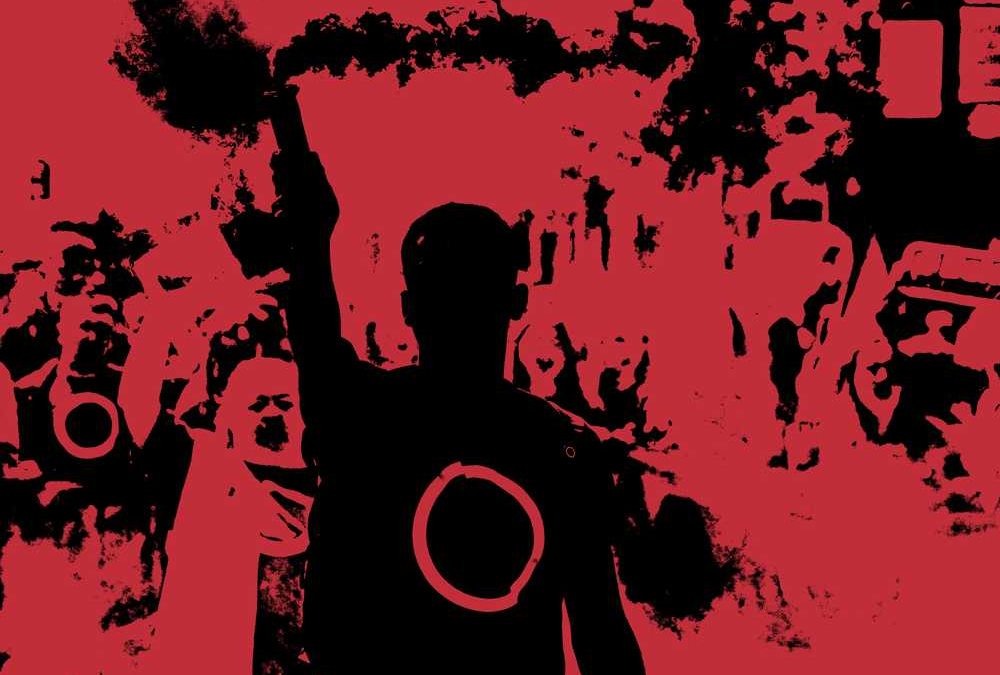
The Irish language movement already exists. Conradh na Gaeilge has more than 200 branches and describes itself as an all-island organization working on behalf of Irish speakers and Gaeltacht communities. An Dream Dearg has shown how a clear campaign based on language rights can bring the Irish language into the heart of the political debate.

In the North, An Dream Dearg helped turn language rights into a highly visible public campaign. It used clear demands, public mobilization, legal arguments, and political pressure. More than 12,000 people marched in Belfast in 2017 for an Irish Language Act. In 2022, more than 17,000 took part in An Lá Dearg after further delays in implementing Irish language legislation in the North.

The campaign did not get everything it was originally looking for, but it helped push real change forward. The Identity and Language (Northern Ireland) Act 2022 gave formal legal recognition to Irish in the North, created the role of the Irish Language Commissioner, and put important language protections into law. After many years of delay, the first Irish Language Commissioner was appointed in 2025.

Now, the same pressure is needed here regarding a complete revival plan for Irish: a legal right to Irish-medium education anywhere there is demand, strong national targets, proper funding for teacher training, more public services through Irish, supports in the workplace and the community, and the publication of an annual report.

Every candidate should be asked what their stance is regarding the Irish language. Every political party should be asked what its strategy is regarding the funding of the language. And every government should be judged by its actions, not by its speeches.

Ultimately, our votes should depend on those answers.

We know what needs to be done. Now it is time for us all to do it.
 

Gníomhartha in ionad na Cainte – 1

Actions Instead of Words - 1


On May 14, 2026, the Oireachtas Education Committee heard two different versions of the state of Irish-medium education in Ireland.

Minister for Education Hildegarde Naughton cited over €500 million spent on building projects for Irish-medium schools since 2020. She reaffirmed the Government’s commitment to expanding opportunities for children to receive an education through Irish.

Then, representatives from Conradh na Gaeilge, Gaeloideachas, An Foras Pátrúnachta, and the lobby group Imeasc spoke.

They described a system struggling with a continuous lack of supply, political reluctance, and official complacency.

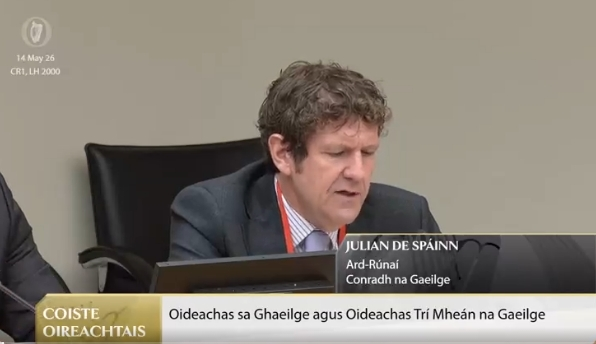
Julian de Spáinn - General Secretary of Conradh na Gaeilge, the national organization that promotes the Irish language - used words like “emergency,” “crisis,” “critical situation,” and “pretense” to describe the state of Irish in the education system. He said the Department or the Minister would never give such an honest description, even though the facts are clearly visible.

Lack of Schools

There are not enough Irish-medium schools in the country. It is a language crisis, because the government has never treated the problem as a matter of urgency.

This failure is even more obvious when compared to the Government's own commitments. The previous Programme for Government promised to attempt to double the number of young people in Irish-medium schools and to provide Gaelscoileanna and Gaelcholáistí anywhere there was significant demand. Conradh na Gaeilge told the committee that the number of students in Irish-medium schools outside the Gaeltacht fell from 48,518 in 2019/20 to 46,933 in 2023/24.

At primary level, the evidence has been visible for years. Gaelscoileanna are overcrowded in much of the country. Parents are on waiting lists because there are not enough places. According to Conradh na Gaeilge, only 6.7 percent of primary school pupils outside the Gaeltacht attend Irish-medium primary schools. At the second level, that figure is just 2.6 percent.

Conradh na Gaeilge cited independent surveys showing that 49 percent of people would choose an Irish-medium education if it were available in their own area. In another survey, 78 percent said every child should have the opportunity to get an Irish-medium education if that is their choice. Another 73 percent said every child who receives primary education through Irish should have the opportunity to continue it at the second level. But Irish-medium education is treated as a marginal sector, rather than being a core part of the country's educational infrastructure.

Unfortunately, the situation gets even worse at secondary school level.

Thousands of children finish their primary education through Irish with no Gaelcholáiste available to them. According to the figures put before the committee, around 3,000 students every year are effectively prevented from being able to continue their education through Irish due to a lack of appropriate supply at the second level. Thirteen counties are still without even one Irish-medium secondary school.

Lack of Planning

Despite this, the Department of Education has indicated that it has no plans to establish any new Irish-medium secondary school between 2026 and 2031 outside areas of demographic growth. This position contradicts the will of the public.

The broader system is failing too.

Conradh na Gaeilge told the committee that more than 60,000 secondary school students have exemptions from Irish. In 2025, 24 percent of Leaving Certificate students did not sit any Irish exam. That was the fourth consecutive year that more than one in five avoided Irish in the Leaving Cert. At Junior Cycle level, 20 percent of students did not take an Irish exam, even though almost everyone sat English, math, and history.

The contrast becomes even sharper when this situation is put in the context of the Official Languages (Amendment) Act 2021. Under that legislation, the State has a target that 20 percent of new public service recruits will be proficient in Irish by the year 2030. The legislation places stronger duties on the government regarding the provision of public services through Irish, especially in the Gaeltacht areas.

Teachers, nurses, Gardaí, and civil servants do not become fluent in Irish without a proper education system.

That process starts at the pre-school level. It continues through primary school and secondary school. It depends on opportunities at third level. A clear long-term plan is essential.

No such plan exists at present. Instead, many children have no access to Irish-medium education at all. And for many of those who do get that opportunity, it is lost halfway through their education.

At the third level, the same pattern continues. Important work is underway in institutions like University of Galway and Maynooth University, but education through Irish is still limited in a large number of professional disciplines.

On the one hand, the State has passed legislation to create civil servants with Irish. On the other hand, it has failed to provide the necessary educational supports to fulfill that duty.

Wales — a role model

Wales has a smaller population than Ireland, and furthermore, it is part of a (larger) state where English is dominant. But about a quarter of Welsh schools operate through Welsh, a much higher percentage than Irish-medium schools in Ireland.

More importantly still, the Welsh Government has adopted clear national targets linked to legislation, teacher recruitment, and long-term educational planning. Their goal is to increase education through Welsh from 23 percent to 40 percent by 2050. In 2022, the Welsh Government announced 23 new Welsh schools and an expansion of the language's use in 25 other schools as part of that approach.

Northern Ireland – Overcoming the Difficulties

Northern Ireland provides an even more striking comparison.

Irish-medium education operates there in a much more difficult political environment. There is still strong opposition from some unionist and loyalist politicians. The language is frequently dragged into broader culture wars.

Despite that, the number of students in Irish-medium education in Northern Ireland has been increasing steadily over the last twenty years. Even within a divided political system, legal duties have been placed on authorities to encourage and facilitate Irish-medium education.

If progress is possible there, despite those political difficulties, it is hard to accept our own government's excuses anymore.

For many years, governments have been quite happy to pay lip service to the plight of the language, without suiting their actions to their words.

Therefore, the citizens of the country must put real political pressure on the Government to implement the will of the public.

In the next article, we will examine the steps that are necessary now.


Daonáireamh 1926

1926 Census

When the 1926 Irish Census was put online recently, it opened up new possibilities for genealogical research.

My wife drew my attention to it after she saw the news. Since then, the two of us have spent many hours researching our family history.

For anyone with Irish roots, this is a treasure trove. The information is limited, but it is enough to give a glimpse of that time, and of the lives our ancestors lived.

The census was taken on April 18, 1926, under the administration of the Irish Free State. Unlike the 1901 and 1911 censuses, which covered all 32 counties, this one covered the 26 counties of the new State.

What makes it powerful is what you can do with it. The 1926 census acts as a bridge back to 1911. From there, you can go back to 1901, and then into Griffith’s Valuation—a mid-19th-century property tax record that serves as a vital substitute for missing census data from that era. After that, you can find further information in the birth, marriage, and death records available on IrishGenealogy.ie.

The Mayo Connection

In this article, I will focus on part of my own family line as an example of what can be done. There is much more still for me to explore.

I began with my father’s side. That was easier. My father was born in 1925, so there he was in the 1926 census, a nine-month-old baby. His older brothers and sisters were there too, along with my grandparents, all on a single handwritten page.

Seven of them were living in a two-room thatched cottage on 16 acres in Drumreagh, on the Mullet Peninsula in County Mayo. Later, when Sheila was born, there would be eight.

Using that information, I stepped back to 1911. There I found my great-grandfather, Michael Barrett, a widower, living in the same house with my grandfather and some of his adult siblings and a cousin. Going back again to 1901, he was there with his wife Julia and their nine children.

A Sad Story

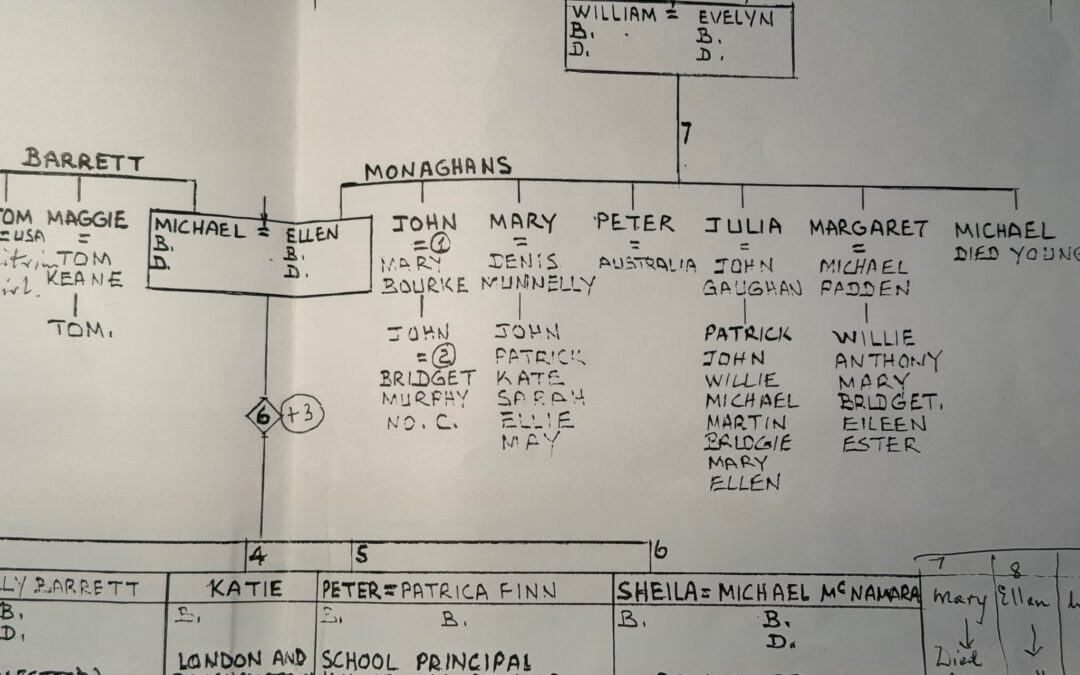
My father gave me a hand-drawn family tree some years ago, which he had put together with his brother John. Although not complete, it proved invaluable. It confirmed the research I was doing and gave me important clues for where to look next.

There was sadness in that family tree that was not immediately visible in the census records. My father’s records showed that three children in the previous generation—Ellen, Mary, and William—had died young. I found records online for two of them. Mary died at six days old. Ellen died at four months. I have not yet found William. It must have been devastating for the family to lose three out of nine children so young.

I searched the birth, marriage, and death records on IrishGenealogy.ie and was pleased to see that the civil records and census records matched. The civil records also provided new information. I discovered that my great-grandmother Ellen Monaghan’s father was named Richard Barrett. My father had written “Dick” in the relevant box on his family chart. Things were lining up again.

The Poet of Erris

My father told me that the connection back to the well-known Dick Barrett came through his mother’s side. Since my great-great-grandfather on my father’s mother’s side was named Richard Barrett, that strengthened the case.

Riocard (Dick) Bairéad was an Irish-language poet, satirist, and schoolteacher. He was involved with the United Irishmen and the 1798 Rebellion. He is best remembered as a poet. Among his works are “Eoghan Cóir” and “Preab san Ól.”

Another interesting name on my father’s chart was my great-great-grandfather, Éamon Barrett. I searched Griffith’s Valuation and found nothing under Éamon. Then I tried Edward Barrett.

There he was. On the same sixteen acres in Drumreagh. A tenant farmer. His landlord was Tobias Kirkwood. By 1901, it appears that Michael Barrett was no longer a tenant farmer but owned the land.

Heritage and Meaning

According to my father, Edward was the first Barrett to settle in Drumreagh as a tenant farmer. By 1901, eleven people were living in the same two-room thatched house. Seven in 1911. Seven again in 1926, including my father.

Life was hard in those days. In the mid-19th century, it must have been especially difficult for Edward Barrett and his family to survive. It is likely that he was farming that land during the time of the Great Famine. In June 1847, hundreds of starving people from Erris reached the workhouse in Ballina, only to be turned away because it was already full. People were living from hand to mouth, in conditions that are hard to imagine today.

I know from my father’s records that two of his uncles emigrated to Chicago in the 1910s. That is another line to follow later. There is a good chance I have relatives here in the United States.

When I look at all those names on the census pages, it strikes me that each one was a person, with a life and a story. Now, only the name remains on paper. Everything else is lost in the mist of time.

It is a sobering thought to see my uncle, my grandfather, and my great-grandfather there in the records, all sharing the same name as me—Michael Barrett. They give me context. They give me meaning.

I am sure many who read this are carrying out their own research using the 1926 census, tracing their families, and learning more about where they came from and how they lived.

I have only followed one line so far. There are many more to explore, and it will take time.

If you have not had the chance yet, I hope my story encourages you to explore your own family roots in the 1926 census.


Deis na Seamróige!

Shamrock Opportunity!

In a few weeks, the Taoiseach will stand in the East Room of the White House. The bowl of shamrock will be presented. Cameras will click and flash. The familiar annual words about friendship and historic ties will be heard.

But behind that ceremony, a more serious question lies hidden.

More than €20 billion in corporate tax was collected in Ireland last year, much of it from a small number of multinational companies headquartered in the United States. It is therefore natural for Taoiseach Micheál Martin to be cautious in conversation with President Trump, since no one can predict the response if tensions were to arise. What should the Taoiseach do — remain silent, or speak honestly about our views?

To navigate an international landscape that is becoming more uncertain by the minute, it is worth looking to Canada and its Prime Minister, Mark Carney.

Carney is known internationally as the former Governor of the Bank of Canada and later of the Bank of England. He earned respect for his steadiness during periods of financial turmoil. His credibility rests on action rather than words.

Carney’s grandparents were from County Mayo. He holds Irish citizenship and frequently speaks publicly about that rich heritage.

There are structural similarities between Canada and Ireland. Both countries are deeply economically integrated with the United States. Both rely heavily on open trade with it, and both are vulnerable when the tone or direction of American policy shifts. Recently, that risk has become more visible and more significant.

Carney’s response has been measured. At Davos earlier this year, he outlined what might be called a “middle-power strategy.” He did not attack the United States. Instead, he argued that smaller countries strengthen themselves through coordination and cooperation with one another.

That principle was evident recently in the case of Greenland. When President Trump renewed his interest in acquiring Greenland, a semi-autonomous territory of the Kingdom of Denmark, Denmark and the government of Greenland responded clearly: the territory was not for sale nor open for negotiation. European Union leaders expressed support for Denmark, and NATO partners reaffirmed their security commitments in the Arctic. The tariff threats associated with the dispute were withdrawn, and the matter did not escalate into a broader crisis.

The episode demonstrated the strength of allies when they stand together.

Canada will continue to trade and cooperate with the United States while at the same time expanding its economic and strategic options. That is risk management. Diversification reduces vulnerability.

In Ireland, a significant portion of corporate tax revenue depends on a small number of companies based in the United States. Pharmaceutical and technology exports to America make up a substantial part of our trade balance. If there were a sudden shift in Washington’s policy, Ireland’s economy would be hit harder than that of many larger EU countries with more diversified revenue bases.

Ireland can maintain and strengthen its economic relationship with the United States while at the same time expanding trade and investment links elsewhere — independently and through the European Union. A broader trade base reduces the risk associated with policy changes in any single capital.

That brings us back to St. Patrick’s Day.

Year after year, proposals are put forward calling for a boycott of the White House visit. But it would not be wise to take that advice. Ireland has symbolic access in Washington that countries of similar size do not enjoy. That access is a significant opportunity.

In my view, the question is not whether the Taoiseach should attend Washington. The real question is how Micheál Martin will use that opportunity on St. Patrick’s Day.

The Taoiseach can calmly and clearly express Ireland’s commitment to cooperation based on international rules and predictable trade. He can articulate his position without jeopardizing the partnership. That is consistent with Ireland’s diplomatic tradition and aligned with many of its European partners.

Carney’s emphasis on diversification is appropriate for a world that is more uncertain than before. He offers a practical approach — not only for Canada, but for countries like Ireland navigating this new world without a map. All that remains now for Micheál Martin is to seize the opportunity on St. Patrick’s Day.


Litir ó Mheiriceá –  Scéal Dochreidte Donna Hughes-Brown

Letter from America- The Unbelievable Story of Donna Hughes-Brown

Donna Hughes-Brown has been released from the Campbell County Detention Center in Kentucky, hundreds of miles from her family in Missouri, after spending five months in custody. Her crime? Two bad checks (worth $80 in total) that she wrote at a grocery store more than ten years ago and for which she had already paid restitution.

It is a great relief that this Irish grandmother is now free, after being caught in the net of immigration enforcement currently taking place in the United States (USA). Her husband, Jim Brown, says the policy has "completely devastated" their family and clearly demonstrates the cruelty of the US government.

Unexpected Problem in Chicago

The nightmare began in July 2025. Donna and her husband Jim Brown had travelled to Ireland to attend the funeral of Donna's aunt. It was a routine trip for Donna, who was born in England to Irish parents in 1966 and moved to the United States in 1977 at the age of 11.

Despite having a Green Card for nearly half a century and having travelled internationally many times without any problem, this time was different. According to Jim, Donna had no problem at US Customs Preclearance in Dublin. However, when she landed at O'Hare International Airport in Chicago, the couple was separated.

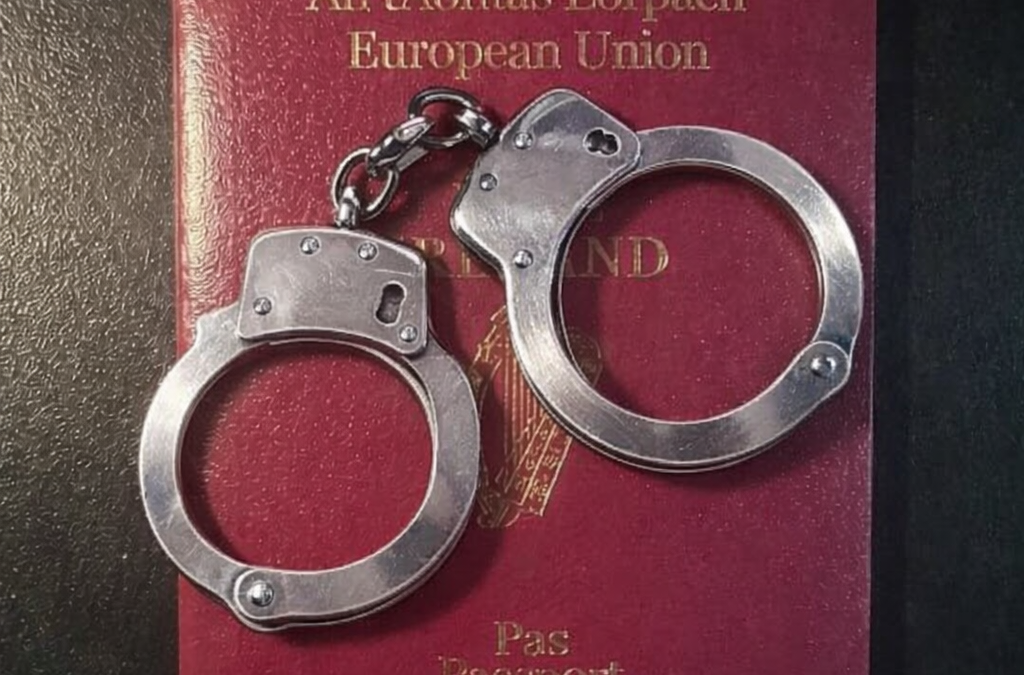
"She was given entry clearance in Dublin and was arrested anyway," Jim Brown said recently. He was told his wife only needed to sign some documents. Instead, she was handcuffed, detained by Immigration and Customs Enforcement (ICE), and imprisoned in Kentucky.

Trump signed the "One Big Beautiful Bill Act" on July 4, 2025. As part of that bill, the legislation of the Immigration and Nationality Act was amended, stating that the government can arrest people (who are not citizens) who violated any law in the past twenty years. The law came into effect on July 24, when Donna and Jim were already in Ireland.

"Crimes of Moral Turpitude"

Between 2012 and 2015, Donna was a single mother struggling and facing a serious financial crisis. She wrote two bad cheques at a local grocery store.

"They were for less than $80 combined," Jim Brown explained in testimony he gave at a Congressional hearing. "She was charged with a misdemeanor, paid the restitution, and completed one year of probation. That happened ten years ago." Under the new interpretation of immigration law, these misdemeanors are now being classified as "crimes of moral turpitude." On this basis, the government can strip Donna of her right of residency and deport her from the USA.

Important Campaign

Jim has been campaigning for months on behalf of his wife. He admits that he voted for Donald Trump because he believed Trump's promises that immigrants who were violent criminals would be arrested and deported. But he now believes the government is targeting people like his wife to meet deportation quotas.

"Look at the news, and the government isn't telling the truth about what is happening to many legal immigrants," Jim said. "The worst thing is that Trump is so disrespectful to people, so inflammatory and retaliatory, that people are afraid to say anything."

Confrontation in Washington

The case reached a tipping point in Washington, D.C., during a hearing on "Worldwide Threats to the Homeland." Jim Brown stood in the gallery while Democratic representatives placed strong pressure on Kristi Noem, DHS Secretary and a Trump ally, regarding the immorality of Donna being held without trial.

Representative Seth Magaziner of Rhode Island forced Noem to address the human cost of her department's policies. "He is a Navy combat veteran who served our country in the Gulf War," Magaziner said, referring to Jim. "He is married to a woman named Donna who came to our country legally when she was 11 years old... Because of you, Donna has been in prison for the last four months."

When Noem tried to avoid the question, saying she wasn’t responsible for which laws should be enforced, Magaziner pushed back, noting her broad discretion as Secretary to issue parole. Under the gaze of the committee and under the gaze of the distraught husband, Noem finally conceded: "I will review the case."

Pattern of Targeting

Donna's ordeal is not an isolated incident. There are striking similarities between her case and the case of another Irish person - Cliona Ward. Although she has a Green Card, Ward was arrested at San Francisco International Airport in April 2025 after a visit to Ireland, due to minor offenses that also go back almost 20 years. Although Ward was finally released in May, her detention indicated that this new aggressive enforcement strategy was beginning.

Home for Christmas

The story reached a happy conclusion at the critical court hearing on December 18. Despite fears that it would be delayed again, Donna was released from ICE custody.

Previously, Jim said: "Show me where it is written in the Bible that it is right to do something like this. It is wrong, period!" Now, after five months of hardship and uncertainty, Donna will be able to celebrate Christmas at home with her family in Missouri.

"She is one hundred percent innocent. She is in this country legally," Jim said. Now, finally, justice has been achieved for them.

Uachtarán na hÉireann Catherine Connolly  –	Teanga, Cultúr agus Cothromaíocht

President of Ireland Catherine Connolly - Language, Culture and Balance

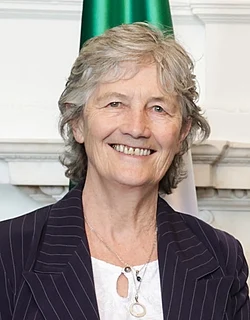
When Catherine Connolly was elected President of Ireland in October 2025, it was clear that a significant change was taking place in the political mood of the country, and that new values were being expressed through her victory. Connolly was the first woman ever to serve as Leas-Cheann Comhairle (Deputy Speaker) of the Dáil, and now she becomes the first independent President from Galway. She is a woman who places honesty and openness at the heart of her public life — especially regarding issues connected with the Irish language, Irish unity, the environment, neutrality, and social equality.

Biography and Roots

Catherine Connolly was born in Shantalla, Galway, where she was raised as one of fourteen children. She earned a Master’s degree in Clinical Psychology from the University of Leeds in 1981, before returning to the Claddagh in Galway, where she still lives with her husband Brian and their two adult sons. She later completed a Law degree at the University of Galway in 1989 and was called to the Bar in 1991. Her public life began in 1999 when she was elected to Galway City Council, and a few years later she became Mayor in 2004 — a period that deepened her awareness of Ireland’s cultural and linguistic identity. She was elected as an independent TD in 2016 and as Leas-Cheann Comhairle in 2020, confirming her as one of the most principled and fair-minded voices in Irish politics.

Return to the Irish Language

Connolly was not raised as a fluent Irish speaker. As she herself has said: “I only had the Irish I learned in school. I was embarrassed when I realised I couldn’t speak naturally with people in the Gaeltacht.” During her time as Mayor, after an event in Conamara where she found herself unable to say even a few words in Irish, she promised herself she would change that. She later completed a diploma course in Irish, and as she said afterwards: “I went back and learned it properly. And in the Dáil, from the very first day I was elected, I placed emphasis on Irish — as a living, vibrant language.” Gradually, Irish became a natural part of her daily life. She began using it in her speeches, interviews, and debates in the Dáil. She often reminds the public: “Irish is not a cultural ornament. It lies at the heart of who we are as a people.”

The Irish Language as a National Issue

Connolly’s election revealed how central the Irish language has become in political debate in Ireland today. Emer Higgins, a Fine Gael TD and Minister of State, said after the election that the government should “reflect on how central Irish was in the presidential race.” “I visited a school in Rathcoole,” Higgins said. “A pupil asked me, ‘Do you think Heather will lose because she doesn’t have Irish?’ Only one student in the class was fluent, yet every single one said it would matter to them if a presidential candidate spoke Irish.” For the first time in many years, Irish emerged as a major campaign theme across social media and news sites such as Tuairisc.ie and Extrag.ie. In an Irish Times poll, 3% of respondents said that “a person who speaks Irish” was the most important quality for a presidential candidate. While not a large number, it signaled a growing awareness of the language’s importance in political life. At the start of her campaign, Connolly herself stated: “It is essential that the President has Irish — not as a legal requirement, but as an expression of who we are as a nation.”

From Galway to Áras an Uachtaráin

Connolly’s roots run deep in Galway, a city where art, science, and community spirit meet. Before entering national politics, she worked as a barrister and city councillor and later as Mayor, known for her integrity and independence of mind. In the 2020 general election, she won a seat as an Independent TD for Galway West, and a few months later surprised many when she was elected Leas-Cheann Comhairle with 77 votes to the Government candidate’s 74. “I went for it,” she said, “because I couldn’t demand gender equality and then fail to act on it myself.”

Culture and Identity

For Connolly, language and culture are inseparable. As President, she is expected to emphasise the links between art, education, and language — “the three pillars of human society,” as she calls them. She believes Irish should not be left confined to classrooms or translation desks but returned to the heart of public life. “It is a living, central language. It is not a dead one,” she has said.

The Environment and Natural Balance

Connolly is also a passionate advocate for the environment. She believes it is not merely a technical matter but a moral one. “If we protect the land and the sea, we are protecting our heritage.”

Neutrality and Human Rights

Throughout her career, Connolly has consistently defended Ireland’s neutrality. “Neutrality is not the absence of action,” she said, “but an active commitment to peace.”

Reconciliation and Irish Unity

“We must create spaces where people can feel comfortable with their identity,” she says. “That is the beginning of reconciliation.”

Conclusion

It is a great honour to have Catherine Connolly as our President. She is an Irishwoman through and through, who will represent us with dignity on the national and international stage. At home, she will promote our language and culture. Abroad, she will stand against war, for human rights, and for our neutrality. In her own words: “Irish came back to me through patience, love, and daily use. Anyone can do the same.”

en_USEnglish