1926 Census
When the 1926 Irish Census was put online recently, it opened up new possibilities for genealogical research.
My wife drew my attention to it after she saw the news. Since then, the two of us have spent many hours researching our family history.
For anyone with Irish roots, this is a treasure trove. The information is limited, but it is enough to give a glimpse of that time, and of the lives our ancestors lived.
The census was taken on April 18, 1926, under the administration of the Irish Free State. Unlike the 1901 and 1911 censuses, which covered all 32 counties, this one covered the 26 counties of the new State.
What makes it powerful is what you can do with it. The 1926 census acts as a bridge back to 1911. From there, you can go back to 1901, and then into Griffith’s Valuation—a mid-19th-century property tax record that serves as a vital substitute for missing census data from that era. After that, you can find further information in the birth, marriage, and death records available on IrishGenealogy.ie.
The Mayo Connection
In this article, I will focus on part of my own family line as an example of what can be done. There is much more still for me to explore.
I began with my father’s side. That was easier. My father was born in 1925, so there he was in the 1926 census, a nine-month-old baby. His older brothers and sisters were there too, along with my grandparents, all on a single handwritten page.
Seven of them were living in a two-room thatched cottage on 16 acres in Drumreagh, on the Mullet Peninsula in County Mayo. Later, when Sheila was born, there would be eight.
Using that information, I stepped back to 1911. There I found my great-grandfather, Michael Barrett, a widower, living in the same house with my grandfather and some of his adult siblings and a cousin. Going back again to 1901, he was there with his wife Julia and their nine children.
A Sad Story
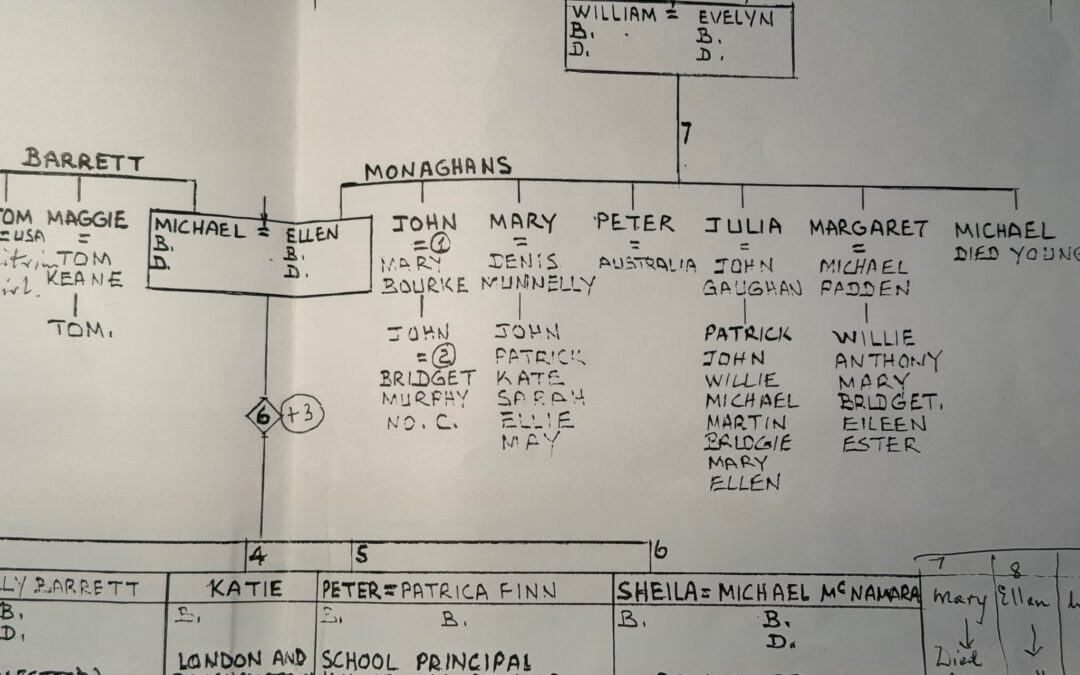
My father gave me a hand-drawn family tree some years ago, which he had put together with his brother John. Although not complete, it proved invaluable. It confirmed the research I was doing and gave me important clues for where to look next.
There was sadness in that family tree that was not immediately visible in the census records. My father’s records showed that three children in the previous generation—Ellen, Mary, and William—had died young. I found records online for two of them. Mary died at six days old. Ellen died at four months. I have not yet found William. It must have been devastating for the family to lose three out of nine children so young.
I searched the birth, marriage, and death records on IrishGenealogy.ie and was pleased to see that the civil records and census records matched. The civil records also provided new information. I discovered that my great-grandmother Ellen Monaghan’s father was named Richard Barrett. My father had written “Dick” in the relevant box on his family chart. Things were lining up again.
The Poet of Erris
My father told me that the connection back to the well-known Dick Barrett came through his mother’s side. Since my great-great-grandfather on my father’s mother’s side was named Richard Barrett, that strengthened the case.
Riocard (Dick) Bairéad was an Irish-language poet, satirist, and schoolteacher. He was involved with the United Irishmen and the 1798 Rebellion. He is best remembered as a poet. Among his works are “Eoghan Cóir” and “Preab san Ól.”
Another interesting name on my father’s chart was my great-great-grandfather, Éamon Barrett. I searched Griffith’s Valuation and found nothing under Éamon. Then I tried Edward Barrett.
There he was. On the same sixteen acres in Drumreagh. A tenant farmer. His landlord was Tobias Kirkwood. By 1901, it appears that Michael Barrett was no longer a tenant farmer but owned the land.
Heritage and Meaning
According to my father, Edward was the first Barrett to settle in Drumreagh as a tenant farmer. By 1901, eleven people were living in the same two-room thatched house. Seven in 1911. Seven again in 1926, including my father.
Life was hard in those days. In the mid-19th century, it must have been especially difficult for Edward Barrett and his family to survive. It is likely that he was farming that land during the time of the Great Famine. In June 1847, hundreds of starving people from Erris reached the workhouse in Ballina, only to be turned away because it was already full. People were living from hand to mouth, in conditions that are hard to imagine today.
I know from my father’s records that two of his uncles emigrated to Chicago in the 1910s. That is another line to follow later. There is a good chance I have relatives here in the United States.
When I look at all those names on the census pages, it strikes me that each one was a person, with a life and a story. Now, only the name remains on paper. Everything else is lost in the mist of time.
It is a sobering thought to see my uncle, my grandfather, and my great-grandfather there in the records, all sharing the same name as me—Michael Barrett. They give me context. They give me meaning.
I am sure many who read this are carrying out their own research using the 1926 census, tracing their families, and learning more about where they came from and how they lived.
I have only followed one line so far. There are many more to explore, and it will take time.
If you have not had the chance yet, I hope my story encourages you to explore your own family roots in the 1926 census.


 English
  Gaeilge