Ceist na nDíolúintí!

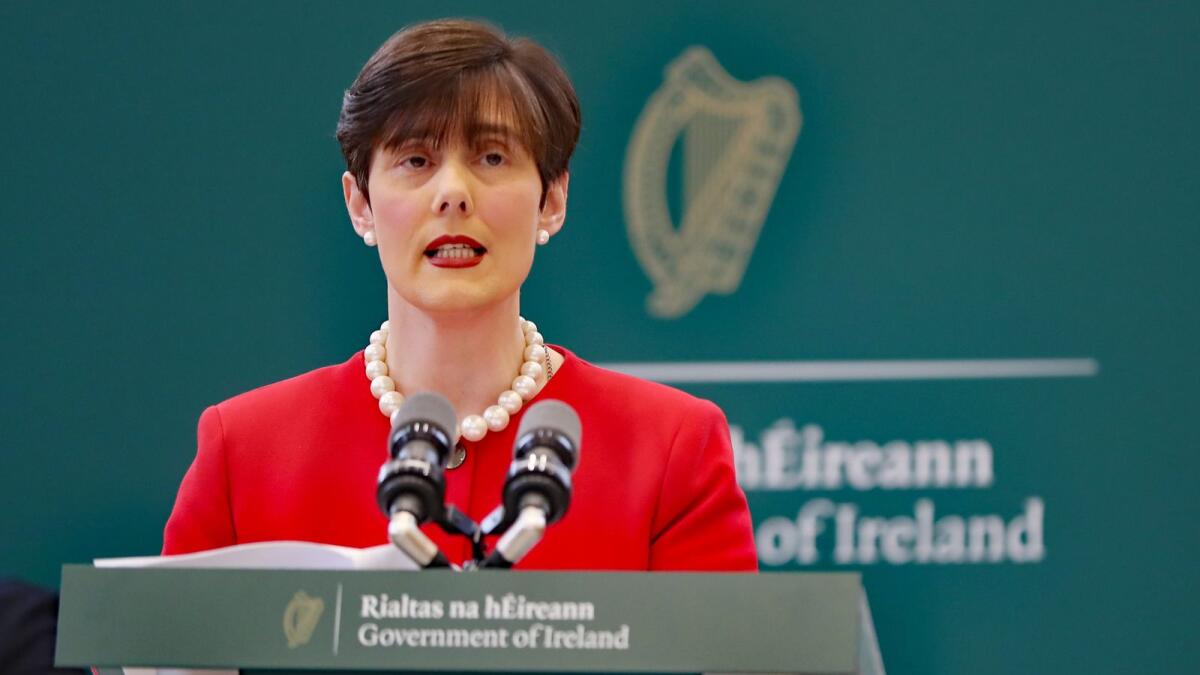
The question of exemptions!

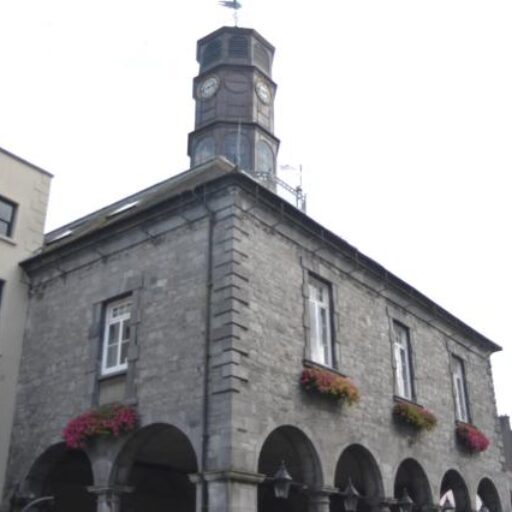
I was in the Castle gardens the other day; stretched out completely from head to tail, relaxed and peacefully drinking in golden sun, when I heard the sharp, ear-splitting whistle, a whistle that woke me up from my sleep suddenly! But I realized in an instant who was to me, as who else but my old friend, Séimí an Droichid, would do the likes inside the heavenly gardens of the Castle. I welcomed him, and made a place for him beside me on the garden bench.

“Sit there beside me on this bench” I said to him, politely.

“Thank you very much,” he said, “and isn’t this a wonderful place you chose to meditate?”

“You said it my friend, but do you have any news on this blessed day?”

“I only have the story that is on the lips of every Irish speaker these days.”

“And what is his story?” I said, trying to provide a story telling opportunity to mad Séimí, as it seemed to me that he had some story to tell.

The Language Question

“You have probably noticed that a series of meetings of the Irish Joint Committee on the exemptions system is currently taking place?” said Séimí.

“I didn’t! Is there a big problem with our current system of exemptions, Séimí?” I wanted to develop an understanding on this topic.

“A very big problem, and if things continue like this, we won’t have a living language before long. There have been those unsupportive of the status of our language for a long time. There was a movement against the Irish language called “Language Freedom Movement” in the nineteen sixties, for example. The result of their campaign was the abolition of the requirement for civil servants to speak Irish since 1974. As a result, there were only 16 employees to deal with the Irish-speaking community in 2018 – a disgrace!”

“But,” I said, “the main goal of the Languages ​​Act 2021 is for 20% of new public service recruits to be competent in Irish before the end of 2030. Isn’t that a good thing?” I asked Séimí this question, seeking an antidote to his negative attitude towards the language.

Three steps back…

“Three steps back, and then only one step forward!” answered Séimí. “And these exemptions are just another step backwards. Initially, these exemptions were for exceptional cases – for pupils with special needs. But after a while, those rules were relaxed, and now quite a few parents are taking advantage of the flexibility of the rules, in order to get an exemption for their children – children who would not have a problem learning Irish, because more than half of them are learning other languages ​​without any question of exemption.”

“But maybe with the right management a scheme like this would work, wouldn’t it?” I said, asking Séimí the probing question.

“Whatever the Department of Education is doing, the scheme is not working well at all. And I’m not alone in that thought. Declan Glynn, assistant general secretary of the Teachers’ Union of Ireland (TUI), said that the system currently in place is “flawed and unsatisfactory”, and that it is now so easy to get an exemption that anyone would be forgiven for thinking it was mainly an automatic process.

Other representatives attending the meetings agreed with the opinion that there should be a curriculum for all students at whatever level of ability they are at and questioned the right to use ‘stress’ or ‘specific language learning disability’ as an excuse to demand an exemption. They are right, in my opinion, Michael, and this problem needs to be solved soon.”

“Well, Sam, I have to agree with you, because it’s clear you’ve done your homework well on the subject, and I didn’t have my eyes on that ball at all. Thanks for being patient with me, and I hope our government will do the right thing and put much stricter rules in place!”

“Me too! Nice to meet you in this wonderful place, Michael, as we discuss important matters together in Irish!

With that, Séimí left without delay, and I was left to my own devices with a new topic to with important matters for my consideration!
.

.

.

.

.

.

.

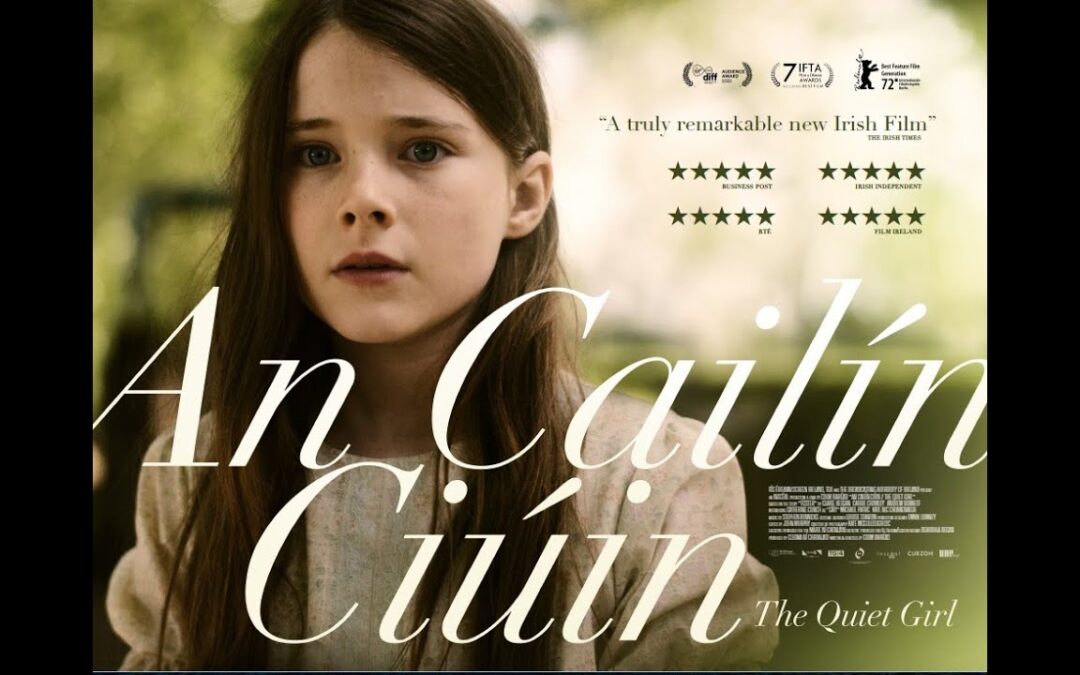
Léirmheas: An Cailín Ciúin!

Review: An Cailín Ciúin

When I was attending Coláiste na Rinne in the summer, I had the opportunity to see the Irish film ‘An Cailín Ciúin’ at the Movies@Dungarvan cinema in Dúngarbhán. It’s a great film, and it’s no wonder it’s won a lot of awards so far, with maybe a few more to come!

‘An Cailín Ciúin’ was the first Irish language film to win the Irish Academy Award (IFTA) for best film. It received a total of 7 IFTAs. It also broke box office records in Ireland and Great Britain, earning around one million Euros to date, more than four times more than any other Irish language film ever.

.

Colm Barrett creates a beautiful film

This film is a wonderful adaptation of the novel ‘Foster’ by Claire Keegan, and this lonely story is brought to life on the big screen in beautiful ways. Director/writer Colm and his team had to recreate rural life in Ireland in the nineteen eighties, and they did so effectively, down to the smallest detail like Bunny Carr on TV producing the show Quicksilver’ (hence the popular expression in Ireland: ‘Stop the lights!’). The use of Irish greatly adds to the atmosphere and authenticity of the film, without a doubt, and shows us that we are able to express things in Irish that cannot be done in the same way in English.

Selection of Actors

Catherine Clinch (twelve years old)’is remarkable in her first screen role as Cáit (nine years old). It’s a very difficult role, because this quiet girl doesn’t have much to say, and she has to use a wide range of facial expressions to tell the story. Despite how young Catherine is and that this is her first role, she demonstrates masterful acting.

Catherine’s family is struggling, surviving from hand to mouth. Worse than that, her father (Micheál Patric) is an alcoholic bully and her mother (Cáit Nic Cononaigh) is overwhelmed with family duties, and is now pregnant again. Cáit and Micheál do a good job as the dysfunctional parents in the film.

They put their daughter in the care of her mother’s cousin, Eibhlín (Carrie Crowley) and her husband, a quiet farmer, Seán (Andrew Bennett), in County Waterford. This is where most of the action in the film takes place, and Eibhlín and Andrew are great as foster parents, providing an exciting and nurturing environment for Cáit for the first time.

.

An Plota

The Quiet Girl is set in 1981 in rural Ireland. Cáit is a girl who keeps her emotions suppressed, because her parents don’t care for her or love her, because they are too busy with their own problems. They are barely able to put food on the table, and as a result, they make the decision to leave Cáit with foster parents for the summer. At first Cáit locks her feelings deeper inside, but soon she develops and blossoms with her new family.

Cáit is not the only one who needs some time to adjust to the new lifestyle. Eibhlín and Seán handle it in different ways. Ebhlín welcomes Cáit in with open arms, and she feels immense sympathy for the young girl. But Seán shows a coldness to her at first, and it takes time for him to accept her into his heart. Eibhlín and Seán also have a big secret, but I won’t reveal it here – you have to see the film!

But as a result, Cáit and her foster parents have things to learn from each other as they rediscover what love means.

.

Conclusion

Every frame in this truly magical film is a work of art. Kate McCullough did the cinematography for the film. She also did the cinematography on the TV series ‘Normal People’. She draws a stark contrast between Cáit’s family home (dark, gloomy) and her foster family home (bright, clean) to emphasize the plot itself. Together with a wonderful score from Stephen Rennicks, everything came together strongly so that Colm Barréad was able to overlay the story on that framework. I would give this worth-while, special film five out of five stars. If you haven’t already done so, I would recommend you go see ‘The Silent Girl”.

.

.

An tUathlathas i gcoinne an Daonlathais!

Autocracy versus Democracy

Recently, the President of the Commission of the European Union, Ursula von der Leyen, gave her annual address on the State of the Union 2022. It is amazing that this speech was available in Irish simultaneously with the original version. It is available online here: https://ec.europa.eu/commission/presscorner/detail/en/speech_22_5493.

I encourage you to read it! Here are my five highlights from her speech!

The courage to stand up to our heroes

Early in the speech, von der Leyen bluntly said: “This is not just a war that Russia is waging against Ukraine. It is a war against our energy, against our economy, against our values ​​and against our future. Autocracy versus democracy. As I stand here, it is my strong opinion that Putin will fail and Europe will have the day, thanks to our courage and solidarity.”

She then praised the people of Ukraine: “Today we have a unique example of courage, and that example is Ukraine.” And she emphasized the relationship between Ukraine and the EU: “Ukraine is a long-lasting legacy, a country full of European heroes. Slava Ukraini! The solidarity between Europe and Ukraine will remain forever.”

We need to get rid of the dependency

The dependency in question here is dependence on fossil fuels from Russia.

“As a result,” said von der Leyen, “gas prices are 10 times higher than they were before the pandemic. Millions of businesses and millions of families are struggling to make ends meet. That is why we are promoting measures for Member States to reduce their overall electricity consumption.” Then, the President laid down plans to control electricity prices.

Preparing for the energy future

Von der Leyen said that there was a lot going on in Europe in terms of offshore wind energy (in the North and Baltic Seas), new design solar panels (in Sicily), and especially in terms of trains using green hydrogen as fuel. According to her, hydrogen can fundamentally change the European market. This is what she said: “We need to make hydrogen a big market rather than a niche market. For that reason I can announce today that we are going to set up a new European Hydrogen Bank. The Bank will be able to invest €3 billion to develop the future hydrogen market.”

It will be very interesting to see how this venture turns out.

How to stand up for our Democracy

von der Leyen promised to tackle the threats from within with a Defense of Democracy package. “We will not allow the Trojan horses of any autocracy to attack our democracies from within,” the President asserted.

As everyone knows, the Union has struggled to address democratic backsliding in several Member States, notably Poland and Hungary.

Although the President did not mention any member states in particular, she said that payments under the common EU budget will continue to be linked to judicial independence and the rule of law.

Rethinking our foreign policy

“This is the time to invest in the power of our democracy,” said von der Leyen. This effort, she said, should start in the immediate vicinity of the block. “I want the people of the Western Balkans, Ukraine, Moldova and Georgia to know: you are part of our family, you are the future of our union, and our union is not complete without you,” she declared.

von der Leyen threw her support behind the idea of ​​establishing a European Political Community, an initiative proposed by French President Emmanuel Macron.

“Since we are serious about a larger union, we must be serious about reform,” she said.

“Therefore, as this Parliament has requested, I believe the time has come for a European Convention.”

Conclusion

von der Leyen put a lot of meat on the bones of the plans for the future of the Union. Her speech was a vision statement and if her vision is realized, the European Union will be more independent, more powerful and more dominant on the world stage than ever before. A new balance of power would be in place in Europe and the world, and with it there would be a better chance that our democratic system will flourish for a long time.

Long live the EU!

.

Praiseach Déanta ag Aer Lingus

Mess made by Aer Lingus

Two weeks before our flights back to the United States, United Airlines sent me an e-mail saying that they had made a change to the reservation. They changed our first flight (on Aer Lingus) from noon to 6:00 A.M., so that we would have seven hours in Heathrow before the second flight. Damn it – could they make a change like that without my permission? Seriously!

I called United Airlines, and an agent came on the line quickly. She was helpful, and made another reservation for us with no issue – the first flight to Chicago (on United) at noon, and an hour later the second flight (on United) to Los Angeles. We preferred the new arrangements, for two reasons. In the first place, we would avoid Heathrow airport. Second, our luggage would have a better chance of arrival with only one airline (United) involved.

We and our luggage reached our destination without a problem, and we were happy with United Airlines because, although we had a small problem at first, they quickly put everything right for us.

Liveline

A few days later, I was listening to Joe Duffy’s ‘Liveline’, and I was stunned when I heard about up to 9,000 passengers across Europe stranded by Aer Lingus!

The callers said Aer Lingus was nowhere to be found, to help them in their time of need. RTE itself was unable to get an Aer Lingus spokesperson as a special guest on the programme. There were a few shocking stories to hear on ‘Liveline’.

Emmett’s story

Emmet and his wife were all set to go to America on their honeymoon. They were going to fly to Heathrow first, and then from Heathrow to Miami. They had booked a cruise for the subsequent day.

They checked in without any problem, went through security and then on to the gate. At 10 A.M., a quarter of an hour before their departure time, Aer Lingus informed passengers that they were experiencing an IT( information technology) problem. Emmet heard nothing more until 4 P.M. when Aer Lingus announced that their flight had been cancelled. As a result, they missed not only their flight from Heathrow to Miami, but also their cruise. The couple had spent almost €5,000 on their travel arrangements, and were now out of pocket because of it, with no information about a refund.

The couple believe that Aer Lingus was responsible for the money they had paid, as they were the cause of the problem in the first place.

Michelle’s story

Michelle didn’t hear anything from the airline, but when she saw on social media that there were major problems with Aer Lingus flights, she immediately knew she was in trouble. Then she contacted her family and friends. When she found out that there were only three flights a week leaving Corfu, where she was staying, she knew she would have to act quickly to get home as soon as possible.

She had to book new flights with Eurowings, in order to avoid staying in Corfu for three additional days. She had to spend €850 on two tickets on Eurowings. Even when they arrived at Dublin airport, the airport was a complete mess. They were waiting almost half an hour in the plane for the boarding stairs to arrive. Then they had to sit around waiting for their luggage, as there were no baggage handlers available. The terminal was crowded with people and luggage. But they were happy and relieved to be back in Dublin.

Excuse?

Aer Lingus has finally apologized to customers who were affected when 51 flights were canceled on the weekend of 10-9-2022. A spokesman for the airline said: “We sincerely apologize to customers for the major disruption caused by problems with our computer system. Those problems have been resolved and our normal schedule is back in place”.

The airline also said that affected customers will be able to change their travel plans for free.

I hope that Aer Lingus has learned a lesson, and will be in touch with their customers to help them whenever something like this happens in the future. If Aer Lingus ignores their customers like that again, they will lose them forever!

.

Todhchaí na Gaeilge

Todhchaí na Gaeilge

Deirtear go bhfuil thart ar 7,000 teanga á labhairt ag daoine, ó cheann ceann na cruinne, ach má tá féin, deir na saineolaithe linn go gcailltear ceann de na teangacha sin gach coicís. Anois, ó tharla nach gcumtar teangacha nua, ach go hannamh, tá sé soiléir go bhfuil uimhir na dteangacha ag dul i laghad ó bhliain go bliain. Cén fáth a gcailltear na teangacha sin? Bhuel, iompaíonn pobal ó theanga amháin go teanga eile ar chúiseanna áirithe.

Concas

 Uaireanta cuireann tír amháin isteach ar thír eile trína gabháil agus a chur faoi chois, agus is é an bealach is éifeachtaí le tír a smachtú nó a teanga a bhaint di, agus teanga an ghabhálaí a chur á labhairt ina háit. Nuair a chailleann tír a teanga, cailleann sí a córas smaointe agus a bealach le breathnú ar an saol mór amuigh. Cailleann sí freisin, a misneach agus a spiorad, nó faoi mar a deireadh siad fadó: Tír gan teanga, tír gan anam!

Dul chun cinn!

 Uaireanta eile, tar éis blianta fada a bheith caite ag tír faoi sháil agus faoi bhráca lucht concais, is amhlaidh a thuigtear do phobal na tíre sin, go bhféadfaidís dul chun cinn níos mó a dhéanamh trí theanga eile, teanga a máistrí, a úsáid feasta, nó tuigtear dóibh, go bhfuil a dteanga féin as dáta, agus iargúlta. “Ní líonfaidh do theanga dhúchais do bholg”, a chloisfeá ó dhaoine dá leithéid, fadó.

An Teanga nach bhfuil láidir….

 Níl dabht ar bith, ach oiread, ach go mbíonn tionchar nach beag ag na teangacha móra idirnáisiúnta ar chúlú na dteangacha laga. Níl le déanamh againn ach breathnú timpeall orainn, agus tabharfaidh muid faoi deara, go mbíonn tionchar an-mhór ag na teangacha ar nós an Bhéarla, na Fraincise, na Gearmáinise, na Spáinnise agus na hIodáilise, i gComhairle an Aontais Eorpaigh, agus cé go n-aithnítear mionteangacha áirithe freisin – an Ghaeilge, mar shampla – tugtar le fios nach bhfuil iontu ach mionteangacha. Le himeacht na mblianta, tá sé soiléir, go dtiocfaidh laghdú ar uimhir na dteangacha labhartha, má leantar den chleachtadh sin. Más uainn iad a shábháil, caithfear úsáid a bhaint as cumas nua-aoiseach cumarsáide, chun fóram poiblí a thabhairt dá bpobal a mionteanga a úsáid ar líne.

AthEarrach

Is féidir le gach duine a fheiceáil, go bhfuil neart nua le tabhairt faoi deara i gcúrsaí na Gaeilge faoi láthair, agus cuid mhaith dá bhuíochas sin ag dul do Chóras na nGaelscoileanna. Ba iad na tuismitheoirí féin a chuir tús leis an gCóras sin, nó chonacthas dóibh nach dtiocfadh an Ghaeilge slán mura ndéanfadh siadsan a ndícheall le scoileanna lánGhaeilge a bhunú, le deis a thabhairt dá bpáistí, an teanga a shealbhú agus a fhoghlaim go nádúrtha, trína labhairt. D’éirigh go seoigh leis an bhfiontar sin, agus anois, dá bharr, tá Meánscoileanna lánGhaeilge againn le hobair na nGaelscoileanna a tharraingt isteach sa Chóras Meánoideachais, agus cheana féin, tá éileamh ar oideachas iomlán Ollscoile a chur ar fáil trí Ghaeilge.  Seans maith go mbeidh a leithéid ar fáil roimh i bhfad, agus ansin beidh sprioc thábhachtach eile bainte amach againn.

Ar an dea-uair, agus b’fhéidir de bharr na nGaelscoileanna, tá go leor daoine óga go láidir ar son na Gaeilge mar theanga bheo – mar a dteanga bheo. Agus tá cuid acu ag obair go dian mar ambasadóirí na teanga. Toghadh Paula Melvin, 29 bliain d’aois, mar Uachtarán ar Chonradh na Gaeilge, agus beidh tionchar mór aici maidir le cúrsaí na teanga ar go leor daoine, ach go háirithe ar dhaoine óga agus dhaoine thar lear (bhí sí ina bainisteoir gradaim le Coimisiún Fulbright maidir leis an nGaeilge).  

Tá an Ghaeilge feiceálach go maith ar líne freisin – ar na meáin shóisialta, san áireamh. Tá gach saghas rang ar fáil ar líne (ó leibhéal oiriúnach do thosaitheoirí suas go Gaeilgeoirí inniúla).  Tá go leor ar fáil as Gaeilge ar Facebook, Twitter, Instagram agus YouTube freisin (cuir isteach #Gaeilge mar théarma cuardach in aon cheann agus tiocfaidh go leor torthaí ar ais chugat!)  Tá pop-up Gaeltachtaí agus ciorcail comhrá á n-eagrú ag daoine freisin, idir imeachtaí ar líne (ar Zoom, mar shampla) agus imeachtaí in ionaid éagsúla fisiciúla (siopa caife, bialann, teach tábhairne agus araile).

Tá cúrsaí ealaíne ag déanamh dul chun cinn seasta freisin – litríocht, ceol, scannánaíocht san áireamh. Níl spás agam inniu plé a dhéanamh ar an ábhar seo, ach mar shampla beag amháin, tá go leor gradaim buaite ag scannáin as Gaeilge ar nós “An Cailín Ciúin” agus “Arracht”.

Conclusion

Gan dabht, táimid ar an mbóthar ceart, agus má leanaimid ar aghaidh le fuinneamh agus diongbháilteacht, fíorófar ár bhfís agus ní chaillfear ár dteanga. Nára fada uainn an lá sin!

en_USEnglish