
Trioblóid ar Neamh!

Trouble in Heaven!

A long time ago, when my father had just retired from his job at Kieran’s College, my parents came to visit us here in California, for three weeks. We drove along the coast, from Los Angeles to San Francisco, and through many places along the way. Both of them were surprised because what they saw in California did not match their preconceptions. We were all impressed by the beauty and diversity of the landscapes that could be seen throughout the length of the State. My parents were also surprised at how friendly and well-mannered all the people we met were. They don't complain about the Mediterranean climate, either.

While their trip got rid of most of their worries about where we were staying, it also gave them a few new worries, or at least a few questions.

Homeless People

When we were walking in the heart of Los Angeles, we had to walk on the road sometimes, because there were homeless people lying on the sidewalk. We couldn't not see them. When we were safe and sound at home again, drinking a cup of tea, my mother asked me: “Why are there homeless people here? It makes no sense. Ours is not a rich country, but you wouldn't find many homeless people there. What's going on?" "There are no strong social policies in America," was my reply, "unlike in Ireland! And housing prices are also very high in this country, so it's hard to buy a house!” But I had to admit that it was a strange thing!

Poverty and Immigration

Another time, we crossed the international border into Tijuana in Mexico. Mexico was and still is, a very poor country. Rubbish was everywhere, and many half-finished buildings could be seen. There were only a few paved roads to be seen, and it was mostly dirt roads. All you saw on the road was an old jumble of cars and trucks falling apart. There weren't many shops or restaurants in the city, either. My parents were stunned. They thought they themselves grew up in a poor country, but after seeing the poverty of Tijuana, they realized that they were never as poor as people in third world countries. When my mother noticed how easy it was for us to come back across the border to America, when it was very difficult for Mexican citizens to do the same, she asked me another question. “Those poor people are in dire need of help. Why wouldn't the richest country help the people of the neighboring country ?" Her question stuck with me, because there was a complicated subject to discuss - immigration control. I said that I didn't know much about immigration policy in the United States, but that it was a difficult process to enter the country legally, and it was expensive to do it. The American officials were concerned about letting any Mexicans into the country, for fear that they would stay there illegally, and millions of people were already living in America without permission.

Health Care

Another time, when we were talking together at lunch, the topic of health care came up. My parents couldn't believe how expensive it was to go to the doctor, or to the hospital. But when my mother heard that you would be sent home from the hospital as quickly as possible, without any time for you to recover, she was furious. "What kind of medical system is that - it's cruel and too expensive - aren't we lucky enough to live in Ireland!" I made a weak attempt to defend the medical system, saying that you need to have health insurance, and then things weren't too bad. But you need to have a job to qualify for health insurance. “But what about the unemployed? What can they do if they get sick?” My mother’s question disoriented me, and I had no answer.

Drug Epidemic

Bhí eipidéim chócaoin ag réabadh na Stát Aontaithe ag an am sin, agus níorbh fhéidir an teilifís a chur ar siúl gan cloisteáil faoi ar an nuacht. “Cén fáth atá fadhbanna drugaí chomh mór sin ar siúl i Meiriceá, agus gach saghas duine ag mí-úsáid drugaí, ní hamháin daoine bochta éadóchasacha?” Arís, bhí mé sáinnithe ag mo mháthair!

Violence and Guns

Horrific mass shootings used to happen in the United States almost every day (and, unfortunately, still do), and my mother told me that it was much more dangerous in many parts of America than in Northern Ireland itself, where a war was going on at that time. She didn't even have to ask me, in that case, because she knew there was no answer to that insanity!

Maybe she was trying to lure me back to Ireland and she made a strong case, but I had no intention of doing that because, to tell the truth, things were going well for us and it would therefore difficult to return home. But my mother's questions have stayed with me ever since and are more important today than ever. My parents would be disappointed to learn that many of the aforementioned problems have now come to Ireland. I'll have more to say about that next week!

.

.

.

.

.

.

.

.

.

.

.

.

.

.


.

Cén Fáth?

Why?

Isn’t if often that someone asks us a question and we don't have a suitable answer because we are stunned! Don't we hate when this happens! Sometimes, we lose a few hours of sleep as a result, even if it's a small thing. I was asked this kind of question recently, and I would love to go back in time to answer the question properly. I may not be able to actually time travel, but I can do it with my imagination, and then write about it!

The Question

"Why are you studying Irish?"

I was in the pub in Glencolmkille with Sinéad, my wife, at the end of the day. Sinéad was meeting a few people from her class and I came to meet them for the first time, as I was not attending the same class as them. We were getting to know each other when I was asked the question. It was a judge who put it to me, and from his tone of voice, it felt to me that this man thought that there was no point in me studying Irish, and that it was a waste of time. He knew that I live most of the year in California, and that's it. The word froze in my mouth, and I was in a panic!

George Mallory

I don't know why, but that question reminded me of another question. The famous climber George Mallory was asked a certain question, many times. This is how Mallory wrote about it:

"People ask me, 'What is it worth to climb Mount Everest?' My immediate answer is "It's not worth it!” There is no chance of any benefit. We will not bring back a little gold or silver, or jewels, or coal, or iron

If you do not understand that there is something in us that faces the challenge of this mountain, and that this struggle is the same as the ceaseless upward struggle in our lives, you will not see why we go.

What we get from this episode is just pure joy. And after all, joy is the reason for life. We don't live to eat and make money. We eat and make money to survive. That's the meaning of life and that's the purpose of life."

Nach iontach an freagra a bhí ag Mallory! Ní gá dom a rá nár cheist eisiach mar sin a cuireadh orm, ach d’aimsigh sé an t-éasc ionam, mar sin féin. Rith sé liom aithris a dhéanamh ar Mallory, agus freagra a scríobh síos don cheist a cuireadh orm.

Yu Ming is My Name!

A short film is available on 'YouTube' entitled 'Yu Ming is My Name'. Before he comes to visit Ireland, Yu Ming reads that Irish is the official language in the country, and he starts learning it as he intends to settle in Ireland. At first, no one understands him and he understands no one. But he meets an Irish-speaker in the pub, who tells Yu Ming that "English is spoken here!" In the end, Yu Ming gets a job in the Gaeltacht, and is able to use his Irish. The reason Yu Ming learned Irish was because he thought that everyone speaks it every day. Unfortunately, Yu Ming did not have the right and he did not have a valid reason to learn Irish. Even in the Gaeltacht, it is quite difficult to use Irish all the time.

Why, then, would anyone – including the questioner, spend a week or two a year attending an Irish language immersion course? There were people who used Irish in their jobs, and I understand that well. But, even for most of them, it wasn't their jobs that motivated them to improve their Irish but the opposite! In addition, there were many people there, including the judge, who did not need to use Irish, from the point of view of their jobs. a chaithfeadh aon duine an ceistitheoir san áireamh, seachtain nó dhó sa bhliain ag freastal ar thumchúrsa Gaeilge? Bhí daoine ann ar úsáid siad Gaeilge ina bpoist, agus tuigim é sin go maith. Ach, fiú dfhormhór dóibhsean, níorbh é a gcuid poist a spreag siad chun feabhas a chur ar a nGaeilge ach a mhalairt!  Chomh maith leis sin bhí go leor daoine ann, an breitheamh san áireamh, nár ghá leo Gaeilge a úsáid, ó thaobh a bpoist de.

My answer

Finally, here is my own answer:

.

Irish culture, and especially the Irish language, is close and ingrained in me, no matter where I live or what happens to me. It is a kind of DNA or a basic characteristic in me with my memory, which my family on my father's side (a poet who was from the Gaeltacht) has had for generations. We find true joy and meaning in being true to ourselves, and wouldn't I be remiss and even foolish to ignore something as important as that?

.

.

.

.

.

.

Brú na Bóinne!

Brú na Bóinne!

World Heritage Site

The Brú na Bóinne World Heritage Site is the richest landscape in Ireland from an archaeological point of view.

The last time we visited Brú na Bóinne, I had a lot more hair! It wasn't a World Heritage Site then, either. We promised ourselves for a long time that we would go there again. It's been a while since then, but my wife and I finally visited this wonderful site again.

We were amazed when we entered the Visitor Center, not to mention the archaeological sites! It is a first-class facility, as good as can be found anywhere in the world. The Visitor Center exhibition is a fully interactive visitor experience discussing the culture, landscape and monuments from the Neolithic period at Brú na Bóinne. Unfortunately, we didn't know about the exhibition in advance, and we weren't able to see it all, because we had to get the shuttle bus to the monuments.

Cnóbha

Built around 3,200 BC, the passage tombs at Brú na Bóinne (Knowth, Newgrange and Dowth) are among the most important Neolithic sites in the world, with the largest collection of megalithic art in western Europe. When we got off the bus at Knowth there was a guide waiting for us. We were not allowed to enter the passage, but there was much to see outside. There is a large tomb and eighteen tombs, and their size is amazing. The large tomb is two meters high and 67 meters in diameter, with two tombs inside. There are 127 pillar stones around the tomb and many of them are decorated with megalithic art, and abstract patterns can be seen on them. We have no idea what the Neolithic artists intended with those abstract symbols. It was a very beneficial, very spiritual experience to see them, however. The guide did an excellent job of explaining to us the contextual background regarding the structure and purpose of the tombs at Brú na Bóinne, the stone carving, the people who built the tombs, and the people who were buried there. He shared with us results from DNA research, which changed our understanding of the Neolithic civilization that built those passage tombs. I will come back to the information he shared with us in a moment.

Newgrange

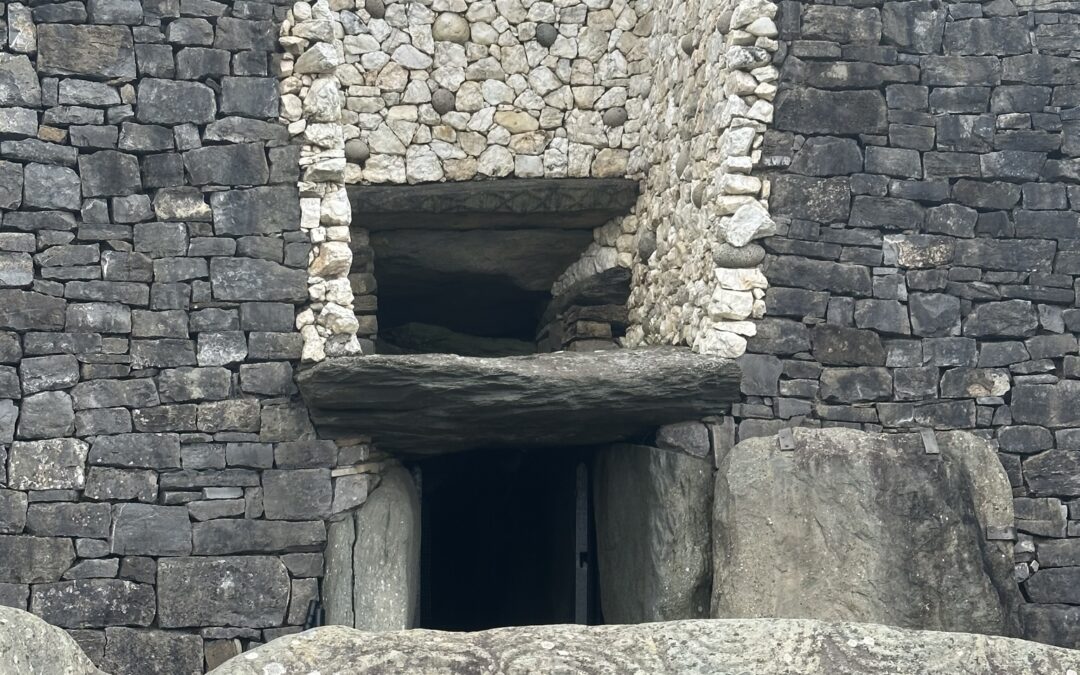
After another trip on the bus, we stopped at Newgrange where another guide was waiting for us. This carn is about 11 meters high and 80 meters in diameter on average. There are 97 curb stones around this tomb and the passage and room are made of 450 other similar stones. Many of them are also decorated with abstract patterns. Inside the room, there is a corbeled vault as a roof, which has kept the room dry for 5,000 years so far!

It is estimated that around 200,000 tons of material were used to build this pile, and white quartz, sandstone and granite stones were collected in some places along the Wicklow mountains. It is thought that those materials were transported by sea rather than by land, but it was a very complex task, no doubt! There were excellent architects and builders working on this project, which took at least thirty years to complete.

We entered the passage which was narrow and low. This passage and the inner room are aligned towards the south-east. There is a small gap above the entrance door (the roof box), which lets the sun in to illuminate the room at the winter solstice. The guide turned off the lights so that it was dark, and then he lit another light and a ray of light came in that lit up the passage and the floor of the room, just as happens with the sun at the solstice. The solstice was undoubtedly very important to the Neolithic people. The passage tombs were multi-functional sites, and it is likely that that society had social events and religious ceremonies in the monuments in Bru na Bóinne.

The bus was waiting for us when we came out of the passage, and we were all quiet in the bus. This trip had an affect on us, I think, and added to our life in a positive, spiritual, even philosophical way!

DNA research

A few things were discovered that were significant and that no one expected. Dr. Lara Cassidy (Department of Genetics at Trinity College) did most of the research and detective work to reveal the facts based on DNA from a man buried in the tomb in Newgrange, confirmed by DNA from other people from other tombs around the country.

Those Neolithic people came to us from the Meath Crescent in the Middle East around 5,000 years before Christ. We don't have much of that DNA in us in Ireland anymore. They were farmers who came over from the Fertile Crescent in the Middle East, and later they went north to Ireland through Europe. What about our own DNA, then? Well, another migration came to Ireland between 3,000 and 2,500 years before Christ, from the Pontic Steppes in eastern Europe, and since then, DNA from those people is seen in us in Ireland.

Dr. Cassidy also discovered a few remarkable things when she did her DNA analysis. Incest was determined, where the parents were close relatives. This only happened when there was a hierarchical society and a kingdom in effect, like the society of ancient Egypt and its pharaohs. It is now considered that such a society existed in Ireland at the time of the construction of the tombs, which was not expected.

Undoubtedly, our archaeological knowledge and understanding is growing and changing all the time, especially with new tools at our disposal, such as DNA analysis. I would highly recommend a visit to Brú na Bóinne, but set aside some time for the exhibition – you will not be disappointed!

.

.


.

.

.

.

Cruinneas sa Ghaeilge!

Acccuracy in Irish!

I had no idea what lay ahead, as we had never been to Glencolmkille before. I shared my first impressions of this area with you last week, and now I want to write a few words about the course I attended in Glencolmkille.

Nuair a shroicheamar Oideas Gael i nGleann Cholm Cille ar an Satharn, chuir bean den fhoireann fáilte romhainn agus threoraigh sí muid go dtí ár lóistín ar imeall an bhaile. Lóistín leaba agus bricfeasta a bhí ann agus bhí seomra mór dúbailte againn (mé féin agus mo bhean chéile) le seomra folctha en-suite.  Is trua é nach raibh lánlóistín ar fáil, cosúil leis an lóistín a bhí againn i nGleann Fhinne an tseachtain roimhe, ach sin a bhfuil.

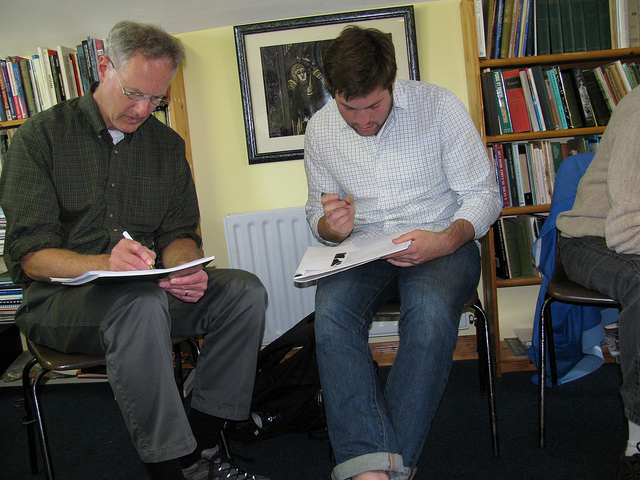
One hundred and twenty people attended the induction session at seven o'clock on Saturday, and one of the organizers explained to us everything about Oideas Gael and the courses that would be available to us. In particular, he said that Irish classes would be available to us at seven levels and another special course called 'Accuracy in Irish'. This course is aimed at people who speak Irish to a high standard, who already have some knowledge of the grammar of the language but who wish to gain a better knowledge of it. The emphasis is on writing and reading the language but speaking activities are also involved. I had no choice but to attend this course!

The other seven classes were more general with the emphasis on spoken Irish. My wife signed up for one for them and she really liked the course. We had a busy schedule, with classes taking place every day (Monday to Friday) from ten o'clock in the morning until lunchtime at one, and again from three to five o'clock in the evening. an bhéim ar Ghaeilge labhartha. Shínigh mo bhean chéile suas le ceann dóibh agus thaitin an cúrsa go mór léi.  Bhí sceideal gnóthach againn, agus ranganna ar siúl gach lá (Luan go hAoine) óna deich a chlog ar maidin go dtí am lóin at a haon, agus arís óna trí go dtí a cúig a chlog sa tráthnóna.

There were ten people in my class, and we had a great teacher called Dubhán. I already knew him, as he taught us the advanced class in Glenfinn the week before. Dubhán is a man very familiar with the subject of Irish, and he has a PhD in hand at the University of Ulster, on the Fiannaíochta legends. He is also a creative writer, and has published a collection of poetry called 'IDEO Locator'. Dubhán laid out the course based on the textbook written by Éamonn Ó Dónaill MA, 'Gramadach gan Stró'. Éamonn taught the same course years ago, using his own book.

I loved the approach that Dubhán had. It didn't start with chapter 1, chapter 2 and so on through the book, page by page. Instead, he chose interesting topics, and then taught lessons discussing those topics and using the book to give us insight. We also did homework from the book, to convince us of the points.

The following are a few examples of the material.

Adjectives in the Genitive Case: I didn't know before this class that there are three declensions of adjectives! We learned about them and the rules associated with them.

Numbers: Dúbhán dived deeply into this matter, and we learned things like this: 'the beginning of the first week' (week in genitive case), but 'the beginning of the second week' (with week in the nominative); 'the end of the long great eleventh year' (genitive) and 'the value of the twelve houses' (nominative).

Verbal noun – genitive case: This genitive case is usually the same as the verbal adjective. For example: 'smoking', but 'smokers' (caitheamh versus caite in latter case), 'cleaning toilets', but 'toilet cleaner’(glanadh versus glanta in latter case)).

The nominative form instead of the genitive: this is a difficult matter – when two (or more) words come together in the genitive case what changes need to be made? It is necessary to learn about the Meaning Unit (Definite and Indefinite) first, to understand the rules related to it. Example: 'discussing John's son's problems' (‘ag plé fhadhbanna mhac Sheáin’).

Variations of speech: for example - 'I don't believe the house was right' ,(Ní chreidim a dheise a bhí an teach); 'there is no man so strong that age does not weaken him', (‘níl fear dá láidre nach lagaíonn an aois é’); 'As Smart as you are, I am smarter', (‘dá chliste tú, tá mise níos cliste’); 'the man is getting weak'( ‘tá an fear ag dul i laige’).

I don't have space to mention other subjects, but the examples mentioned above gave you a small taste of the course. We had a great week learning all the time, and I will definitely be back to attend another course before long. If you are interested in improving your Irish, I highly recommend the courses offered by Oideas Gael in Glencolmkille and courses are also available online!

.

.

.

.

.

.

Gleann Cholm Cille!

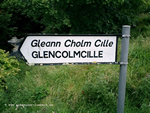
Glencolmkille!

Gleann Cholm Cille

The sheet of fields overflowing

Waves sliding down the valley

Falling towards the sea below

To the most beautiful place in the world

.

Its name is Glencolmkille

I have never seen anything like it

Wonderful and warm people live there chroíúil ina gcónaí ann

The site is steeped in history suíomh

.

Located in Donegal Gaeltacht

In a beautiful, remote place out in the countryside

In a beautiful, remote place out in the countryside

To speak Irish with ease

.

You have affected me deeply, O Glencolmkille

You have me put completely under your spell

I am changed because you moved my heart

I'll miss you when I'm back home

.

Glencolmkille O Glencolmkille

Your equal is not to be had, be it old or new

Glencolmkille O Glencolmkille

We will be back together, be it sooner or later

.

There is no arguing about the beauty of Glencolmkille. My eyes almost popped out of my head when we were driving down the road from Ardanra and an incredible view was revealed above us, stretching down to the shining sea, with the town of Glencolmkille sitting in the valley, framed by majestic hills that drop steeply into the choppy waves on the shores of the Atlantic Ocean. It is difficult to describe this place, without resorting to poetry, to convey to you the feelings associated with the sight. That's why I wrote the poem mentioned above. I also wrote a short poem in English – here it is:

Glencolmcille

Fresh green-fielded quiltwork spills,

Pleats and folds tumbling down hills,

Gliding through glistening, gulleted glen,

Riven by meandering river Murlin

Cloud-swaddled as it cradles spangled sainted land,

Then Softly surrenders to the sea's silver sand.

.

There is much to recommend about the Glen and its area, in terms of the activities available. Oideas Gael's headquarters are on the edge of town, and they organize Irish language courses from the beginning of the summer, at all levels. Other courses are also available – including archeology and mountaineering – all in Irish. People meet in Glencolmkille who have a strong love of culture and language, and although most of them are Irish, foreigners are also involved. I will be writing an article about the same matters in another article, but today there is a general overview, about Glencolmcille and the area where it is located.

Facilities and accommodation

The town has shops, restaurants, pubs and a garage. Bed and breakfast accommodation or self-catering apartments are available, but are very popular. Therefore, it is quite difficult to find any kind of accommodation in the town itself and people often have to find accommodation somewhere else, like Na Cella Beaga, and then commute to the Glen.

Colmcille Way and Colmcille Tour

The Cholmcille Way goes from Glencolmcille in Ireland to the Isle of Î in Scotland, visiting sites associated with the Saint's life and tradition. This Way is similar to the Camino de Santiago in Spain. Every year, a pilgrimage is organized by Gaeltacht cooperatives and language planning areas. The walks are usually led by mountain guides and native speakers.

In Glencolmcille itself, Slí Colmcille follows the route of Turas Colmcille. People go on a pilgrimage to Glencolmkille every year between the 9th of June (the festival of the Saint) and the 15th of August (the festival of the Ascension). Some ancient stones (dating back to 3000 BC) and gallants (dating back to 500-700 AD) can be seen at the 15 sites that make up the stops on the tour.

The Stone

The 'clachán' was opened in 1967, as a community project founded by Father Mica daivhir, a famous priest who founded many social schemes. There are seven thatched houses located under the mountain near the large beach, which give the visitor an insight into local life in the 18th, 19th and 20th centuries in west Donegal. There is also a nice craft shop and cafe.

Conclusion

Glencolmkille is a beautiful and remote place, with many facilities and activities available. I would highly recommend you to visit it and especially if you want to improve your Irish.

.

.

.

.

.

.

.

Lá na nAithreacha!

Fathers Day!

My North Star!!

I always call on him during my life,

When I'm in need,

Or whenever I'm in danger

And I need to be strong..

.

When I have a burning question,

Or whenever I feel sick,

When someone is saying something offensive to me,

Or when things are not going well.

.

On such occasions he comes to me,

And he puts me at my ease,

He takes the burden of my troubles from me,

And I'm not worried in the least anymore.

In this little poem, I try to express the specific characteristic of fatherhood, regarding the support our fathers give us through life's difficulties. By the way, our mothers also support us, but today my emphasis is on the fathers!

As for my own father, he supported me whenever I struggled as a boy growing up. Although I had no problem with my learning ability, I had quite a few other problems. As a teenager I was an utter weakling, and I also had asthma. Therefore, I was no use at hurling. That's a big disadvantage, especially when you're attending Kieran’s College, Kilkenny. I was left out of the heart of things and so I was very lonely. I was a boarding school student at the College, and I had to quickly develop my personal independence. Because I was an weaakling, the bullies always picked on me. My self-esteem was under attack with that behavior. But I was ashamed and I didn't say anything to my father. His support would only make the situation worse, because my father was a teacher in the same College. Anyway, I remained silent. You'd think my dad wouldn't know what was going on, let alone give me any help. But, you wouldn't be right!

I still don't know how my father found out what was going on. He found a creative solution for my situation. The bullies never hit me, because then they would be kicked out of school for misbehaving. But the bullies were still harassing me, using words instead of closed fists. It would have been better for me if it was physical harassment, no doubt. My father also realized that the greatest danger was psychological damage, and devised a solution to combat that.

The solution to the problem?

My father suggested positive and creative strategies for me, without pretending that they had anything to do with the bullying that was going on. I had no clue about it, either! My father emphasized the things I had a particular passion and talent for and told me there was nothing I couldn't do. He gave me courage whenever I was down and gave me a lift. Never yield, he said, to anyone you compete with, because he has the same doubts as you. My father awakened and encouraged my love of reading, although I already enjoyed learning everything at school. He opened the doors to many opportunities for me, and I ran through them fearlessly.

What about the bullies? When they realized they couldn't have the same effect on me anymore, they stopped bothering me and had to find new victims who would be easier to terrorize.

That was a very clever solution because my father managed to kill two birds with one stone. First of all, he defeated the bullies, because fresh meat was no longer available to them. Secondly, he built up my self-confidence by clearly showing that he trusted me completely. That positive attitude stayed with me from then on up to this day. With that very positive attitude, I am not afraid to try anything I want to do in my life. That way, I learn and develop every day. I am deeply indebted to my father Peadar Bairéad for that, God bless him.

.


.

.

.

.

.

.

.

.

en_USEnglish