A Timely Visit to San Miguel de Allende
Reaching San Miguel de Allende (SMA) in Mexico is no effortless journey. We recently flew from Tijuana, just across the border from San Diego, to León in the central highlands. The flight took about three hours. Then we headed out on the road for another two hours by charter bus until we reached SMA.
We stayed in a house that was like a small museum, located a ten-minute walk from the center of town at the top of a steep hill. Ceremonial masks stared down at us from the walls, and a matador’s suit stood in a glass case in the corner. Woven tapestries and paintings hung on the walls, and painted-back chairs stood against them. We sat at a large oak table beneath a beautiful bóveda brick ceiling (a vaulted brick ceiling)—a ceiling once said to be the largest of its kind in Mexico.
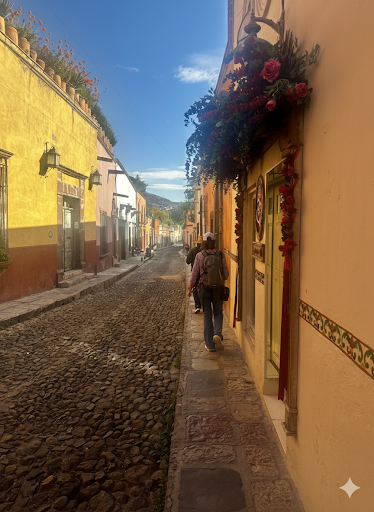
Every morning we woke up immersed in the country’s craftsmanship. It was a perfect base for the week. The town is preserved in Spanish colonial form. Narrow streets. Many of them one-way. Cobblestones everywhere. We were glad we didn’t have a rental car. Driving is best left to the care of the locals. Uber was easy and inexpensive, but we only used it a few times, as the town center was close to us.
The parish church, Parroquia de San Miguel Arcángel, is located in the center of town. The parish was founded in the 16th century, though the current structure was largely rebuilt in the 1690s. In the 1880s, Zeferino Gutiérrez reshaped the façade into the pink neo-Gothic structure that now defines the town’s skyline. It is the heart of the town.
Beside it stands the clock tower. Every fifteen minutes, the bells ring. In the Jardín, the central plaza, the sound spreads across the square. After a day or two, you stop noticing it; it simply becomes part of the rhythm of life. In the evenings, we sat on benches in the plaza. The light turned the stone to a golden color tinged with rose-pink. Mariachi bands gathered to play their tunes. Local families wandered or rested under the shade trees. Children chased each other across the square.
San Miguel was founded in 1542. It prospered in the 18th century as it sat on the "silver route." The revolutionary leader Ignacio Allende was born here in 1769, and after independence, his name was appended to the town in his honor. Today, foreigners make up about a quarter of SMA's population, many of them American or Canadian. That tradition began after World War II, when U.S. veterans arrived to study, funded under the “GI Bill.” The infrastructure still reflects that influence: good schools, modern hospitals, language institutes, and excellent restaurants.
We ate in restaurants every evening. The prices were reasonable. Most of the customers were American or Canadian. We met several women who return year after year to escape the cold at home. They spoke warmly about the weather, the food, and the culture in San Miguel de Allende. During the Super Bowl, our restaurant was packed with locals. They were there to see Bad Bunny perform at the halftime show. During the show, they were entirely focused on the screen. As soon as the music ended, they left.
One day, we hired a driver to visit another town called Guanajuato—by accident, really. We had intended to go to Cañada de la Virgen, an archaeological site about an hour away by car. When we arrived, however, it was closed. We found out later that soldiers had been put in charge of the site due to a dispute between federal authorities and a local landowner. It was our first hint that there was tension beneath the surface, despite the calm that was felt.
The driver suggested we visit Guanajuato instead, and we agreed. That town looked completely different compared to San Miguel. 19th-century architecture. Traffic flowing through underground tunnels. Colorful houses stacked steeply on the hills.
We visited the birthplace of the famous artist Diego Rivera. There were early works and photographs in the museum, as well as material relating to his wife, Frida Kahlo. It felt personal and intimate.
Back in San Miguel on the final day, we spent time at Fábrica La Aurora, formerly a textile factory that now houses studios and galleries. The artists worked behind open doors. The creative energy of the town was palpable.
About a week after we returned home, a major story broke. Nemesio Rubén Oseguera Cervantes, known as “El Mencho,” leader of the Jalisco New Generation Cartel, had been killed in a military operation. Retaliation followed in several cities. Armed men on motorbikes. Vehicles burned on highways. Supermarkets set on fire. Reports of violence in Puerto Vallarta, Guadalajara, Tijuana, León, and elsewhere.
We had flown through Tijuana. We had landed in León. As far as we know, there was no direct impact on SMA, but the peace was more fragile than we thought. We would like to return to that beautiful town again, but we will wait a while longer until things settle down again.




 English
  Gaeilge