An Act of Reparation!
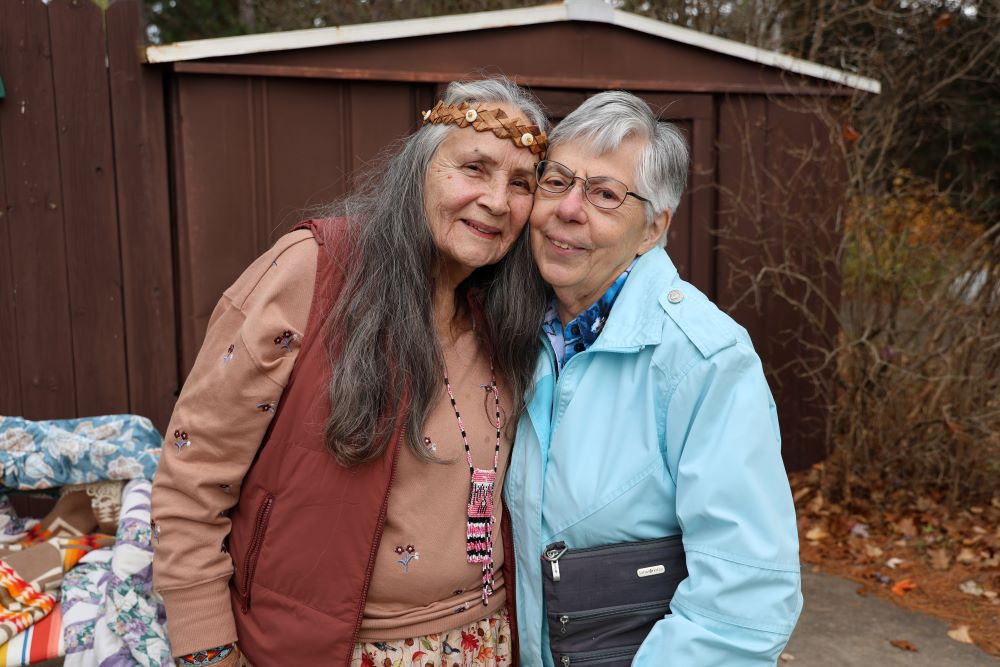
A group of people gathered together beside a lake on a very cold day in October in northern Wisconsin. There was a carpet of multicoloured leaves on the ground. Both nuns and Native Americans from the Lac du Flambeau Band were present.
During the ceremony, the nuns gave the land title to the delegation of Indigenous people. What was involved was two acres of land, which included a cluster of cabins, and a house called the Marywood Franciscan Spirituality Centre. The sale price: $30,000, exactly the amount the order of nuns paid for it 60 years ago. Its valuation today? Around $2.6 million.
In contrast to the land acknowledgement that is common at meetings on stolen land and which is nothing more than a symbolic confession, this was the real thing: the first known case of a Catholic institution in the United States voluntarily returning land to a tribe as an act of reparation.
"We wanted to do more than just say we were sorry."
Sister Eileen McKenzie, president of the Franciscan Sisters of Perpetual Adoration (FSPA), told reporters that the order had spent two years researching the history of the land. They learned that the property was on the traditional territory of the Lac du Flambeau Band, from whom land was stolen through broken treaties.
"We wanted to do more than just say we were sorry," she said. "We wanted to change the story, even in a small way."
The nuns made the decision after painful reflection. FSPA helped run a Catholic boarding school that separated Indigenous children from their families and their culture. That is a shameful legacy not only for FSPA but for Catholics and Protestants throughout North America, as unmarked graves are still being found in every corner of the continent.
"It felt right to give something back," McKenzie said. "This land wasn't ours to begin with anyway."
An emotional homecoming with fond memories
For the Lac du Flambeau Band, there was deep emotion associated with the moment. Tribal President John Johnson Sr. called the act "a step toward restoring balance."
He spoke about elders who remember fishing on that same lake, and about the old paths that used to go through the forests. "When you return to land that knows your name, you feel something inside settling," he said. "That's not a question of ownership. There's a deep connection between our tribe and this place."
The tribe intends to keep the property as a place for healing and cultural renewal — a place where people can gather, stories can be told, and ceremonies can be held on land that is once again under their care.
"It's like a circle closing," Johnson said. "The land remembers us, and now we can remember it."
The quiet revolution called 'Land Back'
Throughout the United States, a growing movement called 'Land Back' is challenging the concept of land ownership. It's considered a critically important effort, and tribes and allies are negotiating, fundraising, and sometimes going to court to reclaim ancestral lands.
What's most striking about this story is the way it happened. It wasn't a government order or a court settlement — but a group of elderly nuns who decided among themselves to do the right thing.
"This changes the moral temperature," said historian and Indigenous rights advocate Nick Estes, who has written extensively on the Land Back movement. "When you see people of faith — people whose institutions benefited from our dispossession — voluntarily giving land back, it opens hearts and possibilities."
More important than just the land
Land is just earth and trees. But for Indigenous Nations, there's memory, language, law, and identity in it. Their culture and the land are interwoven. When they get even a small piece back like this, it makes a huge difference to them, because it begins the reversal of the loss.
Sociologist Dr. Danielle SeeWalker, who studies Indigenous reconciliation efforts, put it simply: "Each acre that's returned is like a heartbeat restarting. You can't measure that in dollars."
For the nuns of FSPA, returning their land to the tribe is an important step. "Francis of Assisi taught us to repair what is broken," Sister McKenzie said. "In this era, perhaps this is what is broken and needs repairing."
A sign, not an ending
This is unlikely to be the end of the story. It's reported that other Catholic communities are doing deep reflection on their own role regarding boarding schools and the land associated with them.
Questions have been put to both the Jesuits and the Benedictines about property that was connected to missions or schools for Indigenous children.
Legal experts believe that voluntary acts like this could influence public policy — showing that reparative transfers like this can be done without ten years in the courts. "An act of reparation like this can be viewed as an act of relationship instead of a political fight," said one law professor.
But the nuns themselves insist they're not seeking praise. "We're not heroes," McKenzie said. "We listened, that's all."
Conclusion
When the ceremony ended, the group formed a small circle, passing around a wooden bowl full of water from the lake. An elder of the tribe blessed the site in his native language - Ojibwe - and the nuns sang a Franciscan hymn. The wind carried their voices over the trees and up into the sky, spreading the hopeful message across the world, without limit, without restraint.
In a country full of empty promises and where money is a false God, an act like this is rare. But by setting down a single example, it's likely that the small group on the edge of the lake has begun inspiring a new movement that will be far greater than they know.
As you reflect on this, think about how we ourselves can do acts like this that will give support to minority and disadvantaged groups in our own country - groups like legal immigrants and the Travelling community.
And we can always support efforts that will promote the Irish language and the preservation of our culture. Look at what President Catherine Connolly is doing in Áras an Uachtaráin, for example, regarding the use of the language.
Finally, in the famous words of Margaret Mead: Never doubt that a small group of thoughtful, committed citizens can change the world; indeed, it's the only thing that ever has.




 English
  Gaeilge