
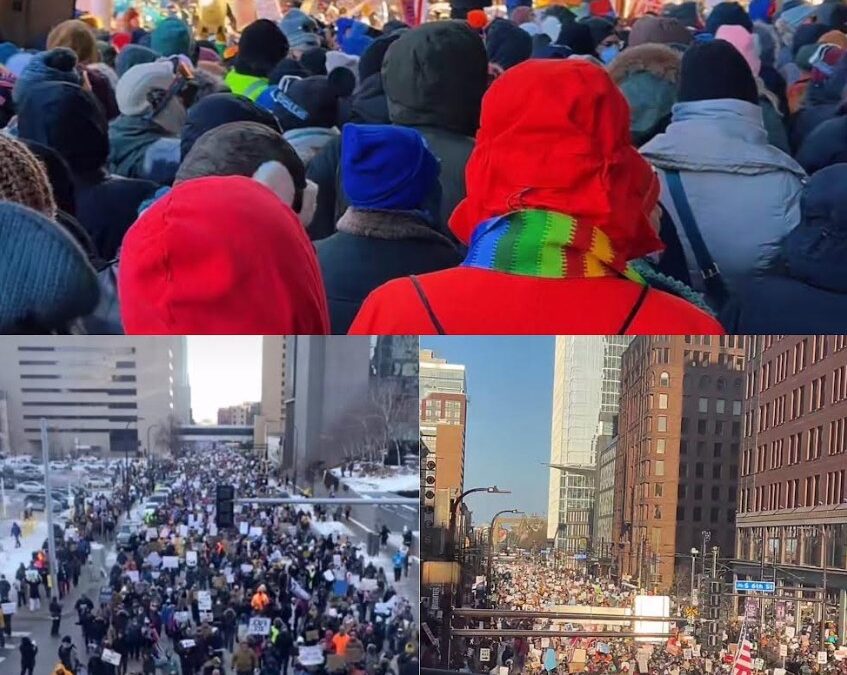
Litir ó Mheiriceá – Aird an domhain ar Mhinneapolis
What is unfolding in Minneapolis is no longer only about illegal immigration. It is a stress test of American democracy, with consequences that reach far beyond a single city, a single state, or even a single country.
Two American citizens were killed following encounters with federal agents during protests that witnesses and video recordings show to have been peaceful. Neither had a criminal record. In both cases, senior federal officials applied the label “domestic terrorists” almost immediately, before any independent investigation had taken place and without presenting evidence to the public. In both cases as well, mobile phone footage tells a story that differs fundamentally from the official version.
As seen recently in the pressure exerted by the United States on Denmark over Greenland, American political stability is not a purely domestic matter. When democratic norms are weakened in Washington, the effects are felt near and far. Countries depend on the international system functioning properly and on major powers meeting their obligations. For countries such as Ireland, whose economic and security interests are closely tied to American stability, this erosion represents a practical and real risk.
Peaceful Protests
The streets of Minneapolis saw peaceful protests. The crowd chanted slogans. They criticised agents of the United States Border Patrol (CBP) and Immigration and Customs Enforcement (ICE). They recorded events on their phones. These are all lawful activities protected under the First Amendment of the US Constitution.
Despite this, the video footage clearly shows federal agents responding with force. Pepper spray and tear gas were used. Batons were used. People were pushed to the ground, restrained with plastic ties, and taken into custody against their will, even though there was no evidence of physical attacks by the crowd.
The Killing of Alex Pretti
Federal officials initially claimed that Alex Pretti attacked federal agents while armed with a gun. The video evidence does not support this claim in any way.
Pretti was legally carrying a concealed firearm and had the required permits. He did not draw the weapon.
Pretti saw a woman in distress after an agent pushed her to the ground and sprayed her with pepper spray. He attempted to help her. Pretti himself was sprayed, forced to the ground by six or seven agents, struck by one agent, and had his firearm taken by another. Then, while lying defenceless on the ground, one agent fired shots at him, followed by another agent. He was hit ten times and died.
After the shooting, the scene was not secured in accordance with standard investigative procedures. The agents left without preserving the site or securing evidence.
Pretti was participating in a peaceful protest, activity protected under the First Amendment. He was lawfully armed under state law and under what he reasonably understood to be lawful under the Second Amendment. On that basis, the video footage raises serious questions about the necessity and proportionality of the lethal force used.
The Killing of Nicole Good
The death of Nicole Good followed a similar pattern. She was killed after agents attempted to remove her from her car as she tried to leave. Without any independent investigation, it was officially stated that she was a terrorist, before the facts were publicly examined.
Once again, video footage and eyewitness accounts reveal a clear gap between official statements and what is visible. As in Pretti’s case, federal authorities refused to allow an independent investigation by state agencies or the FBI, asserting that an internal review alone would suffice. As is widely understood, accountability cannot exist when those who use force investigate themselves.
Smartphones
Smartphones have now become one of the most important democratic tools of the modern era. They expose contradictions between official statements and what can be seen in video recordings. They allow the public to witness events for themselves and reach their own conclusions, without relying solely on official accounts.
Minnesota Governor Tim Walz has urged people to carry their phones at all times and to record interactions with federal agents. This is a lawful act. Such recordings create a permanent record that can later be examined by courts, legislators, journalists, and the public.
Authority Without Accountability
In both deaths, federal authorities refused to permit independent investigations. At the same time, Governor Walz and the Mayor of Minneapolis are under investigation after declining to cooperate with CBP and ICE, arguing that state authority and civil rights were being violated.
If these practices continue without challenge, they are likely to expand. Other cities could be affected. Federal agents could be deployed during election periods, placing pressure on voters under the pretext of security. The erosion of civil liberties rarely remains confined to one location.
Authoritarian regimes in Germany, the Soviet Union, and China did not begin with mass killings. They began by portraying dissenters as enemies and demanding obedience in the name of order.
Response
The American public is not powerless. Peaceful protests can be organised. Votes can be cast in elections. Phones can record events. Pressure can be applied to elected representatives, and accountability demanded.
The international community also has a role. Recent US attempts at geopolitical coercion, including pressure related to Greenland, showed that coordinated resistance can work. Unified responses from the European Union and Canada demonstrated what democratic solidarity looks like, without resorting to threats or escalation.
It is now clear that the international system is changing. In light of these developments, it is reasonable for smaller countries to reassess their dependencies and future strategies, while keeping a close watch on the defence of democratic norms.


 English
  Gaeilge