Michael O'Dwyer, True Renaissance Man
I was very happy to be a student at St Kieran’s College in Kilkenny. As a child, I had a natural curiosity about the world and the stars above. From the moment I opened a book about planets, stars, and galaxies, I was completely enchanted. In my young mind, Newton, Galileo, Descartes, and Einstein were wizards who had uncovered the hidden laws and principles of the universe. To me, science was a kind of magic—only better, because it was true and could be proven. It’s no surprise, then, that when I began my first classes in the College, I was thrilled to find physics and chemistry on the curriculum.
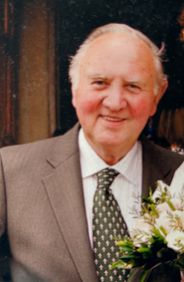
Although almost every teacher in the school was excellent—knowledgeable and passionate about their subjects—one stood out as the person who opened doors of possibility for me: our physics teacher, Mr. Mícheál O’Dwyer.
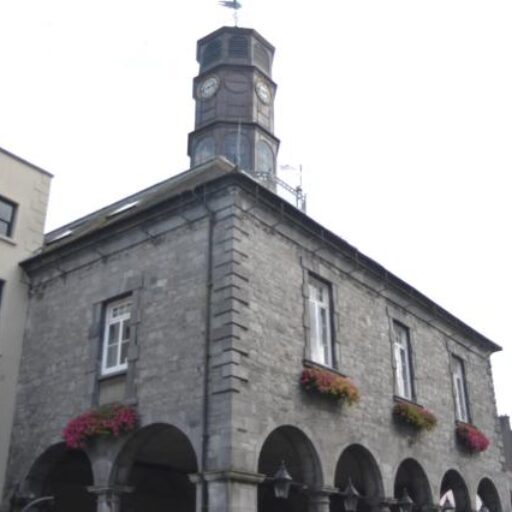
He began teaching at St Kieran’s College in 1967, after ten years teaching in Downpatrick, County Down. In all, he spent thirty-four years working at St Kieran’s—a long career that left a deep mark on generations of students. When I was a teenager, he was like a high priest at the altar of science.
Master Craftsman
Mr. O’Dwyer was a modest, sturdy man, full of energy and quick, playful wit. Unlike many teachers of that era, he never used corporal punishment. He created a safe space where we felt free to think independently. That’s not to say he couldn’t maintain discipline—he certainly could. He used humor and gentle mockery when needed.
I remember one day when I was chatting and laughing uncontrollably in his class while he was trying to teach. He looked straight at me, a serious gleam in his eye, and said, enunciating every word slowly and clearly:
“Now, Michael—just because your father is the vice-principal…”
He didn’t need to finish the sentence. The entire class burst out laughing; I turned crimson with embarrassment. From that day on, I was as quiet as a ghost in the physics lab.
He didn’t need to finish the sentence. The entire class burst out laughing; I turned crimson with embarrassment. From that day on, I was as quiet as a ghost in the physics lab.
When he taught us about focal length in a lens, he didn’t start with equations but with the stories of the scientists who shaped our understanding: Kepler, Huygens, Newton, Descartes, and Gauss. He impressed upon us that we were inheriting a magnificent intellectual tradition. Then he drew a clean diagram on the board, showing how parallel rays of light bend through a lens and converge, before deriving the thin-lens formula for focal length.
Watching him work was like observing a skilled craftsman at his bench—precise, patient, and completely absorbed in his subject.
The Scientific Method
He never left theory as something abstract. In the case of focal length, he divided us into pairs, each with a lens, an object, and a screen. Our task: measure, record, calculate; then test whether our result matched the formula.
In this way, the lesson wasn’t only about optics—it was about the scientific method itself: forming hypotheses, testing them rigorously, and drawing conclusions from tangible evidence. He also taught us the importance of teamwork and cooperation.
Those lessons went far beyond physics; they taught us how to approach problems methodically and how to work together effectively.
Looking back, I can say with confidence that Michael helped shape my path. He lit sparks of curiosity in me—not by telling, but by showing how the principles of physics worked.
He had a profound influence on me at a decisive moment in my life. It’s no accident that I went on to study Physics at University College Dublin, then Electrical Engineering, and finally earned a Master’s degree in Electrical and Computer Engineering at the University of California, San Diego.
I spent most of my career in research and development in the field of wireless communications. My professional journey traces its roots directly back to those early lessons in the physics lab—and to our teacher, Mícheál O’Dwyer.
Scientist and Historian
Many years later, I met Míchael again. By that time, I was closer to the end of my working life than the beginning. I told him plainly what he had done for me and how much he had influenced my life. He was gentle and humble, but I could see quiet gratitude in his eyes.
During that visit, he revealed his second passion: he had become an accomplished local historian. In his retirement, he devoted himself to writing about the history of Kilkenny, uncovering little-known aspects of its past.
Among his works was The History of Cricket in County Kilkenny: The Forgotten Game, a book offering a fascinating insight into the evolution of the GAA. He examined the upper classes of Kilkenny society and wrote about the very area where he himself had grown up. I was delighted to discover that the man who had once shown me the beauty of light and motion was now illuminating hidden corners of our cultural heritage.
True Renaissance Man
News of Mícheál’s passing caused me great sadness—he went on the ‘path of truth’ in February 2025. Those words “path of truth” seem fitting, for he had taught us in his classes what truth meant in science, and how that truth could be proven.
His image remains vivid in my mind—clear and precise, as if it were yesterday: standing at the front of the physics lab, chalk in hand, that kind smile on his face before the words I’ll never forget—
“Now Michael…”
I’m deeply grateful that I had the chance to thank him personally for what he had done for me, and for the lasting, positive influence he had on my life.
Reflecting on his life, I see clearly that few teachers like him exist. Forty-four years of teaching testify to his dedication. He believed passionately in the power of education to change not only the lives of his students but society itself.
I learned physics easily in his class—but I also learned something deeper: how to think logically and practically. That has served me well in every aspect of my life. Even now, when I sit down to write, I still hear echoes of his lessons—his voice in my ear offering quiet advice:
“Be precise and clear. Think logically. Approach every problem with curiosity and respect for the truth.”
As Máirtín Ó Néill wrote in an obituary in the Record 2025 (St Kieran’s College), Míchael O’Dwyer was “a Kieran’s man with many parts —a scientist and historian, truly a Renaissance man.”
Teachers rarely make headlines, but they change the world quietly and profoundly—mind by mind, generation after generation. Míchael stood as the model of a great teacher—a guiding star of knowledge for me always. I will never forget him for as long as I live.
Mistreatment of a Long-Term US resident by immigration officials!



 English
  Gaeilge