Annual Pilgrimage to the Grand Canyon – completing the circle!
I told you about my first hike in the Grand Canyon, many years ago. It was so amazing that I’ve never forgotten it. Let’s jump ahead to the most recent hike my wife and I did. In this case, we went down from the south rim, to the Colorado, and then came back up to the same rim – a 30 kilometer hike or so. We assumed it wouldn’t be too difficult for us.
We had everything ready the night before – clothes, shoes, water, snacks, poles and backpacks. We got up early in the morning at four o’clock, and were on the trail (Bright Angel Trail) by five. It wasn’t hot yet (15C) and the sun hadn’t risen yet. We had a good pace and were making good progress.
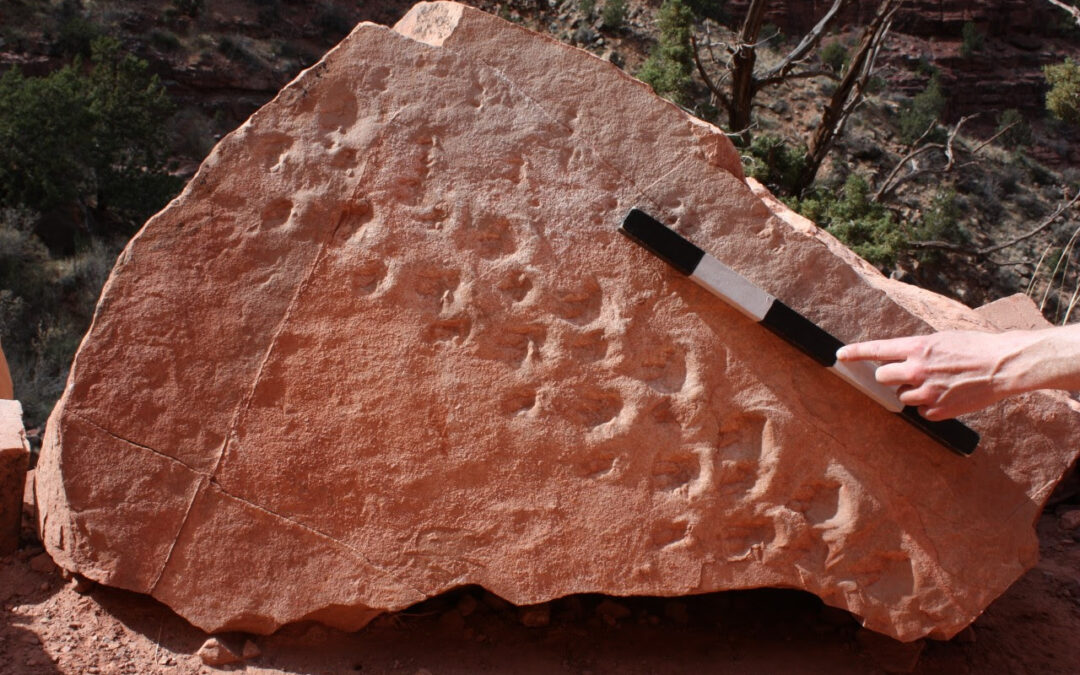
Fossilized remains
My wife Sinéad is an archaeologist, and she saw a large rock by the side of the trail with noteworthy markings. She immediately recognized them as animal fossils, and we spent time looking at them and taking photos. Later, after the hike, Sinéad did more research on them, and it was an interesting story. In 2016, a Norwegian geology professor, Allan Krill, was hiking with his students when he saw a large rock with fossilized markings. Krill was curious, and sent a photo to his colleague, Stephen Rowland, a palaeontologist at the University of Nevada Las Vegas.
The tracks along the trail are even more remarkable than Krill first imagined. “These are by far the oldest vertebrate tracks in the Grand Canyon,” says Rowland. “Even more remarkable,” he said, “they are among the oldest tracks on Earth of animals that lay eggs without shells, such as reptiles, and the earliest evidence of vertebrates walking in sand dunes.”
The large rock that contained the track fell from a nearby cliff – in the Manakacha Formation. Researchers were able to date the tracks to 313 million years old. It’s incredible that the rock fell right next to the trail – and that Sinéad saw it too. I didn’t see it at all. But that’s the kind of thing you see in that canyon, because you’re walking back through the history of the earth itself. While the Grand Canyon is only 5 or 6 million years old, some of the rocks there date back as far as 1.8 billion years – from the Precambrian to the Paleozoic Era! The hike was worth it just to see the tracks.
Native Heritage
We continued walking and before long, we reached Havasupai Garden. The name was changed from Indian Garden to Havasupai Garden in 2022 to honor the Havasupai people, a tribe that had lived in the Grand Canyon for generations. The area, known as Ha’a Gyoh (“where the water comes up”) in the Havasupai language, was used for farming and seasonal migration.
In the 1920s, the Havasupai were forcibly removed from the Canyon by the National Park Service when Grand Canyon National Park was established. Captain Burro was the last of the tribe to be evicted. Indian Garden was a derogatory name that did not acknowledge the tribe’s valuable heritage in the canyon.
After many years, the tribe’s request to change the name to Havasupai Garden was granted. This is a recognition of the indigenous heritage, historical injustice, and the tribe’s ongoing cultural connection to the place.
The Grand Canyon is a historic place, not only geologically, but also in terms of human history. While the Havasupai have been here for over 800 years, Native Americans have been there for about 12,000 years. There are 11 tribes associated with the Canyon.
We had food and drinks at Havasupai Garden and then walked about 4 kilometers down towards Pipe Creek. The Bright Angel Trail descends gently through red cliffs and steep bends like Devil’s Corkscrew, with steep slopes in some sections. We crossed the creek a few times before reaching Pipe Creek. We ended up near the Colorado, but the River Trail – a trail along the river leading to Silver Bridge – was closed, due to work being done on the trans-canyon pipeline.
Slogging our way back, step by step
We turned around at that point, and retraced our steps back to Havasupai Garden. The heat was rising rapidly by then. The temperature was about 27 degrees Celsius at 11am between Pipe Creek and Havasupai Garden. The hike from Havasupai Garden to the 3-Mile Resthouse was challenging, especially in the midday sun. Water, regular breaks, and protection from the sun are essential here. We weren’t feeling great by the time we got to the resthouse and sat in the shade to rest for a while. It took another hour to get to the 1.5-Mile Resthouse, where we took another nice break. Then, we walked slowly, struggling, step by step, until we reached the edge. We were exhausted and a little sick from the heat. The temperature was about 32C when we finished the hike.
We were so happy to be out of the canyon, and decided to go to the Grand Canyon earlier in the year next year, and to be on the trail earlier in the day as well, at four o'clock. Despite the difficulties we faced, we are really looking forward to our next visit to the Grand Canyon.



 English
  Gaeilge