Holidays on Aran island - Part 1
Three islands lie as rocky sentries between Galway Bay and the Atlantic Ocean: Inis Oírr, Inis Meáin and Árainn. They are known as the Aran Islands, and though they sit on the edge of the country, they are at its very heart, serving as protectors of our language and culture. The people of the islands are living proof of that. The history of Ireland can also be seen in nearly every place you step foot on.
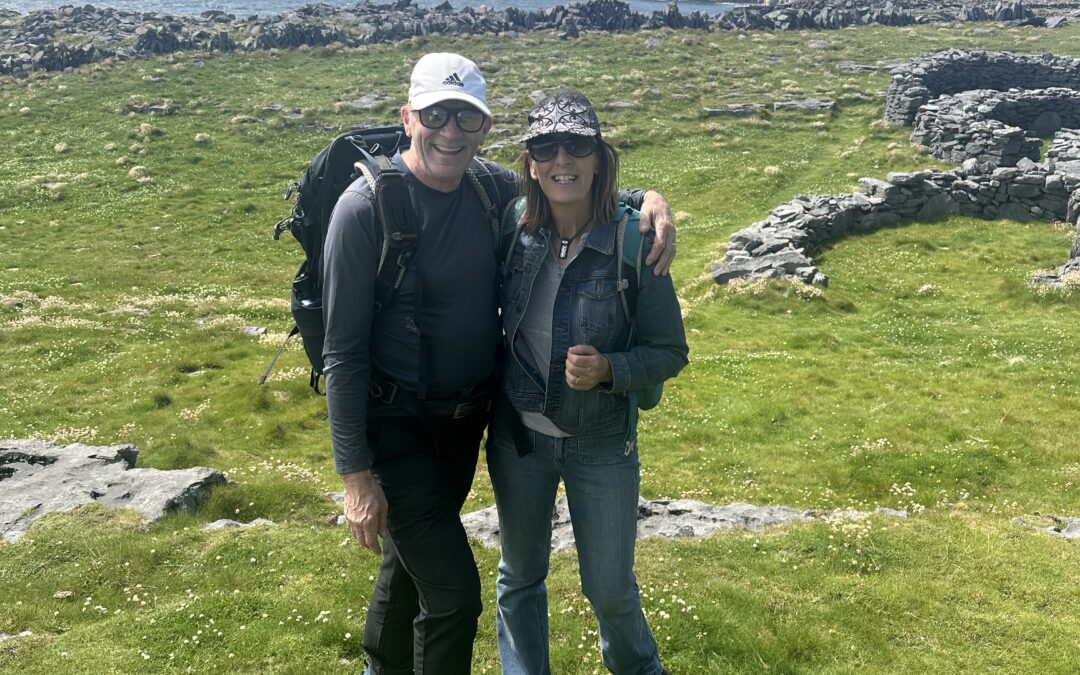
It’s no surprise that my wife, Sinéad, and I go to Árainn whenever we get the chance. We love the Irish language and culture. Sinéad is an archaeologist, with a deep tie to Aran from the standpoint of archaeology, and so the island is a kind of paradise for her—essentially a living museum of archaeology and history.
Prehistory and History
There’s a lot to see dating from the Late Bronze Age (1200–600 BCE) onward. Dún Aonghasa was built around 1100 BCE and expanded later around 500 BCE. The fort is perched on the edge of a cliff, with massive stone walls and defensive spikes surrounding it. It’s a truly awe-inspiring sight. Dún Dúchathair and Dún Eoghanachta are from the same era—they're not as well known as Dún Aonghasa but still impressive.
Around the 8th century, the island emerged as a center of monastic and religious life. Teampall Bheanáin, a tiny church on a hill above Cill Rónáin, is one of the smallest churches in Ireland. It is dedicated to Benen, a follower of St. Patrick.
Pilgrims used to come from the mainland to the Seven Churches, an ancient monastic site that thrived during the medieval period. There are religious ruins there, including churches, stone shrines, and graves. It was one of the most significant Christian sites on the Aran Islands.
There are many other sites to visit on the island as well, including Teampall na Naomh, Teampall Mac Duach, Teampall an Cheathrair Álainn, as well as a range of holy wells and stone altars. Sinéad conducted an important archaeological excavation on Mainistir Chiaráin, in which were uncovered noteworthy features and artifacts. There is a lot to tell about this excavation, but that is a story for another day and another article.
Bronze Age people first settled the Aran Islands, followed by Celtic tribes during the Iron Age. From the 5th century on, the islands became a Christian hub. For the most part, the island communities have remained faithful to their culture and language right up to today.
Tourism
Even so, one mustn’t forget the major changes that have had a significant impact on the islands and their inhabitants over time. Tourism began on the Aran Islands at the end of the 19th century, when writers, artists, and scholars started arriving. They appreciated all the islands had to offer—an ancient culture still being lived, and a unique natural beauty beyond compare.
During the 20th century, tourism gradually expanded. It was once difficult to land on the Aran Islands, but nowadays there are regular ferry services from Ros a’ Mhíl, Doolin, and Galway, and since the 1970s, short flights have been available from Connemara Airport. In recent years, interest in the culture and nature of the islands has grown tremendously, and people love to get out exploring on foot and by bike. These days, visitors come not only from Ireland but from all over the world. Tourism is now an important part of the local economy, although it is still seasonal compared to many other places.
Arrival on Inis Mór
This time, we were passengers on the latest addition to the Doolin Ferries fleet: the Cliffs of Moher Express. This boat is much faster and larger than the others. It’s also fitted with stabilizers for a smoother journey. The trip was excellent—very smooth. That’s great news for me, as I don’t have the strongest stomach for the sea.
We had booked an Airbnb near Tí Joe Watty’s, close to Cill Rónáin. We had stayed in the same small house before—a comfortable place with every convenience, including a fully equipped kitchen. As soon as we stored our bags, we headed straight to the Spar to do our shopping. The manager welcomed us warmly, and we chatted for a moment about how things were going. It was lovely to be back on Árainn again!
Concert
As we were leaving the store, Sinéad spotted a poster advertising a concert that same evening in Halla Rónáin. The featured act would be singer-songwriter Susan O’Neill. Susan O’Neill (or SON) is a talented performer from Ennis, County Clare, who blends traditional music, rock, blues, and soul with a powerful and distinctive voice. She gained acclaim for her collaborative album with Mick Flannery, In the Game, and she’s now one of the most exciting artists in Ireland.
We bought our tickets online and, after a delicious meal at home, walked down the road to Halla Rónáin. The opening musicians were good, but when Susan O’Neill took the stage and started performing, we were captivated from the very first note. She uses live-looping techniques to layer vocals, trumpet, and other instruments skillfully—creating a rich, textured, and powerful sound. The show was outstanding, and we thoroughly enjoyed it—a perfect start to our holiday!
…More to come.



 English
  Gaeilge