Learn with the article
The journey from Sintra to Alte in Portugal went smoothly. A couple of leisurely hours heading south, from the Lisbon area to the Algarve, with a stop for fuel along the way.
As we entered the village, our journey should have been almost over.
“Turn right,” said Google Maps.
I missed the turn.
There were two right turns very close together. By the time I realised my mistake, Google had already found another route for us.
“Turn left.”
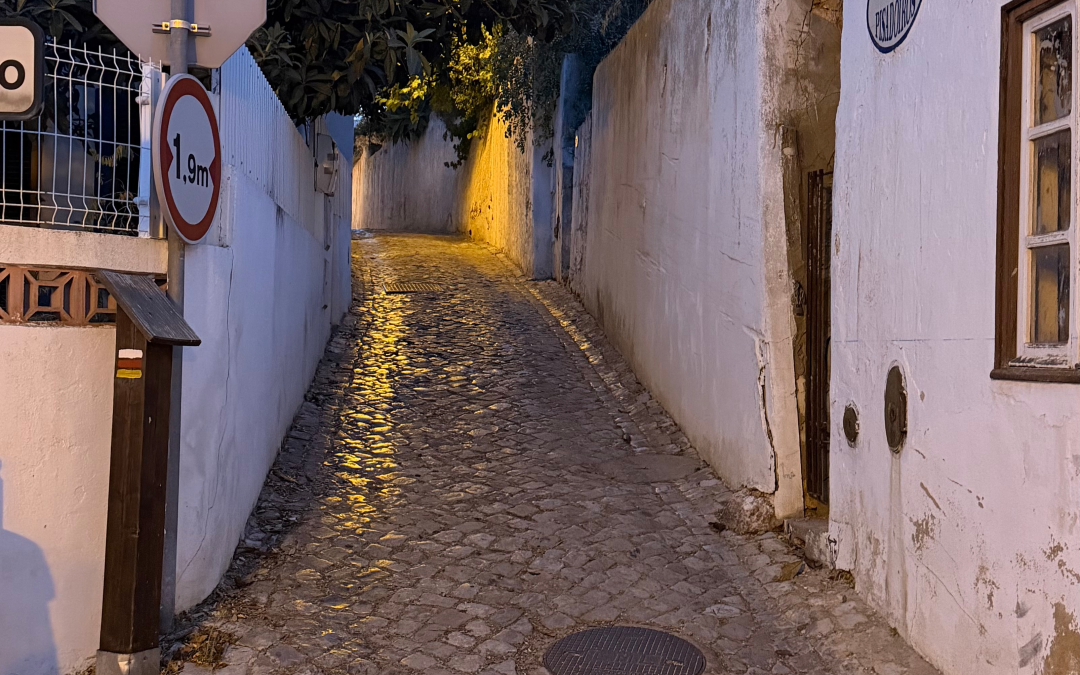
The street was narrow, but there was enough room for the SUV, with a little to spare.
“Turn right.”
It was a sharp turn. On the other side, the street narrowed as it ran between the houses.
We had not gone far when a door opened beside my window. A woman stood in the doorway. The SUV was so close to the door that she had no room to come out. She raised her hand.
“Can I keep going?” I asked.
She answered in Portuguese.
I pointed up the street.
She looked at the SUV, then at me. She raised both hands and waved them from side to side.
I pointed ahead again.
She brought her palms close together. Then she turned one hand sharply and pointed it downwards.
Narrower. Sharp bends. Steep hill.
Once again, I pointed up the road.
She tilted her head, spread her hands and motioned for me to continue.
Off you go.
I nodded.
She closed the door.
Around the next corner, the walls drew closer together.
Sinéad got out of the car.
“Come on,” she called. “Slowly.”
I edged forward.
“Keep the wheels straight.”
The proximity alarms began screaming.
“Stop.”
She walked around the front of the SUV and checked the passenger side.
“You’re very close here.”
“How close?”
She held her thumb and forefinger a tiny distance apart.
I folded in both wing mirrors.
The walls were covered in scratches. Some were light. Others had cut through the whitewash to the stone beneath.
I pressed the accelerator. The SUV jumped forward.
“Easy,” said Sinéad.
I moved another few inches.
“Stop.”
She looked at one side, then the other.
“A little this way.”
The alarms kept complaining.
The temperature was above thirty degrees. Sweat ran into my eyes.
I edged forward again.
“Stop.”
The street turned between two houses. I could not see what lay beyond the corner.
“Go around the corner and have a look,” I said.
Sinéad disappeared around it.
A short while later, she came back.
“It gets narrower.”
I looked in the rear-view mirror. The road disappeared from sight behind us. Even if I could reverse, I would have to do it without the wing mirrors.
I imagined metal scraping against stone.
Then I imagined the SUV wedged between the walls, unable to move forwards or backwards.
Me trapped inside it.
Sinéad walked ahead of me again.
“Come on.”
I released the brake.
“Slowly.”
The SUV jumped, then crept forward.
“Keep going.”
“Stop.”
We did the same thing around the next corner.
And the one after that.
At last, the street opened into a small junction. A church stood in front of us. Sinéad guided me into a space beside it that was wide enough to stop in.
I switched off the engine.
For a few seconds, neither of us moved.
We found the guesthouse on foot. Then I returned to the SUV, drove back along a wider road and took the first right this time, the turn I had missed earlier.
The space outside the guesthouse was narrow, right against a wall.
By then, it looked like a car park.
When I got out, my hands were stiff from gripping the steering wheel. I stretched my back before taking the bags from the rear of the car.
At last, we had arrived.
We told the woman who ran the guesthouse about the road.
“Google,” she said at once. “You should contact them. They have to stop sending people down roads like that.”
We looked at the SUV squeezed in beside the wall outside.
All it would take to avoid the whole ordeal was a single message on the guesthouse website: “Don’t miss the first right before the T-junction. There is a Pharmacy sign at the turn.”
We left the SUV where it was for the rest of the afternoon.
There wasn’t a scratch on it.
Or on us either.

 English
  Gaeilge