Learn with the article
I knew at once that this was not a Catholic church.
The first thing that struck me was the sweet scent of flowers. Large floral displays stood at the front, filling the building with their fragrance. It felt as though nature herself had come to pay her respects.
There were no stained-glass windows. No Stations of the Cross. No statues. No pictures of saints. No sacristy that I could see. At the front stood a simple wooden cross, with no figure of Christ upon it.
Even the pews were different from those in a Catholic church. There were no kneelers, and the padded seats were pleasantly comfortable. The church was bright and filled with light. Pale wood. Large screens. A piano. A lectern.
It was full as well.
Nearly every seat in the church had been taken for the celebration of Evelyn Weidner's life.
It was the first Presbyterian service of its kind I had attended.
My wife, Sinéad, knew Evelyn well. They had served together on the board of a local museum for years. I had met Evelyn a few times at museum meetings and events, and her personality always came through. But it was through her family and friends that day that I came to know her properly.
One person remembered her generosity. Another her gardening. Someone else her volunteer work. One speaker laughed about her mischievous sense of humour. Another could barely speak through the tears.
Slowly, a picture of Evelyn emerged.
She had a mind of her own. Her own ideas. Her own determination. And she knew how to get things done.
A former mayor recalled living nearby as a boy. Evelyn and her husband regularly welcomed international students, who stayed with them for a time, into their home. He admitted he was forever finding excuses to visit because he had developed a crush on one of the young women. Evelyn welcomed him every time.
A German couple who came to America in the 1990s spoke with deep gratitude about Evelyn. They stayed with the Weidners after arriving in America and became part of family life, joining them for Thanksgiving, Christmas and other family occasions. They were treated like family. The husband became so emotional that he handed the microphone to his wife to finish the story.
“She showed us America could become home,” she said.
That sentence stayed with me.
Another speaker recalled meeting Evelyn for the first time through the Rotary Club, where she had been a member for almost forty years. Smiling, he said the word “no” simply did not exist in her vocabulary.
Then he proved it.
When Evelyn invited him to join the board of the local museum, he politely declined. She ignored his answer and asked again. Eventually he gave in and agreed to give it a try. Her hearing suddenly returned, and he is still serving on that board today. The congregation laughed, immediately recognising Evelyn in the story.
Her son told another story.
After moving to the area in 1968, Evelyn and her husband visited several churches before choosing this one. After their first Sunday service, not one person spoke to them. No one even acknowledged them.
Evelyn wrote to the minister.
She told him he needed to address such unacceptable behaviour. She would give him one more chance to deal with the problem.
By their next visit, the problem had been solved.
Before long she was doing far more than attending the church. She was helping to change it.
A retired minister explained how strongly she believed that lay members should play a greater role in worship. Instead of everything coming from the pulpit, members of the congregation would read, speak and pray. Afterwards they stayed to talk together. The new approach worked. They called it Agape, the Greek word for love.
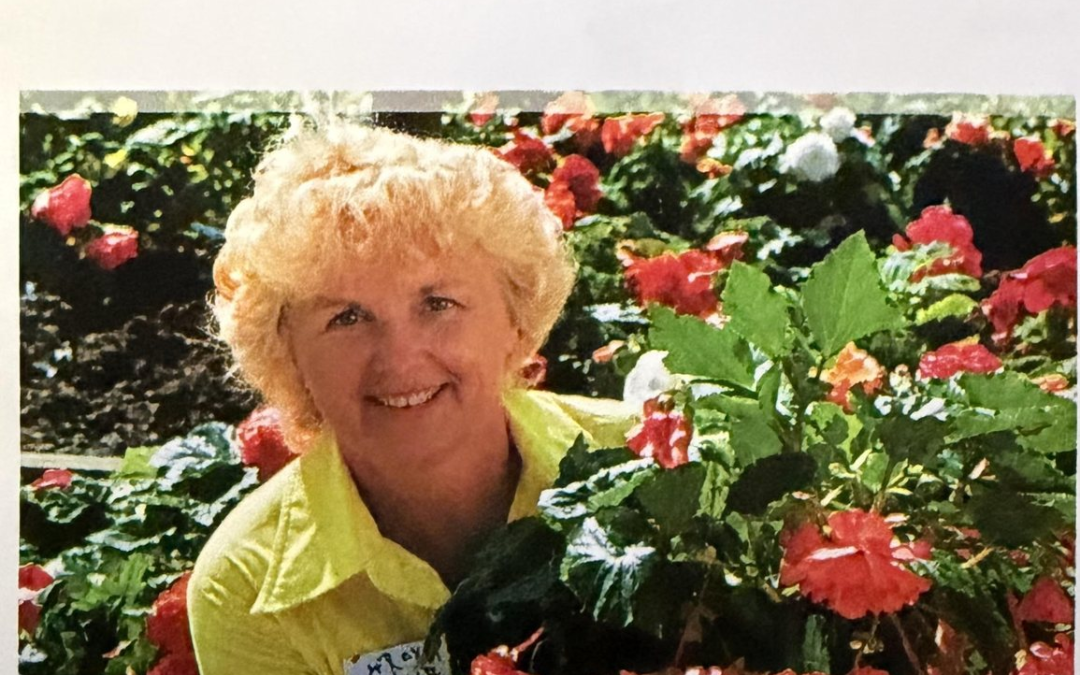
Gardening was Evelyn's lifelong passion. She was born in Northern California in 1929 to Swedish immigrants who owned a nursery, and she had worked with plants since she was seven years old. Later the family moved to Long Beach, where they opened another nursery.
As a young woman she met Bob while visiting his greenhouse business. They married in 1950. Eventually they settled in Encinitas in 1968 because the smog was damaging their plants.
They tried retirement, but it did not last.
One day Bob asked Evelyn whether she would like some begonias. She loved begonias. As a young woman she had even been crowned queen of a begonia show in Long Beach, California.
"Wonderful," she replied.
"That's good," Bob said. "I've bought twenty-five thousand seeds."
That was how the dig-your-own begonia patch began. It was intended to be a small seasonal business, but before long people were coming from all over Southern California. Sunset magazine featured it, and the crowds followed.
When Bob died suddenly in 1988, some people assumed Evelyn would sell the nursery.
They were mistaken.
She had grown up in the business and had no intention of staying at home. She expanded into dig-your-own pansies and brought her daughter Mary into the nursery.
Over the years Evelyn received numerous horticultural awards, locally and across California. In 2001 she was named San Diego Horticulturist of the Year.
"I worked beside her for forty years," Mary said, "and we never really fought."
She said her mother loved bringing people together and never turned down an invitation.
One woman remembered helping Evelyn prepare for a ladybird event at the nursery. Thousands of ladybirds arrived refrigerated so they would remain dormant during transport.
The two women took them out of the refrigerator and began placing them into small plastic containers.
Then the trouble started.
The ladybirds came to life far more quickly than the two women could keep pace with them. Before long they were crawling across the tables, racing up the walls, covering the ceiling and flying around the room. The place descended into chaos, like the famous conveyor-belt scene from the classic television programme I Love Lucy. When the woman's husband walked in, he was greeted by a plague of ladybirds. After a couple of glasses of wine, the two women decided the vacuum cleaner was the quickest solution.
As the stories continued, photographs from Evelyn's life appeared on the large screens while the pianist played quietly in the background.
Among the hymns Evelyn had chosen was Amazing Grace. As the congregation sang, it made for a beautiful farewell.
After the ceremony we spent a little while at the reception, offering condolences and talking with friends.
Driving home, I found myself thinking less about Presbyterian tradition than about the purpose of ceremonies like this.
They are for the living.
They keep the dead alive in memory and story.
They remind us what endures after titles, possessions and achievements are gone.
In Evelyn's case, those memories painted a clear picture.
Generosity.
Kindness.
Compassion.



 English
  Gaeilge