Learn with the article
An aircraft stood on the tarmac.
We assumed it was ours.
Four hours earlier, Sinéad and I had left our hotel at noon for the 45-minute drive to Faro Airport. We would return the rental car and be on our way to Dublin with Ryanair.
That was the plan.
A few days earlier, in the Algarve, a stomach bug had flattened me. I was much better now, but still not quite myself. Luckily, it had struck only after my nephew’s wedding in Alte.
Once we had returned the rental car, we went through security. Then we discovered that, because Ireland is outside the Schengen Area, we also had to go through passport control before reaching our gate.
The line was long, winding and slow.
We shuffled along.
A couple in front of us had three small children. They were doing their best, but it was not easy. There seemed to be more hands needed for the bags, children and passports than the two of them possessed.
The woman told us that her sister had been in the same line the day before.
She had missed her flight because the passport-control queues were so long.
We were suddenly very glad we had arrived so early.
There were automated passport machines beside the line. Anything that might speed things up seemed worth trying.
I scanned my passport.
The machine took my photograph.
Then it took my fingerprints.
A message appeared telling me to proceed to the e-gate.
Excellent.
There was only one problem.
I could not find an e-gate.
I heard other passengers muttering that they could not see one either.
Sinéad had no better luck. The machine could not read her fingerprints.
So we stayed in the line.
Eventually we made it through.
Fortunately, we still had plenty of time to catch our flight.
Passengers were already gathering at our gate. We had paid for priority boarding, so we were among the first called forward.
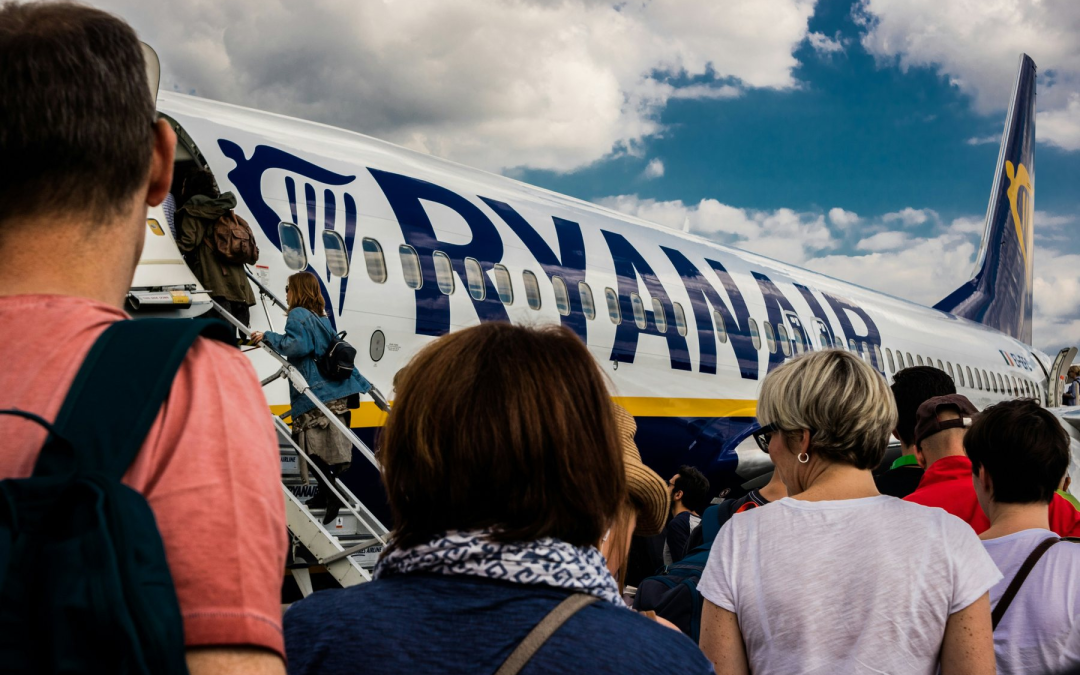
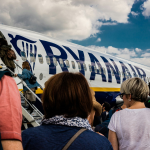
We passed through the gate and were led outside onto the tarmac.
Faro was hot. There was no shade.
We stood there in the sun.
The heat brought the nausea back.
An empty Ryanair aircraft stood in front of us.
Surely that was ours.
A flight crew boarded first.
We were still hopeful.
Then passengers began boarding from another direction.
We watched them climb the steps.
Before long, the steps were retracted and the aircraft taxied off.
There was no other aircraft waiting.
We stayed there a while longer, baking in the sun.
Then a member of staff came over.
We were turned around and sent back the way we had come, across the tarmac and into the terminal again.
We waited there for Ryanair flight 7132 to arrive. That was the aircraft that would take us to Dublin.
FlightAware showed that the flight was about an hour late.
Yet we had already been sent outside to wait for it.
Eventually we saw 7132 taxi onto the runway.
We watched the arriving passengers get off.
Then we waited while the aircraft was prepared for us.
At last came the call to board again.
This time it really was ours: 7133 to Dublin.
By then, there was not much left of the distinction between priority passengers and everyone else.
People pushed towards the aircraft from every direction.
Everyone was on their own.
Eventually we were in our seats.
The doors closed.
The engines started.
I felt a great sense of relief when the ground began moving beneath us.
Flying was not always like this.
When I worked for a multinational company years ago, I crossed the Pacific several times in business class or first class on a Boeing 747.
I loved that aircraft.
You could recognise it before you even reached the gate, with the great hump behind the cockpit. Inside, a spiral staircase led up to the small cabin on the upper deck.
Going up the stairs felt like entering a little world of its own.
There was space and quiet.
Someone welcomed you and took your coat.
But what I remember most is the aircraft itself.
Every takeoff seemed effortless.
The landings were remarkably smooth. Sometimes I barely felt the wheels touch the runway.
I enjoyed every flight I took on it.
Those trips were expensive, of course. Someone was paying for all that space.
My company, in this case.
Ryanair takes a very different approach. It offers seats at low cost. Nowadays, people can travel across Europe at a reasonable price, even to attend a wedding in Portugal.
You book a flight. You pay with Revolut. You get a digital boarding pass. And off you go to the airport.
I would not trade that freedom for a staircase to the upper deck or someone to hang up my coat.
I do not need champagne or a lounge, or even extra legroom.
But no matter how cheap the ticket is, passengers should not be sent out into the sun to wait for an aircraft that is still in the air.
Anyway, eventually we landed in Dublin.
By the time we reached our hotel in Ballsbridge, it was about half past ten at night.
I put down the bags.
For the first time that day, I did not have to scan a passport, stand in a queue or go to a gate that did not exist.
At last, we had found our freedom.
 English
  Gaeilge