
Athmhúintear an Ceacht…
Our garage is also a small gym and a small office. You can enter it from the house through its own door. It has its own key, but I had never had any reason to lock it.
When a few families with young children came to visit recently, I locked the garage door for the first time, so that no child would go in there by accident.
During the visit, I had to go in and out of the garage a few times to get things that were there. After everyone had left, I tried to go back in to return a few things.
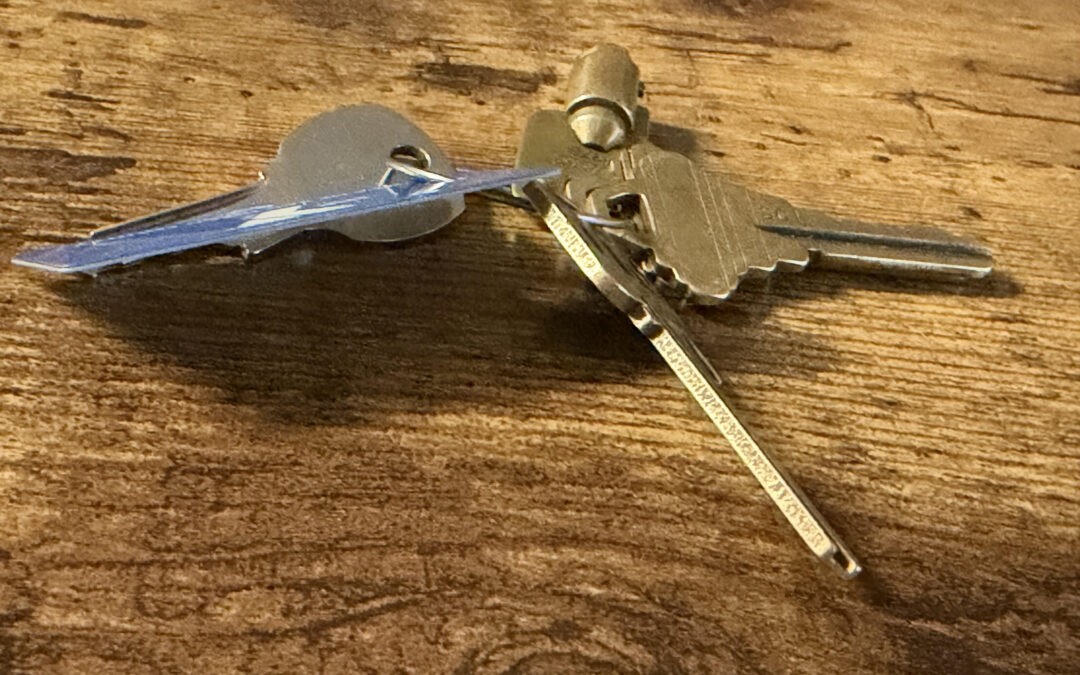
I could not find my keys.
There is a good chance I left the keys inside on my last trip into the garage and closed the door behind me. I could not find a spare key, though I had one. Then it occurred to me that the spare key was inside the garage, which was now locked.
Then I realized how important the garage was in my daily life. That is where I write. That is where I practise guitar. That is where I exercise. It is not elegant or impressive, but it had become a large part of my daily routine.
In the end, I called a locksmith. Fortunately, he was able to open the door without removing the lock and putting a new one in its place. And yes, my keys were sitting there on the desk.
Before he left, I asked him to make a couple of extra keys. I gave one to my wife straight away.
That reminded me of an accident that happened to me last year. For the first time ever, I was not wearing my hiking shoes walking up a mountain. I slipped and broke my ankle.
I realized then that these two incidents in my life were part of a wider pattern.
The real mistake was not that I forgot something. I had changed a routine I had, without putting a new safeguard in place.
A mistake of that kind can be small and annoying, as it was with the garage door. But it can also be much more serious.
Pilots know a lot about mistakes of this kind. In 1987, Northwest Airlines Flight 255 crashed shortly after takeoff in Detroit, in the United States. The National Transportation Safety Board, or NTSB, found that the aircraft took off without the wing flaps being properly set for takeoff. The problem? The crew had not completed the pre-takeoff checklist, and the warning system did not alert them that the plane was not properly configured. The crew failed to carry out an important task, and the warning system failed too.
The World Health Organization, or WHO, studied the use of a simple surgical safety checklist in hospitals in eight cities around the world. The number of major complications fell from 11 percent to 7 percent. The number of patients who died after major operations fell from 1.5 percent to 0.8 percent. It was not that surgeons did not know how to operate. But even skilled people can leave out basic steps when they are interrupted. In many cases, checklists can help avoid mistakes like this. Airlines and hospitals use checklists widely, not only for normal procedures, but also when unusual situations arise. The list itself is not enough, however. It has to be woven into the process. In high-risk situations, that may involve technology, warning systems, and another person confirming the important steps.
I now have my own checklists, for travel and walking, for example. It only takes a minute to go through my checklist, and it helps me avoid mistakes of that kind.
As for the garage door, the solution is now in place. Spare keys are no longer kept in the garage. My wife always has one. Our son too. I now make sure I have my keys any time I leave the car, the house, or the garage.
When I make mistakes like this, the most important thing is to put something in place so they are less likely to happen again.
It is said that the lesson repeats until the student has learned it. I hope I have learned the lesson well from these two recent incidents, and that I will be able to avoid mistakes of this kind from now on.




 English
  Gaeilge