Gníomhartha in ionad na Cainte – 1
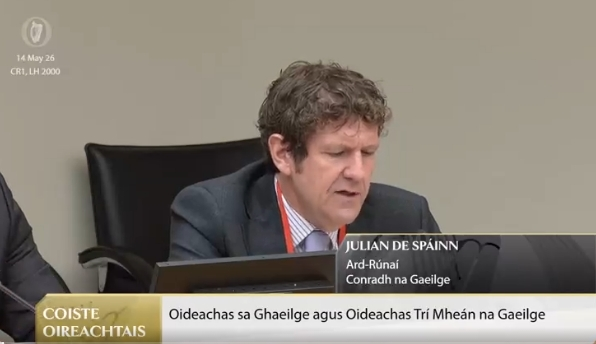
On May 14, 2026, the Oireachtas Education Committee heard two different versions of the state of Irish-medium education in Ireland.
Minister for Education Hildegarde Naughton cited over €500 million spent on building projects for Irish-medium schools since 2020. She reaffirmed the Government’s commitment to expanding opportunities for children to receive an education through Irish.
Then, representatives from Conradh na Gaeilge, Gaeloideachas, An Foras Pátrúnachta, and the lobby group Imeasc spoke.
They described a system struggling with a continuous lack of supply, political reluctance, and official complacency.
Julian de Spáinn - General Secretary of Conradh na Gaeilge, the national organization that promotes the Irish language - used words like “emergency,” “crisis,” “critical situation,” and “pretense” to describe the state of Irish in the education system. He said the Department or the Minister would never give such an honest description, even though the facts are clearly visible.
Lack of Schools
There are not enough Irish-medium schools in the country. It is a language crisis, because the government has never treated the problem as a matter of urgency.
This failure is even more obvious when compared to the Government's own commitments. The previous Programme for Government promised to attempt to double the number of young people in Irish-medium schools and to provide Gaelscoileanna and Gaelcholáistí anywhere there was significant demand. Conradh na Gaeilge told the committee that the number of students in Irish-medium schools outside the Gaeltacht fell from 48,518 in 2019/20 to 46,933 in 2023/24.
At primary level, the evidence has been visible for years. Gaelscoileanna are overcrowded in much of the country. Parents are on waiting lists because there are not enough places. According to Conradh na Gaeilge, only 6.7 percent of primary school pupils outside the Gaeltacht attend Irish-medium primary schools. At the second level, that figure is just 2.6 percent.
Conradh na Gaeilge cited independent surveys showing that 49 percent of people would choose an Irish-medium education if it were available in their own area. In another survey, 78 percent said every child should have the opportunity to get an Irish-medium education if that is their choice. Another 73 percent said every child who receives primary education through Irish should have the opportunity to continue it at the second level. But Irish-medium education is treated as a marginal sector, rather than being a core part of the country's educational infrastructure.
Unfortunately, the situation gets even worse at secondary school level.
Thousands of children finish their primary education through Irish with no Gaelcholáiste available to them. According to the figures put before the committee, around 3,000 students every year are effectively prevented from being able to continue their education through Irish due to a lack of appropriate supply at the second level. Thirteen counties are still without even one Irish-medium secondary school.
Lack of Planning
Despite this, the Department of Education has indicated that it has no plans to establish any new Irish-medium secondary school between 2026 and 2031 outside areas of demographic growth. This position contradicts the will of the public.
The broader system is failing too.
Conradh na Gaeilge told the committee that more than 60,000 secondary school students have exemptions from Irish. In 2025, 24 percent of Leaving Certificate students did not sit any Irish exam. That was the fourth consecutive year that more than one in five avoided Irish in the Leaving Cert. At Junior Cycle level, 20 percent of students did not take an Irish exam, even though almost everyone sat English, math, and history.
The contrast becomes even sharper when this situation is put in the context of the Official Languages (Amendment) Act 2021. Under that legislation, the State has a target that 20 percent of new public service recruits will be proficient in Irish by the year 2030. The legislation places stronger duties on the government regarding the provision of public services through Irish, especially in the Gaeltacht areas.
Teachers, nurses, Gardaí, and civil servants do not become fluent in Irish without a proper education system.
That process starts at the pre-school level. It continues through primary school and secondary school. It depends on opportunities at third level. A clear long-term plan is essential.
No such plan exists at present. Instead, many children have no access to Irish-medium education at all. And for many of those who do get that opportunity, it is lost halfway through their education.
At the third level, the same pattern continues. Important work is underway in institutions like University of Galway and Maynooth University, but education through Irish is still limited in a large number of professional disciplines.
On the one hand, the State has passed legislation to create civil servants with Irish. On the other hand, it has failed to provide the necessary educational supports to fulfill that duty.
Wales — a role model
Wales has a smaller population than Ireland, and furthermore, it is part of a (larger) state where English is dominant. But about a quarter of Welsh schools operate through Welsh, a much higher percentage than Irish-medium schools in Ireland.
More importantly still, the Welsh Government has adopted clear national targets linked to legislation, teacher recruitment, and long-term educational planning. Their goal is to increase education through Welsh from 23 percent to 40 percent by 2050. In 2022, the Welsh Government announced 23 new Welsh schools and an expansion of the language's use in 25 other schools as part of that approach.
Northern Ireland – Overcoming the Difficulties
Northern Ireland provides an even more striking comparison.
Irish-medium education operates there in a much more difficult political environment. There is still strong opposition from some unionist and loyalist politicians. The language is frequently dragged into broader culture wars.
Despite that, the number of students in Irish-medium education in Northern Ireland has been increasing steadily over the last twenty years. Even within a divided political system, legal duties have been placed on authorities to encourage and facilitate Irish-medium education.
If progress is possible there, despite those political difficulties, it is hard to accept our own government's excuses anymore.
For many years, governments have been quite happy to pay lip service to the plight of the language, without suiting their actions to their words.
Therefore, the citizens of the country must put real political pressure on the Government to implement the will of the public.
In the next article, we will examine the steps that are necessary now.




 English
  Gaeilge