Litir ó Mheiriceá –  Aird an domhain ar Mhinneapolis

Letter from America - Global Attention on Minneapolis

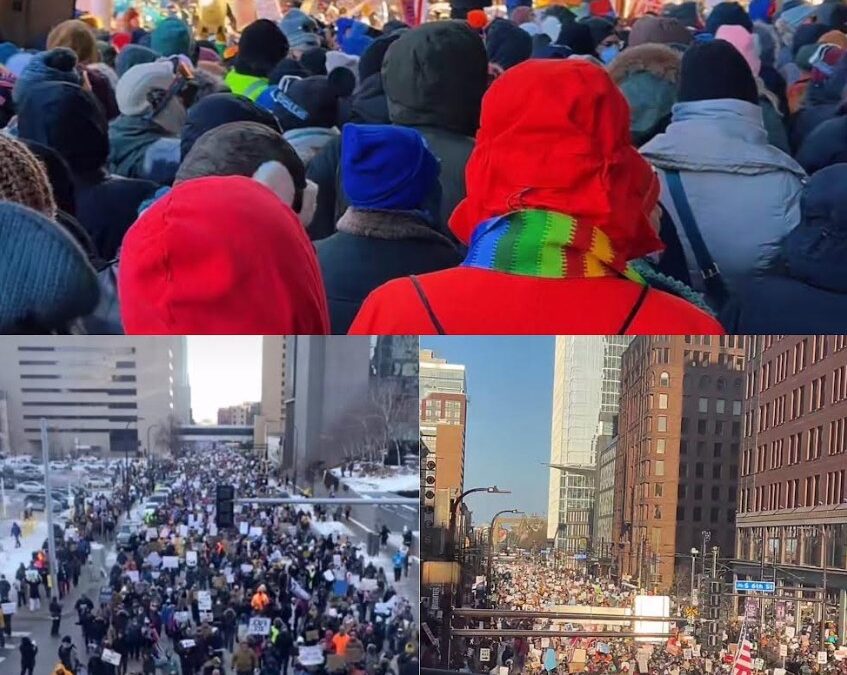
What is unfolding in Minneapolis is no longer only about illegal immigration. It is a stress test of American democracy, with consequences that reach far beyond a single city, a single state, or even a single country.

Two American citizens were killed following encounters with federal agents during protests that witnesses and video recordings show to have been peaceful. Neither had a criminal record. In both cases, senior federal officials applied the label “domestic terrorists” almost immediately, before any independent investigation had taken place and without presenting evidence to the public. In both cases as well, mobile phone footage tells a story that differs fundamentally from the official version.

As seen recently in the pressure exerted by the United States on Denmark over Greenland, American political stability is not a purely domestic matter. When democratic norms are weakened in Washington, the effects are felt near and far. Countries depend on the international system functioning properly and on major powers meeting their obligations. For countries such as Ireland, whose economic and security interests are closely tied to American stability, this erosion represents a practical and real risk.

Peaceful Protests

The streets of Minneapolis saw peaceful protests. The crowd chanted slogans. They criticised agents of the United States Border Patrol (CBP) and Immigration and Customs Enforcement (ICE). They recorded events on their phones. These are all lawful activities protected under the First Amendment of the US Constitution.

Despite this, the video footage clearly shows federal agents responding with force. Pepper spray and tear gas were used. Batons were used. People were pushed to the ground, restrained with plastic ties, and taken into custody against their will, even though there was no evidence of physical attacks by the crowd.

The Killing of Alex Pretti

Federal officials initially claimed that Alex Pretti attacked federal agents while armed with a gun. The video evidence does not support this claim in any way.

Pretti was legally carrying a concealed firearm and had the required permits. He did not draw the weapon.

Pretti saw a woman in distress after an agent pushed her to the ground and sprayed her with pepper spray. He attempted to help her. Pretti himself was sprayed, forced to the ground by six or seven agents, struck by one agent, and had his firearm taken by another. Then, while lying defenceless on the ground, one agent fired shots at him, followed by another agent. He was hit ten times and died.

After the shooting, the scene was not secured in accordance with standard investigative procedures. The agents left without preserving the site or securing evidence.

Pretti was participating in a peaceful protest, activity protected under the First Amendment. He was lawfully armed under state law and under what he reasonably understood to be lawful under the Second Amendment. On that basis, the video footage raises serious questions about the necessity and proportionality of the lethal force used.

The Killing of Nicole Good

The death of Nicole Good followed a similar pattern. She was killed after agents attempted to remove her from her car as she tried to leave. Without any independent investigation, it was officially stated that she was a terrorist, before the facts were publicly examined.

Once again, video footage and eyewitness accounts reveal a clear gap between official statements and what is visible. As in Pretti’s case, federal authorities refused to allow an independent investigation by state agencies or the FBI, asserting that an internal review alone would suffice. As is widely understood, accountability cannot exist when those who use force investigate themselves.

Smartphones

Smartphones have now become one of the most important democratic tools of the modern era. They expose contradictions between official statements and what can be seen in video recordings. They allow the public to witness events for themselves and reach their own conclusions, without relying solely on official accounts.

Minnesota Governor Tim Walz has urged people to carry their phones at all times and to record interactions with federal agents. This is a lawful act. Such recordings create a permanent record that can later be examined by courts, legislators, journalists, and the public.

Authority Without Accountability

In both deaths, federal authorities refused to permit independent investigations. At the same time, Governor Walz and the Mayor of Minneapolis are under investigation after declining to cooperate with CBP and ICE, arguing that state authority and civil rights were being violated.

If these practices continue without challenge, they are likely to expand. Other cities could be affected. Federal agents could be deployed during election periods, placing pressure on voters under the pretext of security. The erosion of civil liberties rarely remains confined to one location.

Authoritarian regimes in Germany, the Soviet Union, and China did not begin with mass killings. They began by portraying dissenters as enemies and demanding obedience in the name of order.

Response

The American public is not powerless. Peaceful protests can be organised. Votes can be cast in elections. Phones can record events. Pressure can be applied to elected representatives, and accountability demanded.

The international community also has a role. Recent US attempts at geopolitical coercion, including pressure related to Greenland, showed that coordinated resistance can work. Unified responses from the European Union and Canada demonstrated what democratic solidarity looks like, without resorting to threats or escalation.

It is now clear that the international system is changing. In light of these developments, it is reasonable for smaller countries to reassess their dependencies and future strategies, while keeping a close watch on the defence of democratic norms.


Litir ó Mheiriceá –  Scéal Dochreidte Donna Hughes-Brown

Letter from America- The Unbelievable Story of Donna Hughes-Brown

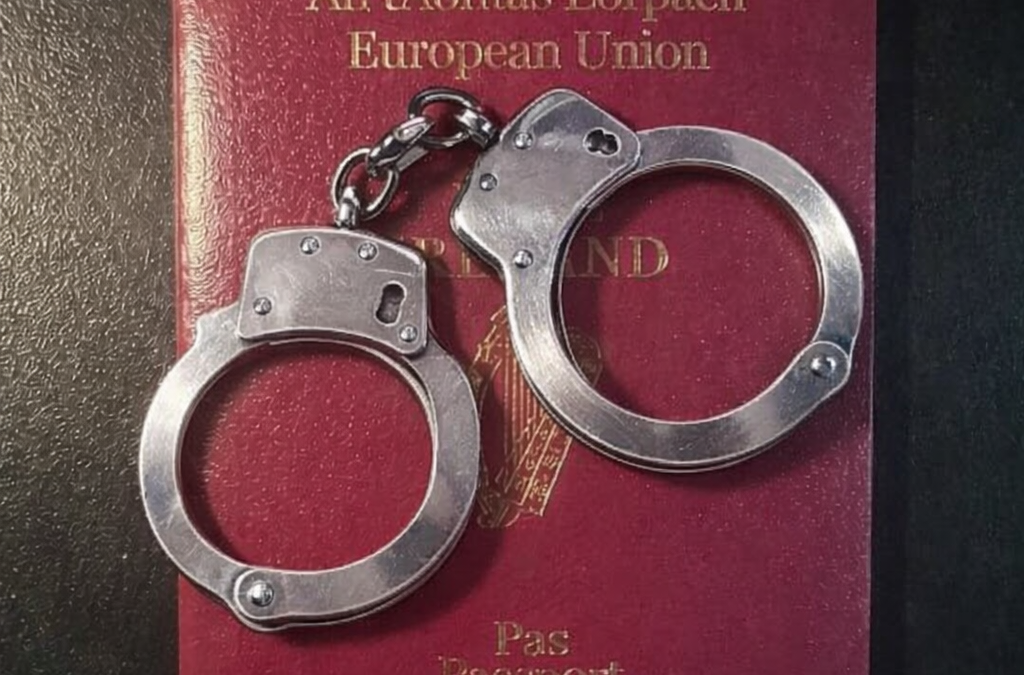
Donna Hughes-Brown has been released from the Campbell County Detention Center in Kentucky, hundreds of miles from her family in Missouri, after spending five months in custody. Her crime? Two bad checks (worth $80 in total) that she wrote at a grocery store more than ten years ago and for which she had already paid restitution.

It is a great relief that this Irish grandmother is now free, after being caught in the net of immigration enforcement currently taking place in the United States (USA). Her husband, Jim Brown, says the policy has "completely devastated" their family and clearly demonstrates the cruelty of the US government.

Unexpected Problem in Chicago

The nightmare began in July 2025. Donna and her husband Jim Brown had travelled to Ireland to attend the funeral of Donna's aunt. It was a routine trip for Donna, who was born in England to Irish parents in 1966 and moved to the United States in 1977 at the age of 11.

Despite having a Green Card for nearly half a century and having travelled internationally many times without any problem, this time was different. According to Jim, Donna had no problem at US Customs Preclearance in Dublin. However, when she landed at O'Hare International Airport in Chicago, the couple was separated.

"She was given entry clearance in Dublin and was arrested anyway," Jim Brown said recently. He was told his wife only needed to sign some documents. Instead, she was handcuffed, detained by Immigration and Customs Enforcement (ICE), and imprisoned in Kentucky.

Trump signed the "One Big Beautiful Bill Act" on July 4, 2025. As part of that bill, the legislation of the Immigration and Nationality Act was amended, stating that the government can arrest people (who are not citizens) who violated any law in the past twenty years. The law came into effect on July 24, when Donna and Jim were already in Ireland.

"Crimes of Moral Turpitude"

Between 2012 and 2015, Donna was a single mother struggling and facing a serious financial crisis. She wrote two bad cheques at a local grocery store.

"They were for less than $80 combined," Jim Brown explained in testimony he gave at a Congressional hearing. "She was charged with a misdemeanor, paid the restitution, and completed one year of probation. That happened ten years ago." Under the new interpretation of immigration law, these misdemeanors are now being classified as "crimes of moral turpitude." On this basis, the government can strip Donna of her right of residency and deport her from the USA.

Important Campaign

Jim has been campaigning for months on behalf of his wife. He admits that he voted for Donald Trump because he believed Trump's promises that immigrants who were violent criminals would be arrested and deported. But he now believes the government is targeting people like his wife to meet deportation quotas.

"Look at the news, and the government isn't telling the truth about what is happening to many legal immigrants," Jim said. "The worst thing is that Trump is so disrespectful to people, so inflammatory and retaliatory, that people are afraid to say anything."

Confrontation in Washington

The case reached a tipping point in Washington, D.C., during a hearing on "Worldwide Threats to the Homeland." Jim Brown stood in the gallery while Democratic representatives placed strong pressure on Kristi Noem, DHS Secretary and a Trump ally, regarding the immorality of Donna being held without trial.

Representative Seth Magaziner of Rhode Island forced Noem to address the human cost of her department's policies. "He is a Navy combat veteran who served our country in the Gulf War," Magaziner said, referring to Jim. "He is married to a woman named Donna who came to our country legally when she was 11 years old... Because of you, Donna has been in prison for the last four months."

When Noem tried to avoid the question, saying she wasn’t responsible for which laws should be enforced, Magaziner pushed back, noting her broad discretion as Secretary to issue parole. Under the gaze of the committee and under the gaze of the distraught husband, Noem finally conceded: "I will review the case."

Pattern of Targeting

Donna's ordeal is not an isolated incident. There are striking similarities between her case and the case of another Irish person - Cliona Ward. Although she has a Green Card, Ward was arrested at San Francisco International Airport in April 2025 after a visit to Ireland, due to minor offenses that also go back almost 20 years. Although Ward was finally released in May, her detention indicated that this new aggressive enforcement strategy was beginning.

Home for Christmas

The story reached a happy conclusion at the critical court hearing on December 18. Despite fears that it would be delayed again, Donna was released from ICE custody.

Previously, Jim said: "Show me where it is written in the Bible that it is right to do something like this. It is wrong, period!" Now, after five months of hardship and uncertainty, Donna will be able to celebrate Christmas at home with her family in Missouri.

"She is one hundred percent innocent. She is in this country legally," Jim said. Now, finally, justice has been achieved for them.

Litir ó Mheiriceá – ‘Operation Absolute Resolve’

Letter from America - 'Operation Absolute Resolve'

Litir ó Mheiriceá – ‘Operation Absolute Resolve’

At daybreak on January 3, 2026, in Caracas, Venezuela, the operation came to a rapid end. The helicopters lifted off. Nicolás Maduro was taken into custody in the United States (USA).

Various explanations emerged over the weekend.

First, on television, Marco Rubio argued that the morning raid was not a war, but an operation specifically aimed at executing an arrest warrant. In this version of the story, the US army merely provided protection to Department of Justice officials as they went about their work.

A few hours later, aboard Air Force One, President Donald Trump gave another explanation. He said that the United States would be "running" Venezuela for a while. American oil companies would move in. The infrastructure would be repaired. Elections would come later.

Rubio’s story and Trump’s story were contradicting each other.

In Caracas, Maduro’s inner circle remained in place. The acting President of Venezuela, Delcy Rodríguez, asked the US to collaborate together.

In 2024, it was widely believed that opposition candidate Edmundo González won a contentious election against the incumbent, Maduro. An exit poll published by the American firm Edison Research showed González leading Maduro 65% to 31%. However, Maduro claimed victory, and González was forced to seek exile in Spain.

González stood in the 2024 election because the opposition leader, María Corina Machado, had been banned from being a candidate. Machado earned international acclaim last year when she was awarded the Nobel Peace Prize.

Shortly after the US operation on Saturday, Machado called on González to "immediately assume his constitutional mandate and be recognized as commander-in-chief." In a statement, Machado said her movement would "restore order, free political prisoners, build an exceptional country and bring our children back home."

Ina phreasagallamh féin, áfach, chaith Trump drochmheas ar mhaíomh fhreasúra Veiniséala chun na cumhachta. Nuair a ceistíodh é go díreach faoi Machado, dúirt Trump le tuairisceoirí: “Ceapaim go mbeadh sé an-deacair di a bheith ina ceannaire. Níl an tacaíocht aici, níl meas uirthi laistigh den tír.”

Police operation or armed robbery?

That raises a question: What plan did the Trump administration have in the first place? The same rotten regime is still in place, and Trump is against putting the winners of the 2024 presidential election in charge of the country, as he ought to do. Therefore, it is hard to see a coordinated US government strategy, which is a cause for concern for us all.

Rubio’s "police operation" tried to keep the raid within known legal boundaries. If it was law enforcement, there is no need to consult the US Congress. International law could be bypassed. The action would be unusual but constrained.

Trump’s explanation blew that approach apart. Running another country to reopen its oil wells is not law enforcement; it is occupation by another name, even if troops do not remain on the ground. In the US government, silence reigned, with Democrats who demanded Congressional oversight overruled by Republicans kowtowing to the Trump regime.

For many years, the post-war system relied on the US as an exemplar regarding compliance with international rules. When the United States used force before, it was in cooperation with its allies and yielding to international agreements.

Operation Absolute Resolve went against those long-established norms. In Venezuela, paralysis is the immediate result. A leader removed from office. A regime left behind. An opposition in exile. An occupying power that insists it is not occupying anything.

Cause for concern in other countries

In other countries, analysis followed quickly after the American operations. An attempt was made to explain this sudden change, not only in terms of the impact on themselves, but on the international order that is now clearly being violated by the US.

In Havana, Cuban state media reported that numerous Cuban security personnel were killed during the raid, confirming what Washington had long claimed: that Cuba was supporting the protection of the Maduro regime.

In Bogotá, Colombia, officials watched the increase in US warships and aircraft with worry. Trump has openly threatened Colombian President Gustavo Petro, accusing him of exporting cocaine to the United States.

In Copenhagen, Prime Minister Mette Frederiksen issued a statement urging the United States to "stop the threats" as Trump reiterated that he needs to acquire Greenland, for security reasons. Greenland, she said, was not for sale.

Trump had spoken about Greenland before. But after what he did in Venezuela, Denmark and Greenland realized that a serious threat was now involved. In Nuuk, the Prime Minister of Greenland wrote online that the rhetoric was "completely unacceptable." It was wrong, he wrote, to link Greenland with Venezuela.

In Brussels, European officials emphasized a distinction. Denmark was one of the founding members of NATO in 1949, along with 11 other countries, including the US. Venezuela is not part of that organization. Different rules apply to NATO, as it is an alliance. There would be major problems if the US took possession of a NATO member state, and there is a high chance NATO would not survive such a serious violation.

Canada was also keeping an eye on matters. Trump has already spoken carelessly about Canada as "the 51st state," a statement once accepted as an inconsequential dispute. After Caracas, however, the Canadian government must pay more serious attention to that threat.

Serious implications

This does not mean American troops will be on the ground in Greenland, Colombia, or Canada tomorrow. That is not how these changes work. But this saber-rattling is just the first step down that road. Therefore, weak countries under threat try to protect themselves by establishing new alliances with parties stronger than themselves. Allies re-examine their relationship with any country that violates international rules.

Competitors notice that they have a stronger argument for violating international rules too. With that new outlook, the invasion of Ukraine looks more acceptable. An invasion of Taiwan would be the same as an invasion of Venezuela. When international agreements regarding state sovereignty break down, everything is at risk. World affairs become much more uncertain and dangerous. The risks of war are raised in general, and that is not a good thing.

Big questions to answer

In Washington, there are big questions to answer. What is Operation Absolute Resolve? What are the milestones of the operation? Are other operations coming?

This confusion is part of the international environment. From Caracas to Havana, from Bogotá to Copenhagen, governments are getting used to not just American policy, but the inconsistency associated with multiple policies that are at odds with each other. That can only end badly. Sooner or later, the co-equal branch of the US government known as Congress must exercise its constitutional powers instead of sitting back and yielding all its power to the president and his friends.

The sooner the better.


An Ghaeilge – 2025

An Ghaeilge – 2025

On a cold November morning at Dublin Castle, a line was quietly crossed. As Catherine Connolly delivered her inauguration speech, Irish carried the day.

For many years, Connolly has been a model in her consistent use of Irish in public life. As President, she made it clear that Irish will also be a central theme of her new role. From the first day onward, Irish will be the working language of the Office of the President. Her staff will operate through Irish.

That is an important decision. As head of state, she will have significant influence over the Official Languages (Amendment) Act 2021, particularly the provision that requires 20 per cent of new public service recruits to have Irish by 2030. With leadership from the top, pressure will be placed on the public service to follow her example.

But the ground had already been shifting.

Tob-Ghaeltachtaí

For at least the past decade, Irish has been gradually returning to everyday life. By 2025, that movement had reached a turning point.

An early signal came from the Pop-Up Gaeltachtaí. The first was founded in Dublin in 2017 and they spread quickly thereafter. By 2025, they had become a normal part of social life rather than a language experiment. They were simple and essential: places to speak Irish without classes or correction. Today, they are found across Ireland and overseas, including in the United States. Pop-Up Gaeltachtaí bridge the gap between having Irish and being able to use it.

Then came a sharper cultural turn.

Kneecap

Kneecap is a politically charged hip-hop/rap trio from Belfast that blends hardcore hip-hop with punk energy. They rap in both English and Irish, addressing working-class life, Irish identity, and political protest. Their sound includes elements of drill, house, and even folk, and their satirical lyrics are often controversial, paired with a raw attitude that attracts fans from the rock and punk worlds.

Their biographical film drew large audiences earlier this year. At concerts, teenagers in football jerseys and retro sportswear shout Irish-language lyrics with the same ease once reserved for English-language music.

This is no longer a marginal phenomenon. It is a movement that reached the mainstream in 2025, with support from the music industry and international media. For the first time, Irish is being seen as a central part of contemporary culture and a source of pride, especially among young people. There is no embarrassment in using the language, even if you only have a few words.

TikTok

Online, the shift is even clearer. On TikTok, Irish is spoken quickly and imperfectly, half-translated, mixed with dialects, nonsense, and memes. You don’t need perfect grammar. Taking part matters more.

“It’s no longer about being precise,” says Ciara, a nineteen-year-old student at UCD who runs a popular Irish-language account. “If you waited until you were happy with the standard of your Irish, you’d never speak. Now, you just start.”

Belfast

If there is one place that shows the scale of the change, it is Belfast. In October, Belfast City Council adopted a full Irish-language policy, backed by £1.9 million in funding. Bilingual signage. Services. Visibility. Ten years ago, such a move would have been unthinkable.

In 2025, however, the political and cultural context had shifted dramatically, with Irish now viewed as a public asset rather than a political flashpoint. The difference now is the presence of clear targets, resources, and public visibility. Irish has moved from promise to practice. This is a practical example of what can be achieved when policy and community align.

In the Gaeltacht Quarter, the impact was immediate. Irish on vehicles. On signs. On walls. A clear message being sent: the language belongs to us.

The change is also reaching higher education. From the 2026–27 academic year onwards, Queen's University Belfast will offer new degree programmes in Law and Broadcast Production through Irish. It is a clear statement of intent. Irish is a living language, not only in the South but in the North as well.

Looking ahead: 2026

The Action Plan for Irish in English-medium schools aims to tackle a familiar outcome: years of study with little confidence. Less emphasis on rote learning. More conversation. More use.

Abroad, demand continues to grow. Irish classes are filling quickly. In San Francisco, waiting lists already exist for courses beginning in early 2026.

There is still work to be done. Policy, funding, and infrastructure will determine how lasting this moment will be. But 2025 was a decisive year — not because of a new vision, but because of new usage. Irish has left the margins and returned to everyday life. That is what will drive the language forward in 2026.


Litir ó Mheiriceá –  Ag Lúbadh na Rialacha ar Muir

Letter from America – Bending the Rules at Sea

In the azure depths of the southern Caribbean, far from the prying eyes of the public, a fundamental change occurred in the United States’ approach regarding drug smugglers at sea.

On September 2nd, the US military struck its first lethal air strike against a boat suspected of smuggling drugs. A significant new directive was involved: Kill smugglers at sea instead of arresting them. This is not how the rules worked in the past, and a storm of controversy has been whipped up about this in Washington D.C. currently.

The Target

Intelligence reports linked the boat to the Tren de Aragua, a Venezuelan gang recently designated by the US government as a Foreign Terrorist Organization. According to every previous government, it was the US Coast Guard that would deal with a boat like this. They would fire a warning shot across the bow before boarding. They would arrest the smugglers, seize the evidence, and the accused would face trial in a court of law.

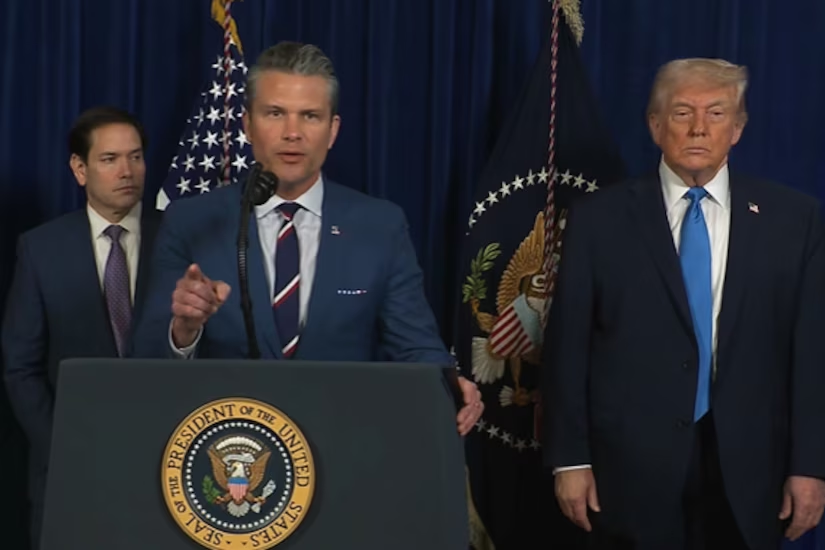
But with "Operation Southern Spear," the rules were rewritten. According to the government, led by President Donald Trump and Secretary of Defense Pete Hegseth, drug smuggling is equivalent to an armed invasion, which justifies a military response rather than a law enforcement one.

The First Strike

The operation began with a precision attack. A guided missile struck the vessel in its center to break the hull and detonate the boat's fuel stores. That explosion smashed the fiberglass structure to smithereens, and nine of the eleven men on board were killed instantly.

The destroyed boat capsized. Debris and bales of cocaine were scattered on the water. Immediately after that, surveillance drones flew over the scene transmitting live video back to command centers in Florida and the Pentagon. The footage revealed an unexpected problem: two survivors.

Shirtless and unarmed, the two men managed to climb onto a floating section of the keel. They were adrift in remote international waters, their vessel destroyed and their comrades dead. They were defenseless and helpless.

The Second Strike

Soldiers who are hors de combat—those removed from the fight due to injury or shipwreck—have protection under the Geneva Conventions. Under the terms of the Conventions, there is a duty to rescue them if possible, and it is not permitted to kill them.

Despite this, the operation commander, Navy Admiral Frank "Mitch" Bradley, ordered a second strike to hit the debris where the two were sheltering.

It was reported that drone video showed the two survivors waving their hands beforehand. The interpretation of this signaling would be the basis for a heated political battle later. According to Democratic lawmakers and human rights observers who saw the video, it was clear the men were in distress, making signs of surrender or rescue. They had no radio, no weapons, and no means of movement.

For the government and its defenders, however, the hand waving was interpreted differently. Senator Tom Cotton and military officials claimed the men were signaling to cartel boats in the area, and therefore they were still fighting and trying to salvage the illicit cargo. It was reported that Admiral Bradley assessed that the debris, which possibly still contained cocaine, was a valid military target for destruction.

In any event, on the admiral's orders, a second series of munitions struck the debris. The two survivors were killed instantly.

Legal and Ethical Controversy

"The term we have for a premeditated act like that outside of armed conflict is murder," said Brian Finucane, a former State Department lawyer, in an interview after the incident. "It is patently illegal to kill a person who has suffered a shipwreck."

The government's defense relied on the targets. By designating the crew as "narco-terrorists," the Pentagon claimed that those smugglers were unlawful enemy combatants who posed a continuous threat to US national security. Secretary of Defense Hegseth defended the decision strongly, saying: "If you bring drugs to this country in a boat, we will find you and we will sink you."

But for over a hundred years, since the US made its first opium seizure at sea in 1886, dealing with drugs smuggled at sea was a policing act, not a military one. People were innocent until proven guilty; evidence was gathered; trials were held. But in this case, Hellfire missile attacks replaced due process of law.

The Consequences

In the months that followed this incident, US forces carried out over 20 other attacks like this, killing more than 80 people. Among them were Colombians, Venezuelans, and citizens of Trinidad and Tobago. Although the US claimed they were all terrorists, families of the dead said they were poor fishermen forced to engage in smuggling—temporary workers who had no knowledge of the wider geopolitical war.

A major problem was also the lack of transparency. The names of the dead were not released initially. No bodies were recovered for post-mortem examination. The "evidence" went to the bottom of the Caribbean Sea.

In Washington, investigations began, demanding to find out if an illegal order like "kill them all" had been issued. Although Admiral Bradley testified that he received no such explicit order from Pete Hegseth, at the same time, he himself ordered the second strike. That indicates the kind of culture involved in Operation Southern Spear.

A New Era of Warfare?

What happened on September 2, 2025, serves as a grim milestone in American foreign policy. That is the day the US ignored the Geneva Conventions by killing defenseless survivors.

That horrific behavior also raises uncomfortable questions: Can a government unilaterally declare that criminals are soldiers? And if so, do they then have the right to kill them without due process, especially those who are hors de combat? What is the Geneva Convention worth if it is ignored?

Congressional hearings and lawsuits will take place to deal with this horrific incident and to answer those questions. Although it is presumably clear to us all what the right answers are, will the US government share that view—a government under the control of President Trump, who has absolutely no respect for national or international rules?


Leorghníomh aithreachais!

An Act of Reparation!

A group of people gathered together beside a lake on a very cold day in October in northern Wisconsin. There was a carpet of multicoloured leaves on the ground. Both nuns and Native Americans from the Lac du Flambeau Band were present.

During the ceremony, the nuns gave the land title to the delegation of Indigenous people. What was involved was two acres of land, which included a cluster of cabins, and a house called the Marywood Franciscan Spirituality Centre. The sale price: $30,000, exactly the amount the order of nuns paid for it 60 years ago. Its valuation today? Around $2.6 million.

In contrast to the land acknowledgement that is common at meetings on stolen land and which is nothing more than a symbolic confession, this was the real thing: the first known case of a Catholic institution in the United States voluntarily returning land to a tribe as an act of reparation.

"We wanted to do more than just say we were sorry."

Sister Eileen McKenzie, president of the Franciscan Sisters of Perpetual Adoration (FSPA), told reporters that the order had spent two years researching the history of the land. They learned that the property was on the traditional territory of the Lac du Flambeau Band, from whom land was stolen through broken treaties.

"We wanted to do more than just say we were sorry," she said. "We wanted to change the story, even in a small way."

The nuns made the decision after painful reflection. FSPA helped run a Catholic boarding school that separated Indigenous children from their families and their culture. That is a shameful legacy not only for FSPA but for Catholics and Protestants throughout North America, as unmarked graves are still being found in every corner of the continent.

"It felt right to give something back," McKenzie said. "This land wasn't ours to begin with anyway."

An emotional homecoming with fond memories

For the Lac du Flambeau Band, there was deep emotion associated with the moment. Tribal President John Johnson Sr. called the act "a step toward restoring balance."

He spoke about elders who remember fishing on that same lake, and about the old paths that used to go through the forests. "When you return to land that knows your name, you feel something inside settling," he said. "That's not a question of ownership. There's a deep connection between our tribe and this place."

The tribe intends to keep the property as a place for healing and cultural renewal — a place where people can gather, stories can be told, and ceremonies can be held on land that is once again under their care.

"It's like a circle closing," Johnson said. "The land remembers us, and now we can remember it."

The quiet revolution called 'Land Back'

Throughout the United States, a growing movement called 'Land Back' is challenging the concept of land ownership. It's considered a critically important effort, and tribes and allies are negotiating, fundraising, and sometimes going to court to reclaim ancestral lands.

What's most striking about this story is the way it happened. It wasn't a government order or a court settlement — but a group of elderly nuns who decided among themselves to do the right thing.

"This changes the moral temperature," said historian and Indigenous rights advocate Nick Estes, who has written extensively on the Land Back movement. "When you see people of faith — people whose institutions benefited from our dispossession — voluntarily giving land back, it opens hearts and possibilities."

More important than just the land

Land is just earth and trees. But for Indigenous Nations, there's memory, language, law, and identity in it. Their culture and the land are interwoven. When they get even a small piece back like this, it makes a huge difference to them, because it begins the reversal of the loss.

Sociologist Dr. Danielle SeeWalker, who studies Indigenous reconciliation efforts, put it simply: "Each acre that's returned is like a heartbeat restarting. You can't measure that in dollars."

For the nuns of FSPA, returning their land to the tribe is an important step. "Francis of Assisi taught us to repair what is broken," Sister McKenzie said. "In this era, perhaps this is what is broken and needs repairing."

A sign, not an ending

This is unlikely to be the end of the story. It's reported that other Catholic communities are doing deep reflection on their own role regarding boarding schools and the land associated with them.

Questions have been put to both the Jesuits and the Benedictines about property that was connected to missions or schools for Indigenous children.

Legal experts believe that voluntary acts like this could influence public policy — showing that reparative transfers like this can be done without ten years in the courts. "An act of reparation like this can be viewed as an act of relationship instead of a political fight," said one law professor.

But the nuns themselves insist they're not seeking praise. "We're not heroes," McKenzie said. "We listened, that's all."

Conclusion

When the ceremony ended, the group formed a small circle, passing around a wooden bowl full of water from the lake. An elder of the tribe blessed the site in his native language - Ojibwe - and the nuns sang a Franciscan hymn. The wind carried their voices over the trees and up into the sky, spreading the hopeful message across the world, without limit, without restraint.

In a country full of empty promises and where money is a false God, an act like this is rare. But by setting down a single example, it's likely that the small group on the edge of the lake has begun inspiring a new movement that will be far greater than they know.

As you reflect on this, think about how we ourselves can do acts like this that will give support to minority and disadvantaged groups in our own country - groups like legal immigrants and the Travelling community.

And we can always support efforts that will promote the Irish language and the preservation of our culture. Look at what President Catherine Connolly is doing in Áras an Uachtaráin, for example, regarding the use of the language.

Finally, in the famous words of Margaret Mead: Never doubt that a small group of thoughtful, committed citizens can change the world; indeed, it's the only thing that ever has.


en_USEnglish