
Litir ó Mheiriceá – Tuilte i Texas!

Letter from America - Floods in Texas!

More than 120 people have died so far and a significant number are still missing after catastrophic flash floods swept through central Texas, USA, on the morning of July 4. Communities along the Guadalupe River, particularly in Kerr County, in the heart of a region known as the Hill Country, have been hardest hit by the flooding.

A terrible tragedy struck Camp Mystic, a summer camp for girls near Hunt, Texas. Located directly on the banks of the Guadalupe River, the camp was overwhelmed early on July 4th when the river rose more than 26 feet in less than an hour. The cabins were submerged before staff could put evacuation plans into effect in time. Not only were the old cabins not moved from the banks of the Guadalupe, but during a 2019 expansion, new cabins were allowed to be built in other areas of the camp, some in areas that were still at risk of flooding. The cabins closest to the river remained in place, despite being located in areas known as “floodways,” areas that are off-limits in many other states. No relocation strategy was devised. The most at-risk buildings were still in use when the disaster struck.

As of July 8, at least 27 campers and counselors have been confirmed dead, including the camp’s longtime director, Richard “Dick” Eastland. 10 other girls and one staff member are still missing.

While some people believe that little could be done given the speed of the flood, the story at Camp Mystic tells a different story. Some cabins were located on slightly higher ground, about 400 meters from the lower ones. The girls in the upper cabins survived. Only those in the lower cabins were lost. If they had had even five minutes of warning, they might have been able to initiate a partial evacuation, or at least alert the staff. The people did not fail. The system failed.

We extend our heartfelt condolences to all the families affected in any way. This is a time of grief and sorrow. Still, we must ask and answer hard questions openly, if we are to be better prepared for the next such disaster.

The Case of Kerr County: No Sirens, No Warning

Like much of the Hill Country, the people of Kerr County have a long history of flash floods. The area is so prone to flooding that it has been nicknamed "Flash Flood Alley." With steep limestone terrain, shallow soils and narrow rivers, it is susceptible to sudden bursts of water, especially when moist air moves in from the Gulf of Mexico, as happened with the recent Barry storm.

But despite the ongoing risk, Kerr County still doesn't have a siren. "We don't have a warning system," County Judge Rob Kelly said bluntly at a press conference. Nearby counties, such as Comal and Guadalupe, have had sirens installed for years. In New Braunfels, about 60 miles away, the warning system is tested monthly. A similar system was considered in Kerr County back in 2016, but Commissioner Buster Baldwin rejected a $50,000 engineering study, saying: “I see the word ‘sirens’ and all that stuff here.” Now, families are asking why that decision was never revisited, especially after the floods in 2018 and 2021 that exposed the same vulnerability. An online petition on Change.org is demanding a modern warning system. Nicole Wilson, who lives in San Antonio and grew up in Kentucky, said: “They know it’s needed. They’ve acknowledged it. They’ve just never been able to implement it.”

Texas Lieutenant Governor Dan Patrick went even further, referring to the upcoming special session of the legislature: “If the city can’t do it, let us do it… If there was a siren, it could make a difference.” For some Camp Mystic families, five minutes could have been the difference between life and death.

Flaws in the response system that saves lives

Lack of Sirens: Kerr County didn’t have a siren system. Many people, including those in Camp Mystic, received no warning before the flood hit.

Weaknesses in Digital Alerts: Warnings were sent via text and apps, but people were asleep or in areas without coverage. Timely warnings weren’t given until water was in homes.

Poor Coordination Between Agencies: There was a breakdown in communication between rescue teams and emergency services. Air rescues were called twice, and some responses were severely delayed.

Failure of Regulation and Planning: Local authorities allowed buildings to remain and new ones to be built in areas at high risk of flooding. They left cabins near the river even though they knew there was a risk of disaster. No steps were taken to protect people.


Steps to be taken

  1. Warning System: Every county with a history of flooding must have a warning system. If counties don’t have the resources themselves, the state or federal government should pay for one.
  2. Comprehensive Alert System: Text messages alone aren’t enough. The public needs to receive alerts via sirens, radios, cell phones, and if necessary, person-to-person.
  3. Shared Tracking and Planning Systems: Emergency agencies need to be able to easily share real-time data and mapping. Everyone needs to be on the same page.
  4. Stricter Rules: Local and state governments need to tighten building regulations in high-risk areas, especially in “floodways.” Cabins of any kind should not be allowed in the most vulnerable areas without independent review.

Missed Opportunity — or one Still to Be Seized?

Last March, House Bill 13 was introduced in the legislature. It proposed a plan for a statewide warning system and funding for rural counties. It failed. It was said to be too expensive.

But now, the cost is being measured in lives instead of money.

The Test Ahead                    

This disaster clearly shows what happens when human life is not prioritized. The upcoming special session in Texas can fix this. I urge them: Fund the sirens. Close the communication gaps. Coordinate the response. Enact the right legislation.

Every state and country has a lesson to learn: Prepare for climate disasters in advance, and provide the right funding at all levels. If we ignore this lesson, it will come back again and again – until it is learned.

Saoire ar Árainn – Cuid 2!

Saoire ar Árainn – Cuid 2!

During our previous visits, I was determined to speak Irish to the locals. Although they spoke Irish, they only spoke English to me – in the shops, in the restaurants, in the pub. It really bothered me that I was treated that way. I couldn't understand why the locals wouldn't speak Irish to me. I was disappointed, as I thought Irish would be the normal language of the island.

I understand now. Árainn is crowded with visitors during the summer, boat after boat discharging crowds of passengers non-stop, from the beginning to the end of the season. Tourists come from all over the world, speaking many different languages. English is the main language of world commerce – on Árainn too. In addition, many people working in the services on the island do not speak a word of Irish. For these reasons, the islanders only speak English to visitors. When they talk to each other, they speak Irish. And if they know you well, they speak Irish to you without issue. I think they do not know that they have this habit, and that it is a practical thing that has happened over time, and is now part of their culture.

This trip, we had a great week on the island. We were busy the whole time - between walks, cycling, seeing the sights, and meeting people. Here is a little taste of the fun that we had.

Blowholes
We rented a couple of bikes. Cars are not usually allowed from the mainland. You see a lot of people on bikes on the island, especially when the weather is nice. The weather was not bad during our visit and we walked and cycled every day. Our first adventure was to visit blowholes. There are a few places on the island that have blowholes, and we went to the closest ones. These holes are formed by sea caves that have tunnels up to the surface, and when the sea is rough, they blow water up through the holes. We cycled to the beginning of a path next to the low road and walked down to the bottom of the beach. There was a sudden drop in the limestone at the edge of the shore, and a little further back, the holes were visible in the stone. Looking down into them, you could see the tidal water below them. Every time the waves came in, the water rose in the holes, and blew out through the holes and up into the air. There was a terrible noise to be heard – a crashing and throbbing that occurred between the limestone and the sea below. One can only imagine what it would be like in rough weather.

Dúchathair Fort

Another fine day, we cycled to the start of the path to Dún Dúchathair and walked the steep path up to the fort. Although this fort does not have a visitor centre, unlike Dún Aonghasa, it is just as impressive in some ways.

It is set high on the cliffs above the sea and has a beautiful expansive view along the coast. You can climb over the walls of the fort and enter the inner courtyard. The courtyard is surrounded by the fort on one side and by large cliffs on the other. Spend some time in Dún Dúchathair if you get the chance.

Aran Sheep: Aransheep.ie by Máirtín Ó Flaithearta

On the path to Dún Dúchathair, there is a sign outside a house: Aransheep.ie. We know the owner, Máirtín Ó Flaithearta and he made us very welcome. He showed us around his shop, which is also a museum, in reality. There was a lot to see and Máirtín had yarn from different breeds of sheep. There are Aran sweaters, blankets and caps on display, as well as a collection of different yarns. There are interesting maps and posters on the walls, showing all sorts of things about sheep, including the distribution of sheep in different parts of the world and different breeds of sheep. There is a big screen in the room and also plenty of chairs, for playing a video or giving a lecture. Máirtín is building another room, so that he has more space. We were there for over an hour, and we really enjoyed it. It is well worth a visit if you have the chance.

Midsummer's Eve

Midsummer's Eve is celebrated on July 23rd, a day when bonfires are lit on the island. It is a remnant of an ancient pagan festival, which used to be a midsummer celebration, associated with the fertility of the land and the worship of the sun. The fire is the heart of the celebration as it is a symbol of brightness. There were specific rituals associated with the celebration but I don't have the space here to discuss them.

Anyway, we visited Seán who had a bonfire lit, which he does year after year. People were coming and going all the time, and it was a great social event. There was a nice smell of peat from the fire, and the weather was reasonably good. Seán offered us drinks and snacks, and we had a nice chat.

There were more cars than usual driving around the High Road. As it turned out, the famous actor Patrick Duffy, the star of the TV series Dallas, was on the island, and according to the rumor he was in Bunghabhla. We didn’t stand idly by either. Curiosity got the better of us, and Seán drove us around the island looking at all the other fires. Quite by accident, we drove through Bunghabhla, but there was no sign or report of the star. But of course, it was a great evening, celebrating ancient traditions with the islanders, and searching for Patrick Duffy!

Conclusion

That’s just a small taste of what we did during our visit to the island. While the island itself is excellent in terms of natural beauty and archaeology, the people of the island are the heart of the place. If you get the chance, visit Árainn – you won’t regret it.


Saoire ar Árainn – Cuid 2!

Holidays on Aran island - Part 1

Three islands lie as rocky sentries between Galway Bay and the Atlantic Ocean: Inis Oírr, Inis Meáin and Árainn. They are known as the Aran Islands, and though they sit on the edge of the country, they are at its very heart, serving as protectors of our language and culture. The people of the islands are living proof of that. The history of Ireland can also be seen in nearly every place you step foot on.

It’s no surprise that my wife, Sinéad, and I go to Árainn whenever we get the chance. We love the Irish language and culture. Sinéad is an archaeologist, with a deep tie to Aran from the standpoint of archaeology, and so the island is a kind of paradise for her—essentially a living museum of archaeology and history.  

Prehistory and History

There’s a lot to see dating from the Late Bronze Age (1200–600 BCE) onward. Dún Aonghasa was built around 1100 BCE and expanded later around 500 BCE. The fort is perched on the edge of a cliff, with massive stone walls and defensive spikes surrounding it. It’s a truly awe-inspiring sight. Dún Dúchathair and Dún Eoghanachta are from the same era—they're not as well known as Dún Aonghasa but still impressive.

Around the 8th century, the island emerged as a center of monastic and religious life. Teampall Bheanáin, a tiny church on a hill above Cill Rónáin, is one of the smallest churches in Ireland. It is dedicated to Benen, a follower of St. Patrick.

Pilgrims used to come from the mainland to the Seven Churches, an ancient monastic site that thrived during the medieval period. There are religious ruins there, including churches, stone shrines, and graves. It was one of the most significant Christian sites on the Aran Islands.

There are many other sites to visit on the island as well, including Teampall na Naomh, Teampall Mac Duach, Teampall an Cheathrair Álainn, as well as a range of holy wells and stone altars. Sinéad conducted an important archaeological excavation on Mainistir Chiaráin, in which were uncovered noteworthy features and artifacts. There is a lot to tell about this excavation, but that is a story for another day and another article.

Bronze Age people first settled the Aran Islands, followed by Celtic tribes during the Iron Age. From the 5th century on, the islands became a Christian hub. For the most part, the island communities have remained faithful to their culture and language right up to today.

Tourism

Even so, one mustn’t forget the major changes that have had a significant impact on the islands and their inhabitants over time. Tourism began on the Aran Islands at the end of the 19th century, when writers, artists, and scholars started arriving. They appreciated all the islands had to offer—an ancient culture still being lived, and a unique natural beauty beyond compare.

During the 20th century, tourism gradually expanded. It was once difficult to land on the Aran Islands, but nowadays there are regular ferry services from Ros a’ Mhíl, Doolin, and Galway, and since the 1970s, short flights have been available from Connemara Airport. In recent years, interest in the culture and nature of the islands has grown tremendously, and people love to get out exploring on foot and by bike. These days, visitors come not only from Ireland but from all over the world. Tourism is now an important part of the local economy, although it is still seasonal compared to many other places.

Arrival on Inis Mór

This time, we were passengers on the latest addition to the Doolin Ferries fleet: the Cliffs of Moher Express. This boat is much faster and larger than the others. It’s also fitted with stabilizers for a smoother journey. The trip was excellent—very smooth. That’s great news for me, as I don’t have the strongest stomach for the sea.

We had booked an Airbnb near Tí Joe Watty’s, close to Cill Rónáin. We had stayed in the same small house before—a comfortable place with every convenience, including a fully equipped kitchen. As soon as we stored our bags, we headed straight to the Spar to do our shopping. The manager welcomed us warmly, and we chatted for a moment about how things were going. It was lovely to be back on Árainn again!

Concert

As we were leaving the store, Sinéad spotted a poster advertising a concert that same evening in Halla Rónáin. The featured act would be singer-songwriter Susan O’Neill. Susan O’Neill (or SON) is a talented performer from Ennis, County Clare, who blends traditional music, rock, blues, and soul with a powerful and distinctive voice. She gained acclaim for her collaborative album with Mick Flannery, In the Game, and she’s now one of the most exciting artists in Ireland.

We bought our tickets online and, after a delicious meal at home, walked down the road to Halla Rónáin. The opening musicians were good, but when Susan O’Neill took the stage and started performing, we were captivated from the very first note. She uses live-looping techniques to layer vocals, trumpet, and other instruments skillfully—creating a rich, textured, and powerful sound. The show was outstanding, and we thoroughly enjoyed it—a perfect start to our holiday!

…More to come.

Oilithreacht Bhliantúil chuig an gCainneon Mór – An Fáinne á Chríochnú Againn

Annual Pilgrimage to the Grand Canyon – completing the circle!

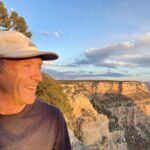
I told you about my first hike in the Grand Canyon, many years ago. It was so amazing that I’ve never forgotten it. Let’s jump ahead to the most recent hike my wife and I did. In this case, we went down from the south rim, to the Colorado, and then came back up to the same rim – a 30 kilometer hike or so. We assumed it wouldn’t be too difficult for us.

We had everything ready the night before – clothes, shoes, water, snacks, poles and backpacks. We got up early in the morning at four o’clock, and were on the trail (Bright Angel Trail) by five. It wasn’t hot yet (15C) and the sun hadn’t risen yet. We had a good pace and were making good progress.

Fossilized remains

My wife Sinéad is an archaeologist, and she saw a large rock by the side of the trail with noteworthy markings. She immediately recognized them as animal fossils, and we spent time looking at them and taking photos. Later, after the hike, Sinéad did more research on them, and it was an interesting story. In 2016, a Norwegian geology professor, Allan Krill, was hiking with his students when he saw a large rock with fossilized markings. Krill was curious, and sent a photo to his colleague, Stephen Rowland, a palaeontologist at the University of Nevada Las Vegas.

The tracks along the trail are even more remarkable than Krill first imagined. “These are by far the oldest vertebrate tracks in the Grand Canyon,” says Rowland. “Even more remarkable,” he said, “they are among the oldest tracks on Earth of animals that lay eggs without shells, such as reptiles, and the earliest evidence of vertebrates walking in sand dunes.”

The large rock that contained the track fell from a nearby cliff – in the Manakacha Formation. Researchers were able to date the tracks to 313 million years old. It’s incredible that the rock fell right next to the trail – and that Sinéad saw it too. I didn’t see it at all. But that’s the kind of thing you see in that canyon, because you’re walking back through the history of the earth itself. While the Grand Canyon is only 5 or 6 million years old, some of the rocks there date back as far as 1.8 billion years – from the Precambrian to the Paleozoic Era! The hike was worth it just to see the tracks.

Native Heritage

We continued walking and before long, we reached Havasupai Garden. The name was changed from Indian Garden to Havasupai Garden in 2022 to honor the Havasupai people, a tribe that had lived in the Grand Canyon for generations. The area, known as Ha’a Gyoh (“where the water comes up”) in the Havasupai language, was used for farming and seasonal migration.

In the 1920s, the Havasupai were forcibly removed from the Canyon by the National Park Service when Grand Canyon National Park was established. Captain Burro was the last of the tribe to be evicted. Indian Garden was a derogatory name that did not acknowledge the tribe’s valuable heritage in the canyon.

After many years, the tribe’s request to change the name to Havasupai Garden was granted. This is a recognition of the indigenous heritage, historical injustice, and the tribe’s ongoing cultural connection to the place.

The Grand Canyon is a historic place, not only geologically, but also in terms of human history. While the Havasupai have been here for over 800 years, Native Americans have been there for about 12,000 years. There are 11 tribes associated with the Canyon.

We had food and drinks at Havasupai Garden and then walked about 4 kilometers down towards Pipe Creek. The Bright Angel Trail descends gently through red cliffs and steep bends like Devil’s Corkscrew, with steep slopes in some sections. We crossed the creek a few times before reaching Pipe Creek. We ended up near the Colorado, but the River Trail – a trail along the river leading to Silver Bridge – was closed, due to work being done on the trans-canyon pipeline.

Slogging our way back, step by step

We turned around at that point, and retraced our steps back to Havasupai Garden. The heat was rising rapidly by then. The temperature was about 27 degrees Celsius at 11am between Pipe Creek and Havasupai Garden. The hike from Havasupai Garden to the 3-Mile Resthouse was challenging, especially in the midday sun. Water, regular breaks, and protection from the sun are essential here. We weren’t feeling great by the time we got to the resthouse and sat in the shade to rest for a while. It took another hour to get to the 1.5-Mile Resthouse, where we took another nice break. Then, we walked slowly, struggling, step by step, until we reached the edge. We were exhausted and a little sick from the heat. The temperature was about 32C when we finished the hike.

We were so happy to be out of the canyon, and decided to go to the Grand Canyon earlier in the year next year, and to be on the trail earlier in the day as well, at four o'clock. Despite the difficulties we faced, we are really looking forward to our next visit to the Grand Canyon.

Oilithreacht Bhliantúil chuig an gCainneon Mór – ar chosán North Kaibab!

Yearly Pilgrimage to the Grand Canyon - on the North Kaibab Trail!

In the last paragraph, we reached our ‘Shangri-La’, when we entered the restaurant at Phantom Ranch. There was only one problem - we would have to leave that sanctuary soon. The relentless sun was waiting for us, and was getting stronger and stronger in the meantime. Finally, our leader - a muscular middle-aged man named Joe - stood up and urged us into action.

“It’s almost nine o’clock already. We’ve done 16 kilometers, with 23 more to go. And there won’t be much shade on the way up. We’ll have a break after 11 kilometers, and water will be available there. Get some water now, and put water on yourself and your berets, sun hats and scarves. Let’s go!”

We all stood up, and off we went. It was as if we had entered a hot oven, and we were stunned. We did as Joe said, and were back on the trail in no time. Although it was warmer than it had been, we were fine as long as there was water on us still. There was some shade for a while, with colorful vertical walls close to us on both sides, acting as shade from the sun. Unfortunately, it didn’t last long, and we had to walk out into the blazing sun again. And the temperature kept rising. From time to time, we were able to wet our clothes, and cool ourselves in the stream next to the trail, a stream called Bright Angel Creek. Finally, Cottonwood Camp appeared ahead of us, as if it were a mirage We took a short break there – filled up with water, wet ourselves, and had a quick bite. We then continued on to ‘Roaring Springs’. You would think it was a traditional waterfall, but you wouldn’t be right. The water comes out of a rock wall, cascading down the slope like a waterfall, but it is actually a natural spring. It also creates a big, continuous sound like a waterfall – hence its name. ‘Roaring Springs’ is the main source of water for both sides of the ridge via a trans-canyon pipeline. We gathered there and Joe spoke to us again. “It’s going to be difficult from here on out,” he said. The path gets very steep, and we will be walking in a much higher area, up to 2,500 metres. This ridge is 300 metres higher than the other ridge. So, let’s stay together from here on out, with Donncha in the lead and me behind. Let Donncha set the pace for the climb, and if anyone has any problems, stop and wait for me. It is essential to drink enough water. You will be able to get water easily from here on out, and I will have extra water too, if needed. We will be on the path until up to four o’clock. Now, good luck to all of us, and let’s go!”

The real work began then.

From Roaring Springs to the North Rim

In the remaining 6 kilometers, we climbed from 1,500 to 2,500 meters – that’s a steep climb. The trail is no longer near Bright Angel Creek, so we couldn’t get our clothes wet. All of that with no shade and challenging and almost unbearable heat— until the last mile, when we found shade through the forest that gradually eased the heat. We were all struggling on the trail, and we had to take frequent breaks, as one or another person got sick along the way. Joe was great in those situations – he helped us all out and encouraged us to keep going. I felt like puking myself one time, and Joe gave me a piece of orange, and sat with me for a while, until I recovered again. He told me that this happens to almost everyone, due to a combination of altitude, temperature and the strain on your body when working very hard.

The Rim!

Finally, we reached the rim, and we all sat down after taking a few selfies. We were all happy but tired at the same time, and we were very happy to see Anne (one of our group who didn’t do the hike with us) coming towards us in her van. She jumped out, and congratulated us warmly. “Get in the van,” she said, which she didn’t have to repeat. We all got in at lightning speed, and we were very happy when she handed us all a bottle of cold water. “How did you do?” she asked us, and Joe answered. “Although it was damn hot, and although we all had some minor problems, the whole team made it through, finally making it. It had been a long day, but I think we all need a nice shower, before a nice meal in the wonderful restaurant at the Grand Canyon Lodge.” We all agreed and indeed we had a nice shower and a wonderful meal too. We were telling story after story and we were all happy with the great achievement we had made. I didn’t hear anything about another hike across the canyon, and I didn’t raise the subject either. That was not the time to even think about another big hike like this, with our bodies still suffering from this one! At the same time, we knew very well that we would be back together again walking across this beautiful canyon before long. It also occurred to me that I was looking at the ground most of the time when we were coming up, and that I would have to do the walk again to address that problem!

en_USEnglish