Oilithreacht Bhliantúil chuig an gCainneon Mór – ar chosán North Kaibab!

Yearly Pilgrimage to the Grand Canyon - on the North Kaibab Trail!

In the last paragraph, we reached our ‘Shangri-La’, when we entered the restaurant at Phantom Ranch. There was only one problem - we would have to leave that sanctuary soon. The relentless sun was waiting for us, and was getting stronger and stronger in the meantime. Finally, our leader - a muscular middle-aged man named Joe - stood up and urged us into action.

“It’s almost nine o’clock already. We’ve done 16 kilometers, with 23 more to go. And there won’t be much shade on the way up. We’ll have a break after 11 kilometers, and water will be available there. Get some water now, and put water on yourself and your berets, sun hats and scarves. Let’s go!”

We all stood up, and off we went. It was as if we had entered a hot oven, and we were stunned. We did as Joe said, and were back on the trail in no time. Although it was warmer than it had been, we were fine as long as there was water on us still. There was some shade for a while, with colorful vertical walls close to us on both sides, acting as shade from the sun. Unfortunately, it didn’t last long, and we had to walk out into the blazing sun again. And the temperature kept rising. From time to time, we were able to wet our clothes, and cool ourselves in the stream next to the trail, a stream called Bright Angel Creek. Finally, Cottonwood Camp appeared ahead of us, as if it were a mirage We took a short break there – filled up with water, wet ourselves, and had a quick bite. We then continued on to ‘Roaring Springs’. You would think it was a traditional waterfall, but you wouldn’t be right. The water comes out of a rock wall, cascading down the slope like a waterfall, but it is actually a natural spring. It also creates a big, continuous sound like a waterfall – hence its name. ‘Roaring Springs’ is the main source of water for both sides of the ridge via a trans-canyon pipeline. We gathered there and Joe spoke to us again. “It’s going to be difficult from here on out,” he said. The path gets very steep, and we will be walking in a much higher area, up to 2,500 metres. This ridge is 300 metres higher than the other ridge. So, let’s stay together from here on out, with Donncha in the lead and me behind. Let Donncha set the pace for the climb, and if anyone has any problems, stop and wait for me. It is essential to drink enough water. You will be able to get water easily from here on out, and I will have extra water too, if needed. We will be on the path until up to four o’clock. Now, good luck to all of us, and let’s go!”

The real work began then.

From Roaring Springs to the North Rim

In the remaining 6 kilometers, we climbed from 1,500 to 2,500 meters – that’s a steep climb. The trail is no longer near Bright Angel Creek, so we couldn’t get our clothes wet. All of that with no shade and challenging and almost unbearable heat— until the last mile, when we found shade through the forest that gradually eased the heat. We were all struggling on the trail, and we had to take frequent breaks, as one or another person got sick along the way. Joe was great in those situations – he helped us all out and encouraged us to keep going. I felt like puking myself one time, and Joe gave me a piece of orange, and sat with me for a while, until I recovered again. He told me that this happens to almost everyone, due to a combination of altitude, temperature and the strain on your body when working very hard.

The Rim!

Finally, we reached the rim, and we all sat down after taking a few selfies. We were all happy but tired at the same time, and we were very happy to see Anne (one of our group who didn’t do the hike with us) coming towards us in her van. She jumped out, and congratulated us warmly. “Get in the van,” she said, which she didn’t have to repeat. We all got in at lightning speed, and we were very happy when she handed us all a bottle of cold water. “How did you do?” she asked us, and Joe answered. “Although it was damn hot, and although we all had some minor problems, the whole team made it through, finally making it. It had been a long day, but I think we all need a nice shower, before a nice meal in the wonderful restaurant at the Grand Canyon Lodge.” We all agreed and indeed we had a nice shower and a wonderful meal too. We were telling story after story and we were all happy with the great achievement we had made. I didn’t hear anything about another hike across the canyon, and I didn’t raise the subject either. That was not the time to even think about another big hike like this, with our bodies still suffering from this one! At the same time, we knew very well that we would be back together again walking across this beautiful canyon before long. It also occurred to me that I was looking at the ground most of the time when we were coming up, and that I would have to do the walk again to address that problem!

Oilithreacht Bhliantúil chuig an gCainneon Mór – ar chosán North Kaibab!

Annual Pilgrimage to the Grand Canyon – Down the Bright Angel Trail!

At the end of the last article, a group of hikers had gathered at the start of the hike at four o’clock this morning, including me. We were about to set off from the south rim to the north rim, dressed in our battle gear. A down jacket, a pair of gloves, a beanie, a scarf, and hiking boots with micro-spikes on. Despite that, I was still shivering with cold.

We started walking down the canyon, our headlamps on. It was a constantly steep still trail, but there were pine logs laid on the trail as steps, like railroad ties. Their main purpose is to stabilize the trail, especially on the steep sections. But hikers also use them, although they are sometimes far apart.

I didn’t know it at the time, but the trail layout is great in terms of rest stops and water. There are rest stops and/or water stops every two and a half kilometers on the way down to the Colorado. You hike another three and a half kilometers, and after crossing the Silver Bridge, you reach Phantom Ranch– a cure for sore eyes and a place with all the amenities – including water, food and drink, hot meals, and even lodging.

I brought five liters of water with me on the hike, which I didn’t need. It’s not good to carry too much weight. But I was a rookie hiker and still had a lot to learn about hiking. First of all, it’s not good to carry extra weight. Secondly, you don’t drink as much going down as you do coming up – especially if it’s not too hot going down. Thirdly, if there is water available along the way, that is also worth considering. But it is better to be overly cautious than to be careless!

After a while, when we were quite warm, we took off our jackets. After another while, when there was no ice left on the path, we took off our micro-spikes. Then, when the sun came up, we also took off our headlamps. The temperature was around 20ºC and we were all quite comfortable. We took a short break at the third stop to go to the toilet and to refill our water if necessary. We had a quick bite there and then continued on to the river. It was 28ºC when we reached the Colorado. It was no longer comfortable, but the temperature did not stop rising either. When we reached Phantom Ranch, it was 35ºC – damn! Then, we entered the restaurant where the air conditioner was working hard. A nice, fresh breeze blew in our direction, and it was nice to be able to cool off for a while, while sipping on iced lemonade. The real hike would begin after the break!

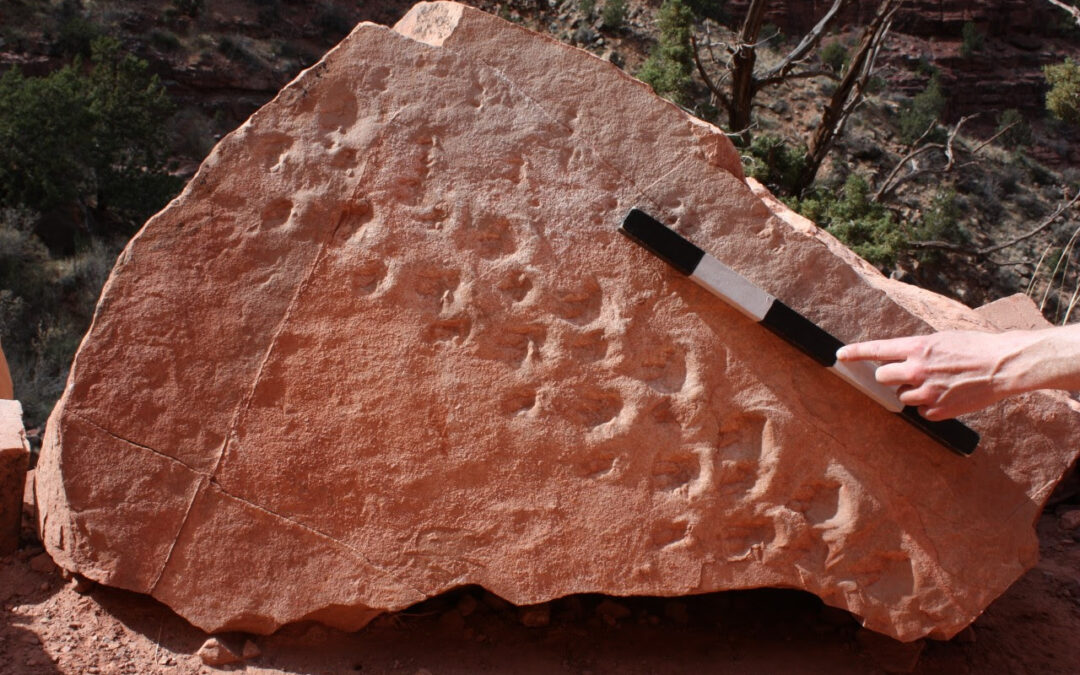
But before that – I haven’t said anything about the views from the rim. In fact, that would be hard to do properly. Suffice it to say that the views are almost supernatural. Deep tunnels have been cut through the rock several kilometers down to the Colorado River, a river that is still working its magic. Starting out on the Bright Angel Trail from the rim, you feel the grandeur of the universe, with the Milky Way clearly visible high in the sky. As the sun rises, the stars gradually disappear and the beauty of the massive walls around you is illuminated, as you descend, step by step, into the view itself. It's like walking back through the layers of time itself. The different rocks have different colors:

  • Kaibab Limestone (limestone formation) – greyish white, 270 million years old
  • Toroweap Formation (mixed formation) – greyish brown, 273 million years old
  • Coconino Sandstone (sandstone formation) – sandy white, 275 million years old
  • Hermit Shale (shale formation) – dark red, 280 million years old
  • Supai Group (mixed formation) – red to brown range, 285–315 million years old
  • Redwall Limestone (sandstone formation) – blue grey – red colour comes from iron clay in
  • Muav Limestone (sandstone formation) – greyish green, 505 million years old
  • Bright Angel Shale (shale formation) – olive green, 515 million years old
  • Tapeats Sandstone (sandstone formation) – golden brown, 525 million years old

Layer upon layer of rock emerges sharply, its strong colors: gray, brown, white, red, blue, green, and gold, all constantly changing with the light. As you approach the inner canyon, sharp peaks and natural towers with tall, tapered spires loom above you, like ancient temples, shaped by the mighty waters of the Colorado. And then, finally, the majestic river itself is revealed. You have left the ordinary world on the edge and gradually entered the nethermost parts of a different world altogether, full of natural magic that is seen nowhere else. It has a profound effect on you. Although you feel very small, your mind is expanded at the same time. You realize that this is also a spiritual experience, and you are completely in tune with nature here at the bottom of the canyon. …More to come.


Oilithreacht Bhliantúil chuig an gCainneon Mór – ar chosán North Kaibab!

Yearly Pilgrimage to the Grand Canyon

My wife and I went on a pilgrimage to the Grand Canyon in Arizona last week. In fact, it’s become a regular part of our lives now – we go there every year at the same time. Sometimes, it’s hard to find the time, but we try our best to go there despite the difficulties of life.

Why, you say? Let me answer your question with another question: have you ever been there? If you have, it’s easier to explain. If not, I would recommend you go there if you can – and I promise you won’t regret it. There’s no such vast beauty to be seen in Ireland. The reward is worth the trouble. And if you go there, you can visit Vegas on the same trip! And yet the story doesn’t end there.

The Size of the Grand Canyon

The Grand Canyon is one of the seven natural wonders of the world. Sixty million years ago, the Rocky Mountains and the Colorado Plateau, of which the Grand Canyon is a part, were formed by tectonic activity. Gradually, the Colorado River carved its way through the ancient rock, digging ever deeper.

Today, it is a steep-sided canyon – 446 km long, up to 29 km wide, and 1,857 metres deep. It covers a vast area of 5,000 km² – that’s half a million hectares.

That’s not easy to imagine. To put it in context: imagine Counties Kilkenny, Waterford and Carlow combined – and every inch of it covered by one deep canyon. And you could almost hide two Carrantuohills in its depths from top to bottom.

While there are other great canyons in the world, the Grand Canyon is the most famous. Around 5 million people visit it every year. It’s an awesome sight to behold from the rim. Most visitors head to the South Rim – it’s not as remote as the North Rim.

Staying at the Bright Angel Lodge

When I first saw the Canyon, my eyes almost popped out of my head in awe. Seeing it on Instagram or TV is one thing – but experiencing it in person is another. It takes your breath away.

After our first visit to the South Rim, my wife and I were completely captivated. There’s magic – not just in the canyon itself, but also in the quiet village on the rim (Grand Canyon Village). We love staying in the village at the Bright Angel Hotel – in a small log cabin on the edge of the canyon.

The hotel has shops, a restaurant and a pub – everything you could possibly need. You can have a lovely dinner, and then take a walk as the sun sets – perfect subject for your next selfie!

Preparations for the Crossing

After several years staying on the rim, we heard about an exceptional hike that a friend of ours had done – a complete crossing from the south rim to the north rim, about 40 km in length.

The descent is not the most challenging – it is the steep ascent that is, especially in the heat of the season. When I heard about this hike, and despite the difficulties he mentioned, I asked to go with them – and they accepted me without delay.

I started training seriously. There were mountains nearby and I did a long hike every weekend – between the altitude and the desert heat.

Oddly enough: In the Grand Canyon, you can experience two climates in one day – freezing at the top of the canyon, with desert heat up to 40°C at the bottom. Therefore, comprehensive preparation is required – layers of clothing, a food strategy, and above all, water management.

If you are going ‘rim-to-rim’ – that is, from one rim to the other, you will be on the trail for up to 15 hours. You need to have a plan for hydration – how much water to carry, where the fill points are, and how to balance your weight. 3–4 liters is essential, but 4 liters weighs 4 kilograms.

The Big Day: Crossing the Canyon           

I met up with the group of hikers later in the year as we had planned. There were about ten of us. We spent a few days at the north rim first to get used to the altitude – 2,500 meters.

At four o’clock in the morning, by the light of the stars, we met up and set off. The temperature was below freezing at the time, but we were prepared. Dressed appropriately, we set foot on the famous Bright Angel Trail – and into the Grand Canyon.


Léamh Filíochta

Poetry Reading

I recently attended a poetry class that I really enjoyed. We had to read our poems out loud in class, and then the other students had the opportunity to share feedback with the author. In this way, we were all learning in two main ways. Firstly, we heard the poems that other people in the class had composed, which was very interesting. Secondly, we received feedback on our own poems, and with that information, we were able to improve the poems. At the end of the course, an open poetry reading was organised for us, which everyone was welcome to attend. I read three poems in English at the event, and I read an introduction to each of them, to put them in context. I have an English and an Irish version of two of the poems, since they relate to Ireland. The other one (the third one) is in English only. Here are the three introductions and the poems associated with them, translated into Irish (except for the third poem itself).


  1. 1. The powerful influence of our parents on us.

Our parents have a great influence on us in our early years. I didn’t really understand that until recently. This is just one example of that influence. My father wrote and my mother read every chance they got, every day, when I was growing up. I have enjoyed writing and reading throughout my life and they are very important to me. Every chance I get, I write or read. I now understand very well that this was no accident but was a consequence of the home environment I had, thanks to my parents. This poem is a tribute to them.Our parents have a great influence on us in our early years. I didn’t really understand that until recently. This is just one example of that influence. My father wrote and my mother read every chance they got, every day, when I was growing up. I have enjoyed writing and reading throughout my life and they are very important to me. Every chance I get, I write or read. I now understand very well that this was no accident but was a consequence of the home environment I had, thanks to my parents. This poem is a tribute to them.

Scríobhaim
Daid ag cnagadh ar a shean-Olivetti,
A eochairbhuillí mar bhuillí croí ár n-óige.
Gach ciúnas agus boladh Tippex
mar shioncóipiú sa cheol cúlra-
ceol deasghnátha an tsaoil.

Sna sosanna gearra ina lá fada –
físeanna leabharlann-spreagtha ag Mam,
faoi dhomhan nís cineálta, nís gile.

Ón ithir thorthúil chruthaitheach seo,
D’fhás peann i mo lámha óga díograiseacha.
Bhínn ag scríobh, ag scríobh, ag scríobh,
go dtí gur lean foirm feidhm,
agus sa deireadh thiar thall –
nochtadh an scríbhneoir ionam.

I Write
Tapping away on his old Olivetti,
Dad’s keystrokes were the heartbeat of our childhood,
with silences and Tippex smells
syncopating the background music
of our mundane life rituals.

Mum fed the short breaks in her long day
with library-fueled visions
of a kinder, grander world.

From this fertile, dream-fed soil
sprouted a pen in my eager young hands.
I wrote and wrote and wrote until
form followed function
and parchment revealed
the writer inside.

  1. The beauty of nature and culture in the Glen Cholm Cille area.

According to tradition, Colmcille built a church in Glencolmcille in the 6th century. This valley is located in a remote area in the north-west of Ireland in County Donegal. The valley slopes down, through rolling countryside, to the Atlantic Ocean. Then, the rugged coastline stretches north and south. To the north, at Sliabh Liag, there are 2,000-foot-high sea cliffs. Glencolmcille is in the Gaeltacht, and our native language is commonly heard spoken there. As such, the area is steeped in traditional Irish culture. I personally feel that this special valley is a wonderful blend of landscape and culture. The poem is a tribute and, in a way, a prayer to this picturesque and historic valley. The poem describes the scene and its effect on me when I first saw the glen on a beautiful summer day, as we entered at the top of the glen and drove down to the coast.

Gleann Cholm Cille
Glasghoirt cuilteáilte úra ag cur thar maoil,
loig is mullaigh scuabtha síos dorchla caol,
ag sleamhnú trí chraos an ghleanna go mín,
stróicthe as a chéile gan rabhadh ag an Muirlín.
Talamh Naofa ina néal-lámha faoi dheireadh,
Spíonta, géilleann sí go do ghaineamh geal na mara.

Glencolmcille

Fresh green-fielded quiltwork spills,
pleats and folds tumbling down hills,
glides through glistening, gulleted glen,
riven by meanders of the river Murlin.
Cloud-swaddled, spangled sainted land,
Exhausted, yields to the silver sand.


  1. The ongoing painful consequences of climate change.

The “butterfly effect” is a description of the large consequences that can occur from small changes. The effect was discovered by Edward Lorenz while researching the weather system. The effect also applies to broader topics, including climate change. In this case, it highlights the risks we take when making even small changes to the climate system. The butterfly migration comes to my area of San Diego from Santa Cruz every year. Last year, I saw one butterfly struggling desperately to stay afloat. Ironically and tragically, the “butterfly effect” has a negative impact on the very creatures for which the effect is named. In fact, the butterfly has done us no harm, but the opposite is true, for it is humanity that is harming the butterfly. All of this gave me a metaphor, in which the butterfly is like a lens. Through this lens, we can see not only our personal and emotional connection to the world, which we know and love, but the reality of its loss, which has already begun. And it is a loss that does not happen all at once, but gradually, butterfly by butterfly - at least at first.

Butterfly Elegy
The nectar-fueled monarch migration
flutters south in shimmering clouds
from Santa Cruz to San Diego
to ancestral breeding grounds.

There, molten clouds of monarchs
drift on failing wings,
no haven to receive them,
no milkweed to nourish their young.

A single monarch spirals down
in quickening, tightening arcs,
its frail and tattered body —
more proof of what’s being lost.

Seirbhís Chuimhneacháin

Memorial Service

Parents suffer terribly when their child dies. They never recover. My friend, Michael, recently lost his adult child. I hadn’t seen Michael at the gym for a month or two. I didn’t know why, but I thought he was on vacation. Unfortunately, he wasn’t.

Michael’s friend sent me a text last week, with a link to an obituary. At first, I was confused, because I didn’t understand why I was getting that notice. Then I saw that Michael was the father of the young person who died. But that’s just the beginning.

Invitation to the memorial service

Often, there is no big funeral when people die in California. However, a month or two later, a memorial service is held for them. Family and friends attend this celebration of life, and there are usually food and drinks available. I received an invitation to the service via another text, and I replied that my wife and I would be there. On Saturday, we dressed up for the occasion, and drove to the service venue - a golf course. We went there and a sign directed us to the ballroom. There was a table just inside the ballroom door, which had a screen showing photos from Áine's life there, and other mementos on the table as well. She had only been 22 years old when she died.

Micheál, Máire and Pádraicín were with her, and they welcomed everyone as they came in. Áine's parents - Micheál and Máire, have been divorced for a few years, and Padraicín is his current partner. A staff member then directed us to our seats. There was a leaflet on each seat for us, with a photo of a man (Liam) on the front page and a photo of a woman (Áine) on the back page, and a program on the center pages.

Áine was a male-to-female transgender person. She had gender reassignment surgery a few years ago when she was 20 years old. She grew up as a boy named Liam.

There were many people mentioned on the programme: Micheál at the beginning, Áine’s sister, Áine’s friends, her uncle and aunt, Padraicín and Máire at the end.

Celebration of Áine/Liam’s life

Micheál thanked us all for being there. It gave him and his family support and comfort, he said. He had fond memories of Áine and the relationship between them, and Micheál broke down crying from time to time during his speech, because it was very difficult for him to be up on stage, talking about his child like that. He said that it was difficult for him, his ex-partner, and his partner to accept it when Liam (at the time) told him what he was thinking. But they accepted him, and gave him their full support. When Liam had changed to Áine, Micheál admitted that he had never seen his child so happy before. She did not live at home at the time, but she went there often, because the university she attended was not too far from home. Micheál then said that things are not easy in America right now, but especially if you are transgender or an immigrant. The government targets all kinds of attacks on vulnerable people like that, he said. I was in tears and so was everyone listening to him, because this is an incredibly tragic story.

Áine’s sister, Emma, then came up on stage. She told us funny stories, because Liam was definitely a character, as they grew up together. There was devilment in his jokes. When someone was on the side of the road fixing a hole in their wheel, Liam rolled down his window and shouted at the poor guy, saying they weren’t allowed to park there. Emma said that Liam was also very smart, and that it was easy for him to learn science and maths. He enrolled in an engineering course at university without any problems, as he got great results in the entrance exams.

Everyone else praised Liam/Áine highly, both family and friends, and they had lots of stories to tell. At the end, Liam/Áine’s mother came up, and she also told a story or two. Then, she recited a poem by Robert Burns. The heartfelt speeches touched us all emotionally. Everyone was exhausted by the end.

Food and drinks were available afterwards. Most of the people at our table - all of us Michael’s friends from the gym - were leaving. So, we went home too, because we didn’t know anyone else, except for Micheál, and he was already very busy.

Conclusion

The suicide attempt rate among transgender people worldwide is between 32% and 50%. The main risk factors influencing suicidal behavior among transgender people are gender-based victimization, discrimination, bullying, violence, rejection by family, friends and the community; harassment by a personal partner, family members, the police, the community and the government, and discrimination and abuse in the health care system.

We will never know all the factors that formed a major influence on Áine, but the cultural and political environment were likely a few of them. In any case, it is a great sadness to her family, her friends and all of us, that Áine lost her life by suicide in the prime of her life, – eternal peace to her soul.

Ag freastal ar rang filíochta!

Attending a Poetry Class

The writer’s life can be a lonely one—especially when you’re buried in your keyboard. It’s important to make an effort now and then to break out and connect with others. It’s become clearer in recent years just how essential social connection is for our well-being. A vibrant social life often means less stress, better health, and even a longer life. We were all cut off from society during the COVID-19 pandemic—we had no choice. That level of isolation was never healthy, and it took a long time after the pandemic to relearn how to mix with people again. I’m still seeking out opportunities to talk and connect with others.

So when I read about a poetry class happening in my area, my interest was piqued. Here’s the blurb I saw:

"Writing can sometimes feel like a solitary effort, but a reading and critique group can offer support and feedback, boost your confidence, and open new insights into your work. The class begins with a close reading of poems by contemporary poets to spark fresh ideas. Then we’ll share pieces of our own efforts and offer comments to each writer."

Even though I was quite nervous about it, I signed up. I had already written a poem that I planned to share in the class.

I was a little late to the first class, as parking had been hard to find. The other writers and Anna, the instructor, were already seated around a table. I pulled out a chair and sat down.

Then we all introduced ourselves. I noticed that, except for Anna, we were all around the same age. She was at least ten years younger. Most of the group already knew each other from previous classes with Anna. It didn’t take long for me to realize she was an excellent teacher and facilitator—warm, friendly, and genuinely good at conversation.

To start, she handed out a few contemporary poems. One of us read one aloud, and another read the next. Then she asked us questions about each poem such as:
“What did you think of the poem?”
“What is the poet saying, in your view?”
“What aspects did you like best, and why?”

We had a lively discussion about the poems, and I found it fascinating to hear everyone’s views, including Anna’s. I had to gather my own thoughts and share them with the group as well. I hadn’t read these poems before, and I discovered a new appreciation for contemporary poetry. I learned about poets I hadn’t encountered before—like Derek Sheffield, Sharon Olds, and Mike Saye. Their work had a clarity and emotional depth that impressed me. They conveyed so much in so few words. That’s the magic of poetry—something deeply inspiring.

As the saying goes, a good start is half the battle—and it was true in this case. In the second part of the class, the focus turned to us students. One by one, we read our own poems aloud and listened to the group’s feedback. Before the class, I had assumed I’d be mortified to read my poem aloud to strangers—let alone listen to them critique my precious work.

But it wasn’t like that at all. Anna was excellent at guiding the discussion, keeping everything constructive. She praised what we’d written while also gently pointing out weaknesses and problems—without making anyone feel bad. She modeled how to critique positively, and we followed suit. Anna fostered a safe, open atmosphere, and we were able to be honest with each other.

I read my poem aloud and got some incredibly helpful feedback. I revised the piece based on the input, and I’m very happy with the result. No doubt about it, I’m getting huge value from this class, and I’m glad I overcame my reluctance to join. If you ever get the chance to go out, meet people, do something together, and share—don’t hesitate. Don’t overthink it. Just go!

In that same spirit of openness, I’ll finish by sharing the poem I wrote and revised. I hope you enjoy it!

Scríobhaim

Tapping away on his old Olivetti,
Dad's keystrokes were the heartbeat of our childhood,
with silences and Tippex smells
syncopating the background music
of our mundane life rituals.

Mum fed the short breaks in her long day
with library-fueled visions
of a kinder, grander world.

Ón ithir thorthúil chruthaitheach seo,
D’fhás peann i mo lámha óga díograiseacha.
Bhínn ag scríobh, ag scríobh, ag scríobh,
go dtí gur lean foirm feidhm,
agus sa deireadh thiar thall –
nochtadh an scríbhneoir ionam.


en_USEnglish