Ceacht an Rúitín Casta

Lesson of the Twisted Ankle

We often think our own way is better than the right way. I've written more than once about walking safety, about checklists and gear, and about the great respect you must always have for mountains. But on a certain evening recently, with an hour or two free, I broke my own rules. I started a walk on a well-known path without hiking boots, without walking poles or a first-aid kit. All I had were worn running shoes and too much self-confidence.

It didn't go well, and I soon learned the lesson.

Falling Slowly

In certain places, the path is steep and covered with fine gravel. It's a multi-use trail, and mountain bikes often scatter the gravel across it, making conditions even worse for walkers. As I was descending a steep part of the path, my right foot slipped unexpectedly to the left, my body fell to the right, and my ankle turned inward and stretched badly under the load.

The fall was like a slow-motion movement, like a tree being felled.

For a second, I was sure I had broken bones. I kept control, and stayed on the ground for a while, breathing slowly and deeply, scanning for blood or anything out of place. I then stood up, and my ankle was very painful, but I was able to walk with a limp and slowly. I began the long walk back to my car.

Temporary First Aid

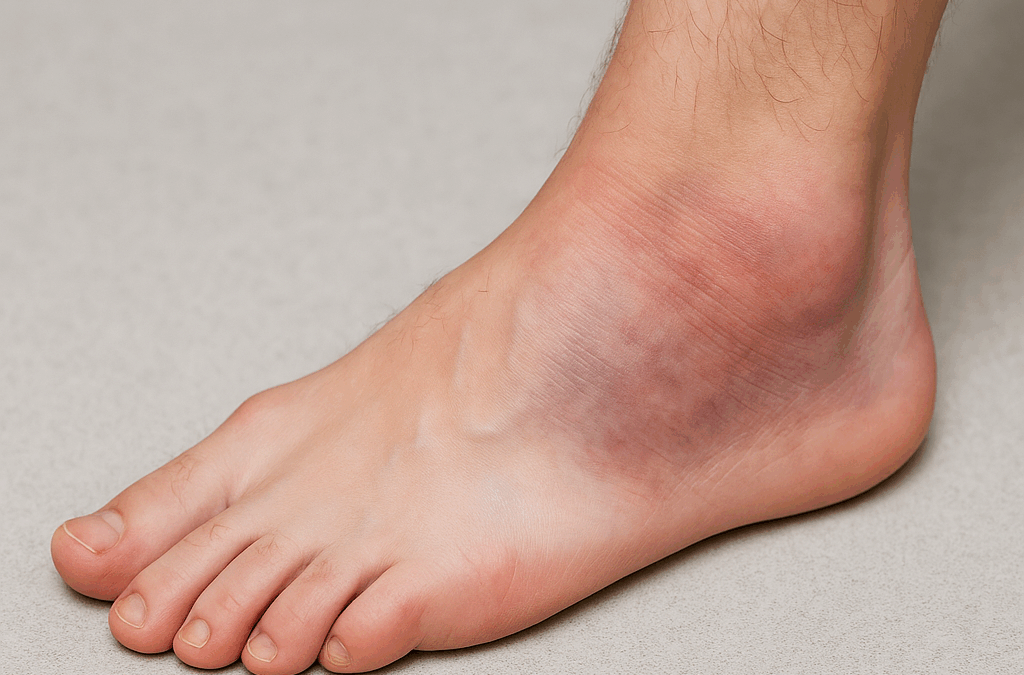
Back home, I bandaged the ankle, took ibuprofen, and propped my foot up on a pillow. By morning, the situation had worsened. My right foot was badly swollen. Purple bruising appeared on the inside of my foot. Painful blisters appeared on the ankle. I cleaned them and put medical dressing on them.

so he can examine my foot and advise me about it.

Nuair a bhí mé i mo shuí le mo chos ar leac oighir agus mé ag smaoineamh faoi cad a tharla, thuig mé gan mhoill: d’fhéadfaí é seo a sheachaint. Sa deireadh, is ormsa atá an locht.

The Three Essentials I Omitted

I was injured because I didn't have three essentials:

  • Hiking boots — without them, I had no chance. It is crucial to wear hiking boots when you're on the trail.
  • Hiking poles — without them, I didn't always have good balance. Two extra points of contact are the difference between a firm stance and a sprained ankle.
  • First-aid kit — without it, I had no relief in case of an accident. It is useful, not only for serious injuries, but for bee stings or sunburn as well.

Why did I omit the essentials? It happened because of impulsiveness.

People become careless with experience. I knew the path, I had walked it often, and that put me at ease. But I quickly paid for that assumption.

The Broader Lesson

A study published in the American Journal of Emergency Medicine says that almost 40% of walking injuries are related to ankles. The National Park Service also reports that footwear is a factor in more than 60% of these cases.

Every experienced walker, including myself, has heard this advice already. But it needs to be applied every single time, without exception.

As I found out, the time you forget the advice is the time you'll be in trouble.

Moving Forward

The ankle will heal. I will lose a couple of weeks on the trails. But I have learned a lesson. From now on:

  1. I will be using boots and walking poles, and a first-aid kit every time on the path.
  2. The mountain will still be there tomorrow; there's no prize for going out unprepared today.

I hope I have learned the lesson well. Otherwise, the next time could be not only worse, but fateful.

Mistreatment of a Long-Term US resident by immigration officials!
Ceol sna Sléibhte!

Music in the Mountains!

I recently had the opportunity to participate in a short guitar workshop at the Rocky Ridge Music Center in Estes Park, Colorado. We – myself, my wife Sinéad, and our friend Debbie – took a flight on August 9th from San Diego to Denver. Then we rented a car at the airport and drove up into the mountains to Estes Park.

Sinéad and I stayed in a cabin on the Rocky Ridge campus above the town of Estes Park, while Debbie was based in a hotel in the center of town. All our meals and even snacks and drinks during Happy Hour were included in the package that Sinéad and I had, which created a social and friendly atmosphere.

Workshop and Practice

The workshop started on Sunday and finished on Wednesday (August 10-13). We had six guitar students, five of us being engineers, which added color to our conversations and stories. Our instructor, Colin McAllister, was wonderful, and he is a professor at the University of Colorado, Colorado Springs. He himself began by studying aerospace engineering before transitioning to music as a career.

Each morning, we had "Technique Olympics" and especially exercises from the book Pumping Nylon. We learned how to hold the guitar correctly, and how to place our hands in the right position on the guitar. Then, we did exercises on the fingerboard to gain control of our fingers.

Each afternoon, we prepared for the jam session, selecting a few lively pieces in blues style. The jam itself took place late in the evening, outdoors in the same location as Happy Hour. Everyone got a chance as lead guitarist, with others playing rhythm as background. The music brought joy to the other participants, both piano students and their instructors.

The Performances

We were learning different styles in the workshop — Tibur and Mike W. practicing classical works for the performance, Paul with mandolin along with his guitar, and the other three of us focusing on other aspects - blues and rock music, for example. Our student showcase was on Tuesday evening (August 12). We played an ensemble piece together that we had prepared and practiced with Colin, and Tibur and Mike W. played a jazz song together that represented the class beautifully.

I liked everyone I met. Tibur, a man originally from Hungary, was the first person I met. He was very friendly from the start, and later in the course, he showed me a guitar pedal he had, as well as an app for making recordings. He was a very humble person, and he had the ability to play difficult songs on his guitar.

As the program drew to a close, we thanked Colin and the other students, and the program concluded on Wednesday (August 13) with the faculty concert. Colin played solo, adding variety to the events by playing classical and bluegrass numbers, which drew great applause from the audience.

Social and Natural Experience

During the course, Sinéad and Debbie spent their time exploring Rocky Mountain National Park and Estes Park. They saw a couple of moose, many elk and deer. They went up the mountains to an altitude of 4,000 meters, and saw great mountains and beautiful views. Debbie told us that a herd of elk came into the town streets near her hotel and the police were managing them!

On our way down from Estes Park on Thursday, we stopped in Boulder, Colorado and walked along Pearl Street – a famous street there – and ate a tasty meal before returning to the airport. On the way, we had another special highlight — a black bear climbing an almost vertical rock face, jumping from rock to rock and looking down curiously from time to time at its enchanted audience.

Final Reflection

In truth, it wasn't just a workshop, but also a social event. A community spirit grew among all of us at the camp, between pianists and guitarists. We were all there as learners who had a great love for music, so there was a kind of connection between us beforehand.

Rocky Ridge gave us new insights into music and how to play our musical instruments better. But there was more to it than that. It's a special camp, located in a beautiful place up in the mountains. There isn't much WiFi available, and isn't that a wonderful thing. Additionally, nobody was talking about politics. So, we had a rural sanctuary for ourselves up in the mountains. It reminded us what it means to be human and conscious, and that the world isn't always as bad as we think.

Now that I'm back home, I'm practicing my guitar with new energy and fresh ideas. I hope to return to Rocky Ridge again as soon as possible. As Bono said: Music can change the world because it can change people.


Seanchairde!

Old Friends!

Retirement Celebration

I decided to take a voluntary redundancy package from my longtime employer Qualcomm almost 10 years ago, when the company announced it would have to let people go. I was ignored during the mandatory 60 days they had to keep me employed. It was like I had become a leper. When I was at my best, there would be a line outside my office, people wishing to consult with me.

Many others were in the same boat. The biggest difference between us was that most of them had no choice as they were laid off. However, we were all treated the same way – as if we didn't exist at all.

After many years of hard work and consistently long hours, this is what happened – they didn't care about us – we were discarded. This experience gave me a new understanding – don't believe the corporate stories, they're not for your benefit, but for the God of Profit!

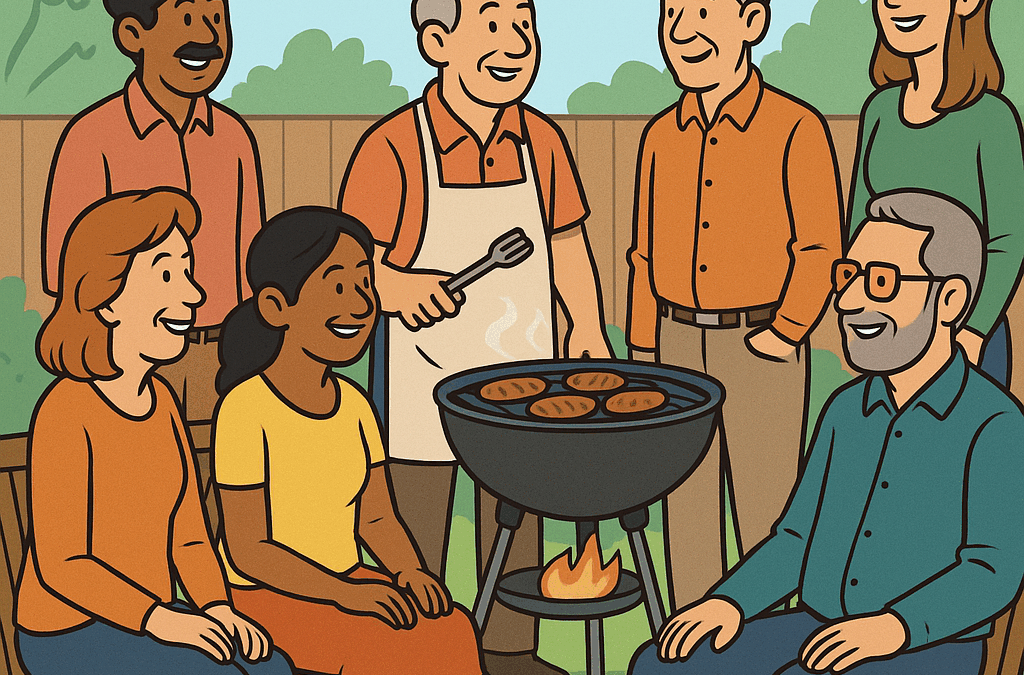
Although my company ignored me, my valuable friends in the company did the complete opposite! Four of them organized a get-together, and one invited my wife and me to his house for a barbecue. I didn't know anyone else had been invited.

I had no expectation whatsoever of the party they had organized for me. We had a wonderful celebration, reminiscing together and sharing stories both serious and humorous. They also gave me valuable gifts, appropriate for my retirement – a gift voucher from my favorite outdoor equipment store, for example, as they knew I was an avid hiker.

Encore!

I received an invitation from the same friend again last week, 10 years after his first invitation. A friend from our group (Liam) was visiting from Atlanta, where he now lives. So three couples would be present out of the five who came together 10 years ago. The other friends no longer live in the area – one works for Amazon in Seattle, Washington, and the other is retired in Morro Bay, California. This gathering wouldn't be in my honor this time, but celebrating Liam's visit.

It was nice to come together for a late breakfast of delicious Indian food followed by ice cream. Liam and his wife are considering relocating back to San Diego. Although they're happy in Atlanta, their son lives in San Diego, and they would like to be closer to him.

Liam was laid off from Qualcomm a year and a half ago. They let go one of the most talented engineers I've ever met with, male or female, and someone who was extremely loyal to Qualcomm. After that, he has no loyalty left for the company, and is looking for positions in other companies.

So only one of us – our host, Vijay – still works at Qualcomm currently, and is doing very well there. Long may it last!

This time again, as we enjoyed cold drinks, we went down memory lane. The feelings regarding Qualcomm weren't as positive as they were 10 years ago.

Liam's son works in the same team as Vijay. Vijay is a vice president and in charge of the team, as it happens. Con (Liam's son) told us that out of a dozen engineers who started with him at the company more than three years ago, only he remains.

Leadership Secrets

During our conversation, we began discussing why so many engineers were leaving the company and why Con himself hadn't left.

Why did they leave? There was always too much work to do. And their managers never expressed appreciation for them.

And why didn't Con leave? The culture in his team wasn't the same. It was a wonderful culture.

Why? Vijay and Liam said that I had implemented that culture many years ago, and it's still there. Liam and Vijay learned the leadership style from me, and they've continued it to this day. They asked me to say a few words about it.

I said that the most important thing when you're a leader is the people themselves, and how you treat them. Put trust in them, let them run with it, and they'll do their utmost. Nobody likes to have someone constantly looking over their shoulder. Be available as a leader all the time to answer questions and solve problems, and you'll be amazed at the results you'll see. When you respect your employees, they'll respect you too, and you'll have a strong team with staff members working hand in hand.

They completely agreed with me and said it was a great pity there weren't more leaders of the same mindset.

I was surprised and delighted that they all had that feeling. It was so nice that my friends told me how they felt. I felt that we, including myself, had made important differences that are still visible in the company ten years after I left.

What differences?

  • A difference by working together instead of being separated from each other.
  • A difference through developing pioneering technology – we put high-speed broadband on the smartphone for the first time, a historic achievement.
  • A difference for Qualcomm. Although we received no recognition for it as we were leaving, Qualcomm succeeded tremendously with that new technology.

But despite that corporate indifference at the end, I am still grateful for the leadership of the founder, Irwin Jacobs, in the early days before Qualcomm became a corporate behemoth. He had faith in us and gave us the space and resources to do excellent work. Wasn't it from that wonderful man that I learned my own leadership style!

At the end of the day, I clearly understood one thing. While companies forget their employees, even before they leave, the opposite is true regarding your true friends you met there. These enduring friendships—that began in the workplace but lasted long after—are the most valuable gifts of all.


Saoire ar Árainn – Cuid 2!

Saoire ar Árainn – Cuid 2!

During our previous visits, I was determined to speak Irish to the locals. Although they spoke Irish, they only spoke English to me – in the shops, in the restaurants, in the pub. It really bothered me that I was treated that way. I couldn't understand why the locals wouldn't speak Irish to me. I was disappointed, as I thought Irish would be the normal language of the island.

I understand now. Árainn is crowded with visitors during the summer, boat after boat discharging crowds of passengers non-stop, from the beginning to the end of the season. Tourists come from all over the world, speaking many different languages. English is the main language of world commerce – on Árainn too. In addition, many people working in the services on the island do not speak a word of Irish. For these reasons, the islanders only speak English to visitors. When they talk to each other, they speak Irish. And if they know you well, they speak Irish to you without issue. I think they do not know that they have this habit, and that it is a practical thing that has happened over time, and is now part of their culture.

This trip, we had a great week on the island. We were busy the whole time - between walks, cycling, seeing the sights, and meeting people. Here is a little taste of the fun that we had.

Blowholes
We rented a couple of bikes. Cars are not usually allowed from the mainland. You see a lot of people on bikes on the island, especially when the weather is nice. The weather was not bad during our visit and we walked and cycled every day. Our first adventure was to visit blowholes. There are a few places on the island that have blowholes, and we went to the closest ones. These holes are formed by sea caves that have tunnels up to the surface, and when the sea is rough, they blow water up through the holes. We cycled to the beginning of a path next to the low road and walked down to the bottom of the beach. There was a sudden drop in the limestone at the edge of the shore, and a little further back, the holes were visible in the stone. Looking down into them, you could see the tidal water below them. Every time the waves came in, the water rose in the holes, and blew out through the holes and up into the air. There was a terrible noise to be heard – a crashing and throbbing that occurred between the limestone and the sea below. One can only imagine what it would be like in rough weather.

Dúchathair Fort

Another fine day, we cycled to the start of the path to Dún Dúchathair and walked the steep path up to the fort. Although this fort does not have a visitor centre, unlike Dún Aonghasa, it is just as impressive in some ways.

It is set high on the cliffs above the sea and has a beautiful expansive view along the coast. You can climb over the walls of the fort and enter the inner courtyard. The courtyard is surrounded by the fort on one side and by large cliffs on the other. Spend some time in Dún Dúchathair if you get the chance.

Aran Sheep: Aransheep.ie by Máirtín Ó Flaithearta

On the path to Dún Dúchathair, there is a sign outside a house: Aransheep.ie. We know the owner, Máirtín Ó Flaithearta and he made us very welcome. He showed us around his shop, which is also a museum, in reality. There was a lot to see and Máirtín had yarn from different breeds of sheep. There are Aran sweaters, blankets and caps on display, as well as a collection of different yarns. There are interesting maps and posters on the walls, showing all sorts of things about sheep, including the distribution of sheep in different parts of the world and different breeds of sheep. There is a big screen in the room and also plenty of chairs, for playing a video or giving a lecture. Máirtín is building another room, so that he has more space. We were there for over an hour, and we really enjoyed it. It is well worth a visit if you have the chance.

Midsummer's Eve

Midsummer's Eve is celebrated on July 23rd, a day when bonfires are lit on the island. It is a remnant of an ancient pagan festival, which used to be a midsummer celebration, associated with the fertility of the land and the worship of the sun. The fire is the heart of the celebration as it is a symbol of brightness. There were specific rituals associated with the celebration but I don't have the space here to discuss them.

Anyway, we visited Seán who had a bonfire lit, which he does year after year. People were coming and going all the time, and it was a great social event. There was a nice smell of peat from the fire, and the weather was reasonably good. Seán offered us drinks and snacks, and we had a nice chat.

There were more cars than usual driving around the High Road. As it turned out, the famous actor Patrick Duffy, the star of the TV series Dallas, was on the island, and according to the rumor he was in Bunghabhla. We didn’t stand idly by either. Curiosity got the better of us, and Seán drove us around the island looking at all the other fires. Quite by accident, we drove through Bunghabhla, but there was no sign or report of the star. But of course, it was a great evening, celebrating ancient traditions with the islanders, and searching for Patrick Duffy!

Conclusion

That’s just a small taste of what we did during our visit to the island. While the island itself is excellent in terms of natural beauty and archaeology, the people of the island are the heart of the place. If you get the chance, visit Árainn – you won’t regret it.


Saoire ar Árainn – Cuid 2!

Holidays on Aran island - Part 1

Three islands lie as rocky sentries between Galway Bay and the Atlantic Ocean: Inis Oírr, Inis Meáin and Árainn. They are known as the Aran Islands, and though they sit on the edge of the country, they are at its very heart, serving as protectors of our language and culture. The people of the islands are living proof of that. The history of Ireland can also be seen in nearly every place you step foot on.

It’s no surprise that my wife, Sinéad, and I go to Árainn whenever we get the chance. We love the Irish language and culture. Sinéad is an archaeologist, with a deep tie to Aran from the standpoint of archaeology, and so the island is a kind of paradise for her—essentially a living museum of archaeology and history.  

Prehistory and History

There’s a lot to see dating from the Late Bronze Age (1200–600 BCE) onward. Dún Aonghasa was built around 1100 BCE and expanded later around 500 BCE. The fort is perched on the edge of a cliff, with massive stone walls and defensive spikes surrounding it. It’s a truly awe-inspiring sight. Dún Dúchathair and Dún Eoghanachta are from the same era—they're not as well known as Dún Aonghasa but still impressive.

Around the 8th century, the island emerged as a center of monastic and religious life. Teampall Bheanáin, a tiny church on a hill above Cill Rónáin, is one of the smallest churches in Ireland. It is dedicated to Benen, a follower of St. Patrick.

Pilgrims used to come from the mainland to the Seven Churches, an ancient monastic site that thrived during the medieval period. There are religious ruins there, including churches, stone shrines, and graves. It was one of the most significant Christian sites on the Aran Islands.

There are many other sites to visit on the island as well, including Teampall na Naomh, Teampall Mac Duach, Teampall an Cheathrair Álainn, as well as a range of holy wells and stone altars. Sinéad conducted an important archaeological excavation on Mainistir Chiaráin, in which were uncovered noteworthy features and artifacts. There is a lot to tell about this excavation, but that is a story for another day and another article.

Bronze Age people first settled the Aran Islands, followed by Celtic tribes during the Iron Age. From the 5th century on, the islands became a Christian hub. For the most part, the island communities have remained faithful to their culture and language right up to today.

Tourism

Even so, one mustn’t forget the major changes that have had a significant impact on the islands and their inhabitants over time. Tourism began on the Aran Islands at the end of the 19th century, when writers, artists, and scholars started arriving. They appreciated all the islands had to offer—an ancient culture still being lived, and a unique natural beauty beyond compare.

During the 20th century, tourism gradually expanded. It was once difficult to land on the Aran Islands, but nowadays there are regular ferry services from Ros a’ Mhíl, Doolin, and Galway, and since the 1970s, short flights have been available from Connemara Airport. In recent years, interest in the culture and nature of the islands has grown tremendously, and people love to get out exploring on foot and by bike. These days, visitors come not only from Ireland but from all over the world. Tourism is now an important part of the local economy, although it is still seasonal compared to many other places.

Arrival on Inis Mór

This time, we were passengers on the latest addition to the Doolin Ferries fleet: the Cliffs of Moher Express. This boat is much faster and larger than the others. It’s also fitted with stabilizers for a smoother journey. The trip was excellent—very smooth. That’s great news for me, as I don’t have the strongest stomach for the sea.

We had booked an Airbnb near Tí Joe Watty’s, close to Cill Rónáin. We had stayed in the same small house before—a comfortable place with every convenience, including a fully equipped kitchen. As soon as we stored our bags, we headed straight to the Spar to do our shopping. The manager welcomed us warmly, and we chatted for a moment about how things were going. It was lovely to be back on Árainn again!

Concert

As we were leaving the store, Sinéad spotted a poster advertising a concert that same evening in Halla Rónáin. The featured act would be singer-songwriter Susan O’Neill. Susan O’Neill (or SON) is a talented performer from Ennis, County Clare, who blends traditional music, rock, blues, and soul with a powerful and distinctive voice. She gained acclaim for her collaborative album with Mick Flannery, In the Game, and she’s now one of the most exciting artists in Ireland.

We bought our tickets online and, after a delicious meal at home, walked down the road to Halla Rónáin. The opening musicians were good, but when Susan O’Neill took the stage and started performing, we were captivated from the very first note. She uses live-looping techniques to layer vocals, trumpet, and other instruments skillfully—creating a rich, textured, and powerful sound. The show was outstanding, and we thoroughly enjoyed it—a perfect start to our holiday!

…More to come.

Oilithreacht Bhliantúil chuig an gCainneon Mór – An Fáinne á Chríochnú Againn

Annual Pilgrimage to the Grand Canyon – completing the circle!

I told you about my first hike in the Grand Canyon, many years ago. It was so amazing that I’ve never forgotten it. Let’s jump ahead to the most recent hike my wife and I did. In this case, we went down from the south rim, to the Colorado, and then came back up to the same rim – a 30 kilometer hike or so. We assumed it wouldn’t be too difficult for us.

We had everything ready the night before – clothes, shoes, water, snacks, poles and backpacks. We got up early in the morning at four o’clock, and were on the trail (Bright Angel Trail) by five. It wasn’t hot yet (15C) and the sun hadn’t risen yet. We had a good pace and were making good progress.

Fossilized remains

My wife Sinéad is an archaeologist, and she saw a large rock by the side of the trail with noteworthy markings. She immediately recognized them as animal fossils, and we spent time looking at them and taking photos. Later, after the hike, Sinéad did more research on them, and it was an interesting story. In 2016, a Norwegian geology professor, Allan Krill, was hiking with his students when he saw a large rock with fossilized markings. Krill was curious, and sent a photo to his colleague, Stephen Rowland, a palaeontologist at the University of Nevada Las Vegas.

The tracks along the trail are even more remarkable than Krill first imagined. “These are by far the oldest vertebrate tracks in the Grand Canyon,” says Rowland. “Even more remarkable,” he said, “they are among the oldest tracks on Earth of animals that lay eggs without shells, such as reptiles, and the earliest evidence of vertebrates walking in sand dunes.”

The large rock that contained the track fell from a nearby cliff – in the Manakacha Formation. Researchers were able to date the tracks to 313 million years old. It’s incredible that the rock fell right next to the trail – and that Sinéad saw it too. I didn’t see it at all. But that’s the kind of thing you see in that canyon, because you’re walking back through the history of the earth itself. While the Grand Canyon is only 5 or 6 million years old, some of the rocks there date back as far as 1.8 billion years – from the Precambrian to the Paleozoic Era! The hike was worth it just to see the tracks.

Native Heritage

We continued walking and before long, we reached Havasupai Garden. The name was changed from Indian Garden to Havasupai Garden in 2022 to honor the Havasupai people, a tribe that had lived in the Grand Canyon for generations. The area, known as Ha’a Gyoh (“where the water comes up”) in the Havasupai language, was used for farming and seasonal migration.

In the 1920s, the Havasupai were forcibly removed from the Canyon by the National Park Service when Grand Canyon National Park was established. Captain Burro was the last of the tribe to be evicted. Indian Garden was a derogatory name that did not acknowledge the tribe’s valuable heritage in the canyon.

After many years, the tribe’s request to change the name to Havasupai Garden was granted. This is a recognition of the indigenous heritage, historical injustice, and the tribe’s ongoing cultural connection to the place.

The Grand Canyon is a historic place, not only geologically, but also in terms of human history. While the Havasupai have been here for over 800 years, Native Americans have been there for about 12,000 years. There are 11 tribes associated with the Canyon.

We had food and drinks at Havasupai Garden and then walked about 4 kilometers down towards Pipe Creek. The Bright Angel Trail descends gently through red cliffs and steep bends like Devil’s Corkscrew, with steep slopes in some sections. We crossed the creek a few times before reaching Pipe Creek. We ended up near the Colorado, but the River Trail – a trail along the river leading to Silver Bridge – was closed, due to work being done on the trans-canyon pipeline.

Slogging our way back, step by step

We turned around at that point, and retraced our steps back to Havasupai Garden. The heat was rising rapidly by then. The temperature was about 27 degrees Celsius at 11am between Pipe Creek and Havasupai Garden. The hike from Havasupai Garden to the 3-Mile Resthouse was challenging, especially in the midday sun. Water, regular breaks, and protection from the sun are essential here. We weren’t feeling great by the time we got to the resthouse and sat in the shade to rest for a while. It took another hour to get to the 1.5-Mile Resthouse, where we took another nice break. Then, we walked slowly, struggling, step by step, until we reached the edge. We were exhausted and a little sick from the heat. The temperature was about 32C when we finished the hike.

We were so happy to be out of the canyon, and decided to go to the Grand Canyon earlier in the year next year, and to be on the trail earlier in the day as well, at four o'clock. Despite the difficulties we faced, we are really looking forward to our next visit to the Grand Canyon.

en_USEnglish